A Love Story In Grass
There are a handful of resources humans covet beyond cold clear air. These include mountain-side rock and river-bank sand shaped into construction material, soil for agriculture, marble to lay temple and hospital floors.
For wildlife, the list is much more rustic. Wild animals build houses and covet their real estate too – in exactly the kind of places humans may look down upon.
Mynas and Rose-ringed parakeets will tussle over holes in old or dead trees, where they nest. A termite mound, built with turrets and tunnels on the stump of a tree by the insects will have a monitor lizard moving in. A Coppersmith Barbet will spend days carving holes in soft-wooded trees, which may get stolen by another bird. Homes are made, and homes are lost.
But more than anything—a bird, that industrious creature that builds its own home—needs grass. Unless it is a lawn mowed to perfection, grass is not valued by humans. Lawns are coveted because they are within our control; we tend to condescend all that looks unruly, wild, thorny or uncontrolled. Carpet grass is loved in gardens, and wild grass is rooted out.
Yet, wild grass is the mainstay of the nest enterprise. It can be a driver of a species persisting, or going locally extinct.
With the rains hitting the earth, and long tendrils of grass emerging above soil, this is the time to witness a natural wonder.
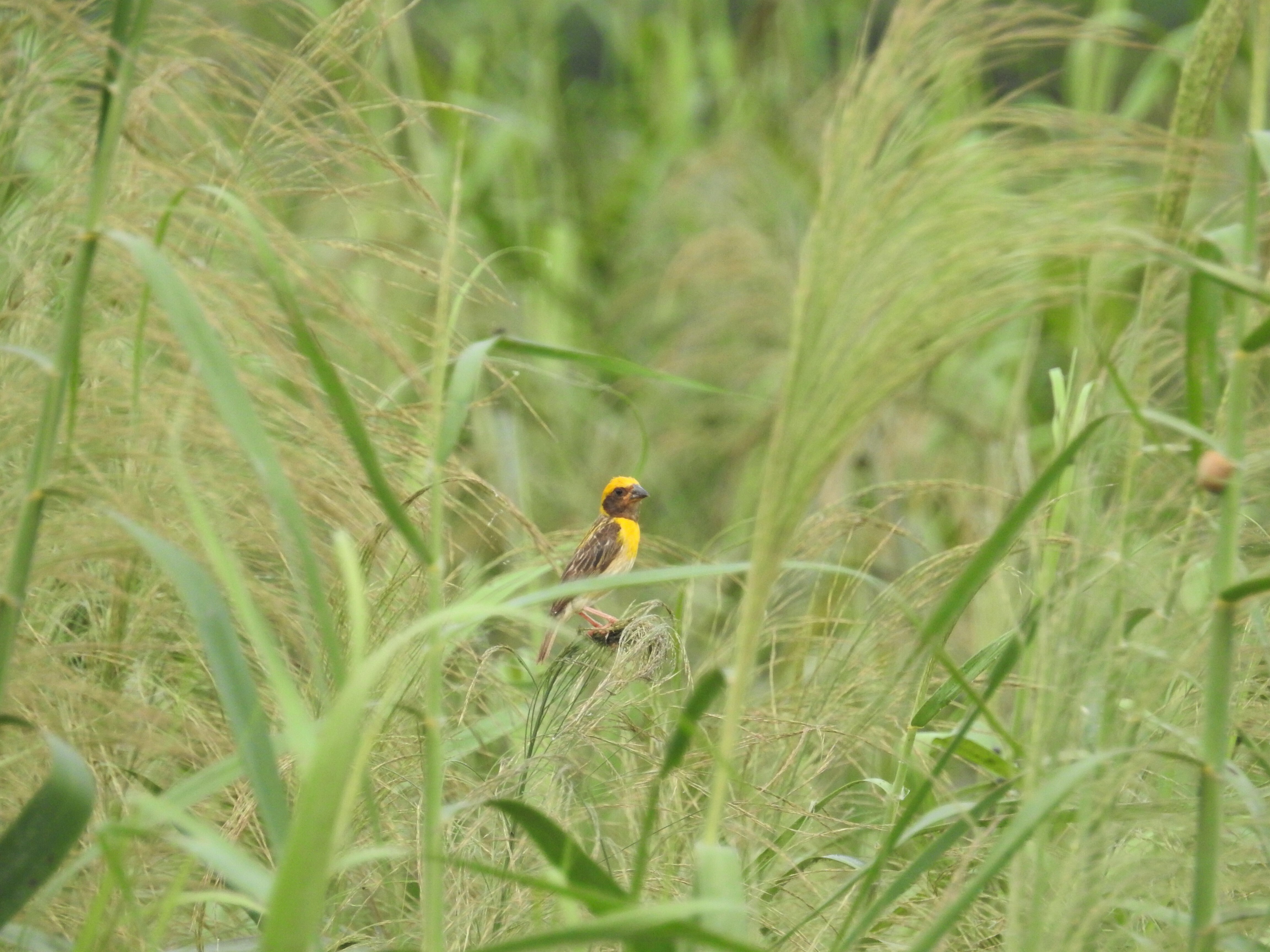
That natural wonder is a little, mango-yellow and grassy-brown bird busy at creating marvels. This is the male baya weaver. He has enviable building skills, and perhaps even some lessons on consent. The little, sparrow-sized bird will build nests from grass and leaves during the monsoon. They are woven in intricate, gravity-defying patterns, and the nests hang, rather than rest. They look something like slender-throated urns, suspended from a branch, the bottom holding an opening designed so it can be entered without disemboweling the contents of the nest. The baya will build several nests on one tree, and then it waits for a female to come and inspect them. If she likes the property, she moves in. If she doesn't, she moves on.

This bird-built architecture is an iconic marker of the Indian countryside. A single tree may have many weaver bird nests; as more than one bird may settle in the same tree. The trees they choose are usually thorny, to prevent predators. The male has patches of bright yellow during the monsoon— decked specially in breeding plumage (he will be brown at other times of the year). He is often spotted sitting on a frond of grass. Monsoonal winds make the plants sway, and his bright-yellow body flickers like lights in the green-and-gold grasses. According to traditional ecological knowledge, a suite of baya weaver nests means that water is nearby. Most often, the bayas choose trees that are spiny and next to a water body—this is another level of protection from predators.

But this is not entirely a happy story. From most local birding records, it seems weaver birds are on the decline.
We cherish our quirky tastes – tea from a particular Darjeeling hill, a preference for a home in the less moist parts of the Himalayas, a holiday on a beach with the right amount of seclusion, or a car with a sunroof for Vitamin D in the winters.
In the wild though, habitat specialists are doing badly; while creatures that can live in a very large variety of habitats are doing better (examples would be crows, mynahs, and indeed, humans). The baya is a citizen of grass; and its thorny tree, swathes of grass and a waterbody—just a handful of naturally occurring things—are disappearing.

More broadly, birds of grassland are hanging by a veritable blade of grass. The Great Indian Bustard is a grassland specialist; it needs large grasslands, scrub land or pesticide-free fields. It is down to about 100 birds, and the world's last viable population is in India. Because so much of grassland is lost, India has started an emergency captive breeding programme to stave off the Great Indian Bustard's extinction. While the first chicks have hatched, the more urgent question is where the birds will be sent – as we continue to lose grassland. A life in a captive facility isn't the same as a life in rolling grasses.
Other grassland birds – the Bengal Florican (found in wet grasslands) and the Lesser Florican (found in dry grasslands) are also down to a few hundreds.
The ‘revenue' system for land—an old colonial legacy—decreed that land should provide income. Grasses were not seen to be particularly valuable, and grasslands were often classified as wasteland. They were turned to fields, industrial estates or burnt for some other land use.
But as the climate changes, it is becoming clear that what we need are natural ecosystems, as these are inherently resilient against drought, heat waves or other climate extremes. And grasses have a superpower—they hold the soil down and prevent erosion. Grasslands are not wasted land. In mangrove ecosystems that have become degraded, specific grasses are now being used to hold down the shore and restore soil fertility.
The idea that all land should be productive in the way we understand, that all plants need to create flowers for us to enjoy, or that we will be doing well only if we plant malls where wild plants grow, is reductive.
It reduces our capacity to understand the workings of the worlds outside our offices; it is prosaic to a level that discourages learning.
Let grasses grow; let natural ecosystems be. That should be one of the fronts against climate change. The baya's love story in grass is a reminder that the world is bigger than our understanding, and a blade of grass is more than it seems.
Neha Sinha works with the Bombay Natural History Society. Views expressed are personal.
The views expressed here are those of the author and do not necessarily represent the views of BloombergQuint or its editorial team.

-
One El Nino, India Can Handle. Two Could Break The Granary

India's grain stocks can absorb one bad year, but a second El Nino could drain the buffer in two to three years, economists say.
-
India's Troika Of Good Luck | Joining The Dots
As Jensen Huang's exit drags Nvidia down, a cooling AI trade and resilient earnings have revived investor interest in India. A likely RBI rate hike looms.
-
Talking Points This Week: Leadership Shock At Nvidia, Earnings Strength, And The Fog Over Hormuz
The Anthropic IPO pricing and first trading day, Nvidia's upcoming earnings, and any fresh signals from Iran will set the tone for the following week.
-
Signature Play: The Classic Cocktail Is Dead. Or Is It?
Classic cocktails are disappearing from India's cocktail menus. But they're still being ordered, taught to bartenders and borrowed from. So, who's really having the last drink?
-
A New Samvat Wishlist: Inclusive Prosperity And Human Development
India has strengthened its economic foundations through infrastructure, digital access and enterprise. Its next growth chapter must deepen productivity, create better livelihoods and widen participation in prosperity.
-
Love, Sex Aur Dhokha: The Audacious Plot To Spy On Jensen Huang
A Taipei dinner, a Singapore chip buyer and a suspected Chinese asset: inside the alleged spy operation that got close to NVIDIA's Jensen Huang.
-
Ten Things I Learnt This Samvat
Patience can be a trap. Cheap stocks can stay cheap. Leverage can wipe you out. What did Samvat 2082 teach us? Niraj Shah writes on 10 lessons from the year gone by.
-
Talking Points This Week: Tech Nerves, FII Buying, And A Faraway Banking Shock
The global markets are not shining this Diwali. The exception in the large markets is, India.
-
Midterm Rally Lasted A Day. The Hard Reality Of A Divided US May Last Two Years | Opinion
Between a contested AI boom, a debt ceiling that arrives in 2027 and a president with every incentive to act alone, the next two years may prove more volatile than the first day's rally suggests.
-
Blue Wave Will Derail the AI Trade but Won't Dismantle the AI Era | Unhedged Position
The Democrats' sweep of the US Congress will see politics collide with economic forces both over the long and short term.









