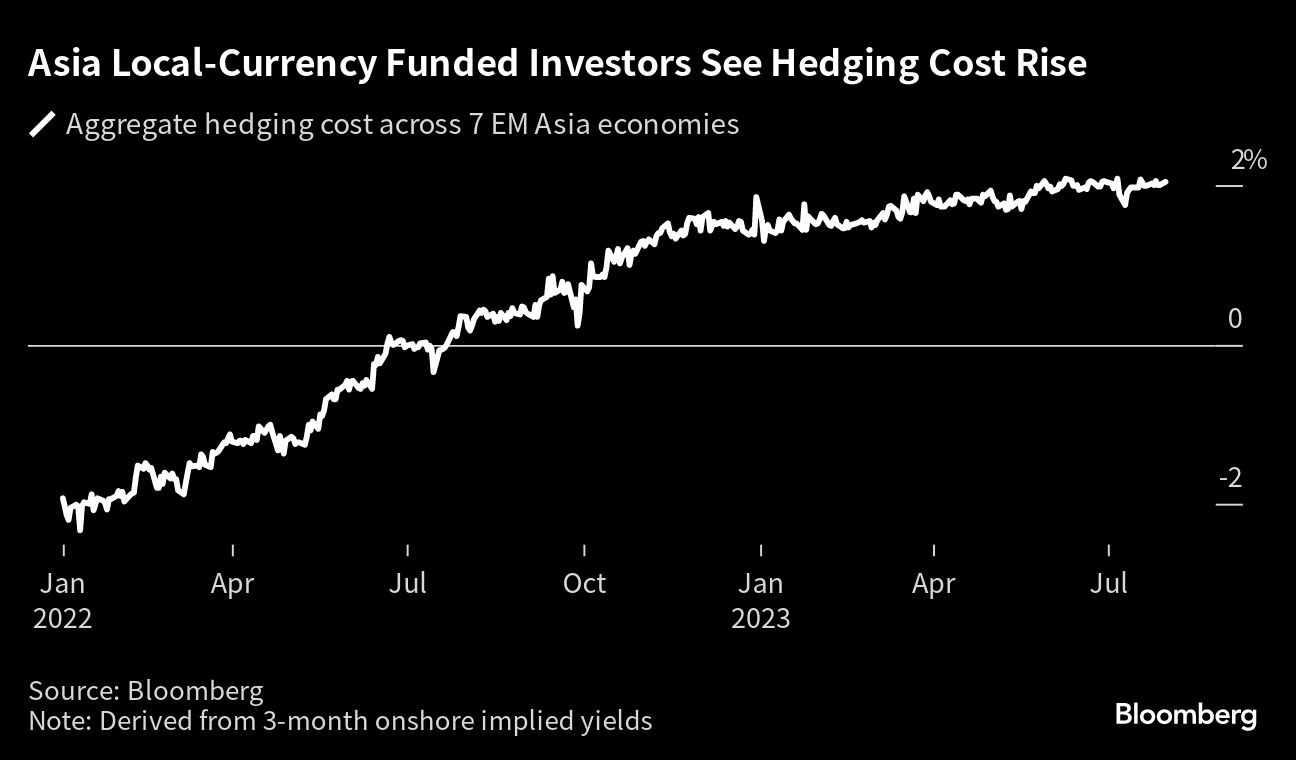
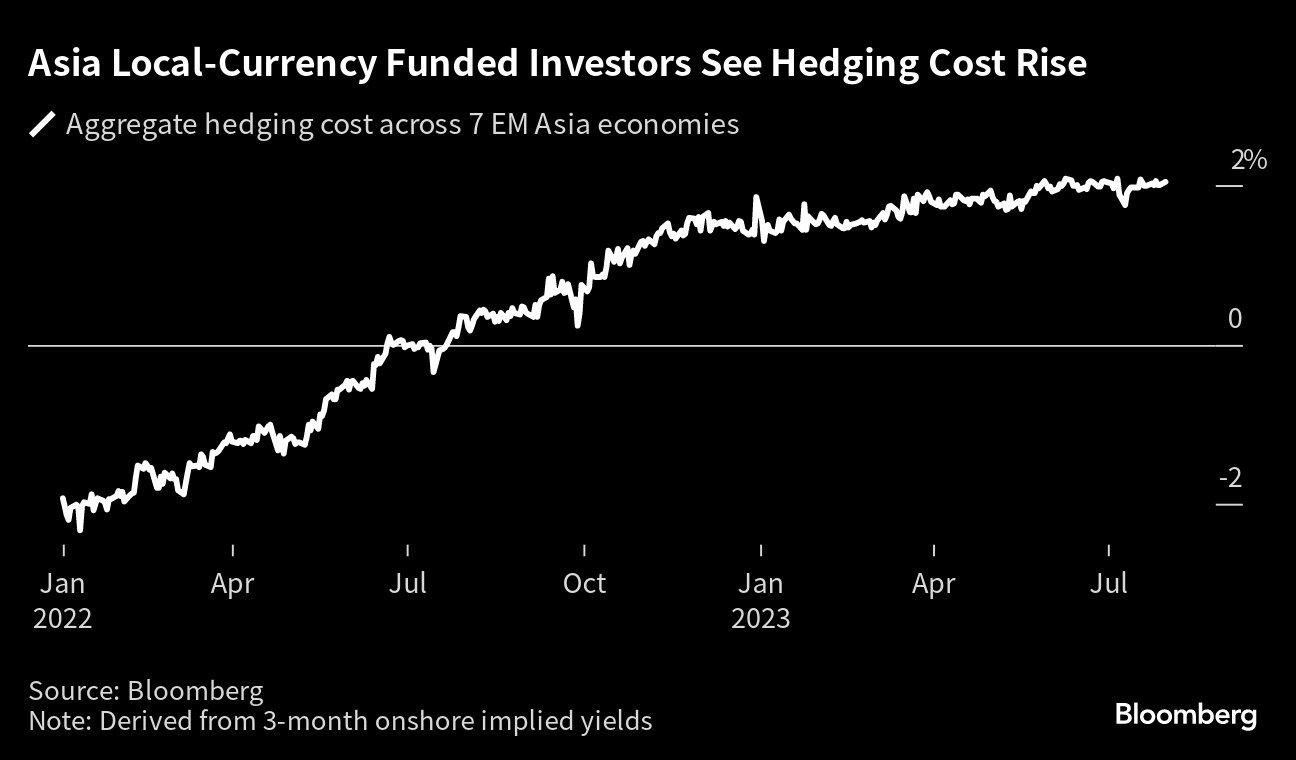
(Bloomberg) -- Local-currency investors from emerging Asian nations aren't shying away from hedging their overseas investments even as the cost of protection rises to the highest in 14 years amid concern dollar weakness may erode the value of their portfolios.
The aggregate hedging cost for funds from seven emerging-Asian economies has risen to the highest since at least 2009, according to data compiled by Bloomberg, mainly due to the divergence between their monetary policies and those of the US. And while the prospect of a Federal Reserve rate pause ensures that gap doesn't widen further, increasing bearishness toward the dollar is prompting investors to safeguard their holdings.
“Local funds will increase hedging of their dollar investments after the Dollar Index slumped past the 100.0 level in July, with hedging interest to also pick up on concerns that a further gap lower in the dollar will incur an even larger cost of hedging,” said Christopher Wong, a strategist at Oversea-Chinese Banking Corp. in Singapore.
Asian currencies rose 1.5% versus the dollar in July as they snapped three straight months of losses, according to a Bloomberg Index. Meanwhile, asset managers boosted their short dollar bets to a record level in July, while hedge funds also flipped to a net short position on the US currency in the same month, Commodity Futures Trading Commission data show.
“If investors are bearish on the dollar until the year end, then of course hedging now would be the best strategy,” said Stephen Chiu, a currency and rates strategist at Bloomberg Intelligence. Hedging costs may remain elevated as long as the Fed doesn't appear to entertain any rate cuts in the near-term, he said.
The aggregate hedging cost is the difference between the three-month onshore forward implied yield and the equivalent US secured overnight refinancing rate. Local forward implied yield moves relative to equivalent US rates have made it less favorable for emerging Asian investors to offer local currency in exchange for dollars.
--With assistance from Chester Yung.
(Updates with fresh comment in 3rd paragraph and hedging cost calculation in last paragraph.)
More stories like this are available on bloomberg.com
©2023 Bloomberg L.P.
Essential Business Intelligence, Sharp Market Insights, Practical Personal Finance Advice, Daily Fuel, Gold and Silver Prices and Latest Stories — On NDTV Profit.