6.5% GDP Growth Likely In The Coming Decade: Chief Economic Advisor
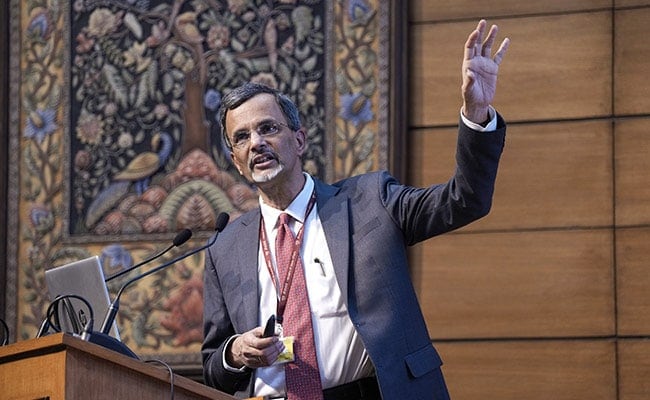
The Indian economy is likely to grow at the rate of 6.5 per cent in the coming decade on the back of the turnaround in financial and investment cycle, Chief Economic Advisor (CEA) V Anantha Nageswaran said on Wednesday.
Addressing an event here, Mr Nageswaran further said going forward, global exports growth volumes may be somewhat tepid in terms of their growth rates due to the kind of uncertainties the world is facing.
"So, I think the restoration of the financial, credit and the investment cycle in the commercial sector and the real estate sector will probably see us growing on an average of six and a half per cent in the coming decade," he said.
The Asia's third-largest economy recorded year-on-year growth of 4.4 per cent in October-December, down from 11.2 per cent a year back and 6.3 per cent in the preceding quarter.
The finance ministry's Economic Survey has projected the economic growth to be 6.5 per cent in the 2023-24 fiscal beginning April 2023, while the RBI has projected India's economic growth to slow down to 6.4 per cent in FY24 from 7 per cent in the current fiscal.
Mr Nageswaran attributed the slowdown in India's economic growth just before COVID-19 pandemic to the classic financial cycle distress that India went through.
"If you look at data from 2012 onwards, so basically pre-pandemic period itself, we went through a period of classic financial cycle repair, credit cycle repair, which is what brought down a slowdown in the construction sector, and real estate sector," he opined.
According to Mr Nageswaran, in the second decade of the century, by the time India could start thinking of enjoying the repaired balance sheets, came the pandemic for two years.
"And then came the commodity price shock and later came the interest rate shock in the second half of the 2022," he said, adding that so naturally, some of these things do induce uncertainty in the minds of private investors and they may be a little bit more cautious than they might have been.
Referring to India's energy security, Mr Nageswaran said there is tremendous pressure on energy transition for justifiable reasons.
"So there is no question of denying that there is a need for energy transition, but the question is how do we go about it?," he asked.
Noting that developing countries including India, definitely need economic growth to finance their energy transition requirements, Mr Nageswaran said without domestic savings, there is no question of adequacy of resources for financing energy transition.
While emphasising that to address climate finance, there is need to address economic growth first, he said somehow relegating economic growth and development to the second to the fringes to put climate issues on top of the agenda would be actually doing a disservice to the climate agenda.
"If we are going to attract so much private sector capital for climate transition or energy transition, what happens to the current account deficit?," he wondered.
Replying to a question on production-linked incentive (PLI) scheme, the CEA said the exit clause is very important for any scheme.
The government has announced PLI schemes for 14 sectors, including white goods, textiles and auto components.
The objective of the PLI scheme is to make domestic manufacturing globally competitive, create global champions in manufacturing, boost exports and create jobs.
(Except for the headline, this story has not been edited by NDTV staff and is published from a syndicated feed.)

-
The Curious Case of Equitas Small Finance Bank And A CEO Who Quit For Stock

PN Vasudevan believes persistent investor concerns over a perceived conflict of interest had become a governance overhang on Equitas Small Finance Bank's stock, even as the lender improved profitability and asset quality.
-
Talking Points This Week: AI Cash Burn, A Tiger Comeback And An India That Still Finds Its Own Path
India is not immune to higher oil or tighter global liquidity, yet its earnings base is broader, its domestic policy levers are still available.
-
Foreign Investors Own Half Of HDFC Bank and ICICI Bank. An LTCG Cut Could Matter Most Here
Foreign portfolio investors have US$115 billion parked in HDFC Bank, ICICI Bank. If the government cuts long-term capital gains tax, Jefferies says returning foreign money could land here first.
-
'Never Seen This Level Of Negativity': Sandeep Tandon Says The Next Rally May Be Closer Than You Think
Veteran investor Sandeep Tandon says foreign selling is easing, large-caps are due a comeback and mid-caps are crowded, while he turns positive on gold, power and pharma this Diwali.
-
Indians Stay With Family, Not In Hotels | The Reason Why
India still lacks enough clean, reliable and affordable hotels for budget-conscious travellers.
-
The Economic Imperative: Analysing The Material Driving Force Behind India-Canada Strategic Reset
This economic complementarity is further reinforced by deep institutional investment ties and talent mobility, which form the bedrock of the bilateral framework.
-
Medicine Pricing: Where Must Profit Stop?
India must confront excessive margins, hidden incentives and regulatory gaps that threaten the integrity of medicine.
-
Why Amazon And Flipkart Are Struggling To Beat Meesho In India's Smaller Cities
With 274 million users and lowest-cost logistics, Meesho is defending its value commerce crown against giants like Amazon and Flipkart.
-
High US Salaries, No Green Card Certainty: The Financial Calculation Facing Indian H-1B Families
The suspension of PERM processing at eight technology employers does not cancel existing H-1B visas. What it does is force a question many Indian families have been avoiding: is the US salary worth tying your career and family plans to one employer?
-
Swiggy vs Eternal: Food Delivery's Two Rivals Are No Longer In The Same Race
Eternal is building a private AI assistant, dark.ai. Swiggy is still working out how to make Instamart pay, with an operating loss of Rs 895 crore in the July-September quarter while Blinkit stayed profitable.










