40% Chance Of A US Recession, Other Key Economies Face High Risk: Report
The global economy is in the grips of a serious slowdown, with some key economies at high risk of recession and only sparse meaningful cooling in inflation over the next year, according to Reuters polls of economists.
Most central banks are only part-way through a still-urgent cycle of interest rate rises as many policymakers make up for a collective error in judgment last year thinking supply chain-related inflation pressures would not last.
That carries with it another risk - central banks moving too quickly without taking time to assess damage from the fastest interest rate rises in more than a generation following over a decade of near-zero rates.
Despite their aggressive response - in some cases, the most in several decades - inflation has yet to ease in most of the near-50 economies covered in the June 27-July 25 Reuters surveys of more than 500 forecasters around the world.
The US Federal Reserve, due to hike rates by another 75 basis points later on Wednesday, is a case in point. Inflation there, currently at a four-decade high of 9.1 per cent, is not expected to cool to the Fed's 2 per cent target until at least 2024.
Soaring inflation has turned into a serious cost of living crisis in much of the world, pushing up recession risks.
40% Chance Of A US Recession; Rising For Other Key Economies
There is already a median 40 per cent chance of recession happening in the world's largest economy in the coming year, up sharply from three months ago, and those chances have risen for the euro zone and Britain too.
"Recessionary dynamics are increasingly evident in our forecast. Notably, we now see several major economies - including the United States and the euro area - slipping into recession. Even so, the timing of these downturns varies, and they are expected to be relatively mild," noted Nathan Sheets, chief global economist at Citi.
"By any metric, the global economy is slowing and prospects are deteriorating. Global recession is, indisputably, a clear and present danger."
Global growth is forecast to slow to 3.0 per cent this year followed by 2.8 per cent next, both downgraded from 3.5 per cent and 3.4 per cent in the last quarterly poll in April. That compares with the International Monetary Fund's latest forecasts of 3.2 per cent and 2.9 per cent.
Of the 48 economies covered, 77 per cent of growth forecasts were downgraded for next year with only 13 per cent left unchanged and 10 per cent upgraded.
Graphic: Reuters Poll - 2023 GDP Growth Revisions
Similarly, inflation forecasts for nearly 90 per cent of the 48 economies were upgraded for next year and over 45 per cent for 2024. That means no quick respite from a cost of living crisis pinching households.
Indeed, the vast majority of respondents said it would be at least next year before the crisis eases significantly (86 per cent) with more than a third (39 per cent) saying over a year.
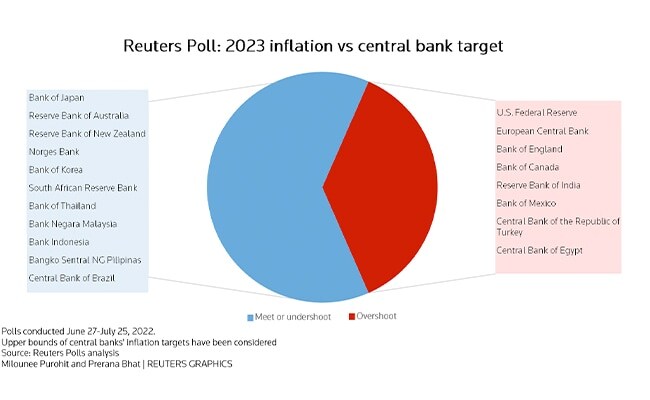
Among the top 19 global central banks covered, a slight majority, 11, will see inflation returning to target next year.
The remaining eight will not, including some of the biggest ones like the Fed, the European Central Bank, the Bank of England and the Reserve Bank of India.
Graphic: Reuters Poll - Global Monetary Policy And Inflation Outlook
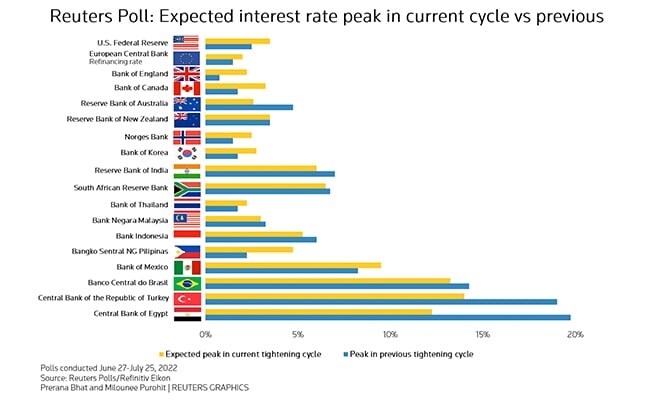
Developed ones, by contrast, are only on average about half-way through, held back in part by the European Central Bank, which only just began raising rates.
That means more rate rises still lie ahead.
"We are particularly concerned about two developments. First, the shift to aggressive hikes at many central banks. This is an inevitable outcome of moving late. However, it greatly increases the risk of overkill, as there is not time to reassess the impact of the hikes," noted Ethan Harris, global economist at Bank of America Securities.
"Second, we worry about feedback effects across regions. In particular, recessions in the US tend to impact global confidence and growth even more than warranted by the size of the US economy. Stay tuned."
Graphic: Reuters Poll - Comparison Of Tightening Cycles

-
Signature Play: The Classic Cocktail Is Dead. Or Is It?

Classic cocktails are disappearing from India's cocktail menus. But they're still being ordered, taught to bartenders and borrowed from. So, who's really having the last drink?
-
A New Samvat Wishlist: Inclusive Prosperity And Human Development
India has strengthened its economic foundations through infrastructure, digital access and enterprise. Its next growth chapter must deepen productivity, create better livelihoods and widen participation in prosperity.
-
Love, Sex Aur Dhokha: The Audacious Plot To Spy On Jensen Huang
A Taipei dinner, a Singapore chip buyer and a suspected Chinese asset: inside the alleged spy operation that got close to NVIDIA's Jensen Huang.
-
Ten Things I Learnt This Samvat
Patience can be a trap. Cheap stocks can stay cheap. Leverage can wipe you out. What did Samvat 2082 teach us? Niraj Shah writes on 10 lessons from the year gone by.
-
Talking Points This Week: Tech Nerves, FII Buying, And A Faraway Banking Shock
The global markets are not shining this Diwali. The exception in the large markets is, India.
-
Midterm Rally Lasted A Day. The Hard Reality Of A Divided US May Last Two Years | Opinion
Between a contested AI boom, a debt ceiling that arrives in 2027 and a president with every incentive to act alone, the next two years may prove more volatile than the first day's rally suggests.
-
Blue Wave Will Derail the AI Trade but Won't Dismantle the AI Era | Unhedged Position
The Democrats' sweep of the US Congress will see politics collide with economic forces both over the long and short term.
-
It's Time To Take The GST Council's Bet On Trust Global
Payment records can prove India's services exports, and clear, proportionate rules can bring foreign digital sellers into the tax net.
-
Opinion | India at 38: From Innovation Overperformer to Innovation Powerhouse
India now has 453 VC-backed deep science startups, 18 of them late-stage, after 117 percent growth since 2020. Laurus Labs, at USD 9.3 billion, is the most valuable deep science company in any middle-income economy outside China.









