2022 Nobel Economics Prize Puts Focus On Central Banks' Role To Avoid A Crisis
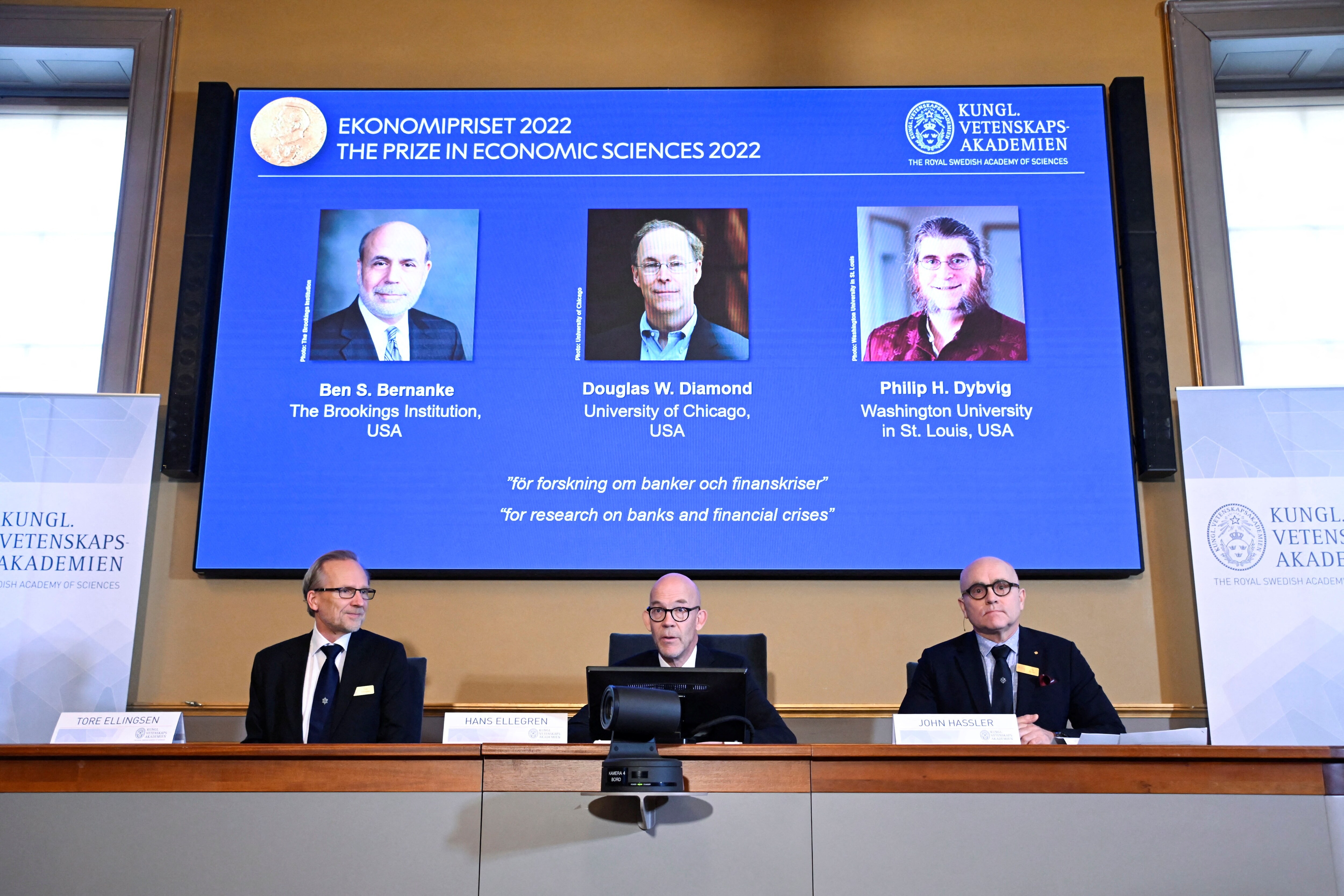
At a time when the World Bank and the International Monetary Fund have warned of a possible global recession in 2023 and central banks have gone into overdrive to hike interest rates to control inflation, a trio of economists from the United States have won the 2022 Nobel Economics Prize for significantly improving "our understanding of the role of banks in the economy, particularly during financial crises".
The US trio of former US Federal Reserve Chairman Ben Bernanke, Douglas Diamond and Philip Dybvig have been awarded this year's Nobel Prize for economics for their research on regulating the financial sector and propping up failing banks to stave off economic crises.
Observing that their analysis has been of great "practical importance", the Nobel Committee added, "The actions taken by central banks and financial regulators around the world in confronting two recent major crises – the Great Recession and the Covid pandemic-induced slowdown – were in large part motivated by the laureates' research".
The Nobel Prize Committee's words are yet another validation for Bernanke, the former chief of the US Fed when the financial crisis began in 2008, and faced criticism for the bank bailouts that triggered a public backlash. However, Bernanke, a scholar of the Great Depression, believed that the economy could be saved by saving the existing financial system.
He has been credited for using innovative methods to protect the financial system from failing, including bringing the interest rate near zero for the first time in Fed history and initiating widespread quantitative easing (the central bank buying government securities and assets to stimulate the economy).
"He (Bernanke) played a decisive role in stabilising the US and global economies," Reuters quoted Mark Carney, former chief of Canada's central bank, saying in 2013.
Mr Bernanke is undoubtedly one of the most high-profile award winners – perhaps the first ex-Fed chief to win the prize. Nevertheless, the contribution of Douglas Diamond and Philip Dybvig, both frequent collaborators and the namesake of the Diamond–Dybvig model, are invaluable as they laid down the theoretical basis for bank runs and financial crises.
Diamond, who is associated with Chicago University, and Dybvig, a professor at Washington University in St. Louis, in 1983 postulated that the liquidity needs of savers clash with the borrowers who want to take long-term loans. This, the model says, is a source of tension for banks.
In a normal situation, banks allow savers to access their savings. At the same time, borrowers get their loans with a long maturity, while many savers rushing to withdraw their savings could lead to a bank collapse.
Their analyses showed that the government (central bank in the modern sense) acting as a lender of the last resort could help protect the banking system. Finally, as an intermediary, they argued, banks can analyse borrowers' creditworthiness and avoid 'bad loans' as much as possible.
'Bad loans' (read subprime loans in the US) were one of the triggers for the 2008 global financial crisis and led to the collapse of banks worldwide.
Raghuram Rajan, former Reserve Bank of India chief, has paid a rich tribute to the duo in a LinkedIn post, calling Diamond the "father of modern banking theory." He added that their papers also influenced Bernanke to make the Diamond-Dybvig model a required reading while the Fed grappled with the financial crisis.

-
Talking Points This Week: Leadership Shock At Nvidia, Earnings Strength, And The Fog Over Hormuz

The Anthropic IPO pricing and first trading day, Nvidia's upcoming earnings, and any fresh signals from Iran will set the tone for the following week.
-
Signature Play: The Classic Cocktail Is Dead. Or Is It?
Classic cocktails are disappearing from India's cocktail menus. But they're still being ordered, taught to bartenders and borrowed from. So, who's really having the last drink?
-
A New Samvat Wishlist: Inclusive Prosperity And Human Development
India has strengthened its economic foundations through infrastructure, digital access and enterprise. Its next growth chapter must deepen productivity, create better livelihoods and widen participation in prosperity.
-
Love, Sex Aur Dhokha: The Audacious Plot To Spy On Jensen Huang
A Taipei dinner, a Singapore chip buyer and a suspected Chinese asset: inside the alleged spy operation that got close to NVIDIA's Jensen Huang.
-
Ten Things I Learnt This Samvat
Patience can be a trap. Cheap stocks can stay cheap. Leverage can wipe you out. What did Samvat 2082 teach us? Niraj Shah writes on 10 lessons from the year gone by.
-
Talking Points This Week: Tech Nerves, FII Buying, And A Faraway Banking Shock
The global markets are not shining this Diwali. The exception in the large markets is, India.
-
Midterm Rally Lasted A Day. The Hard Reality Of A Divided US May Last Two Years | Opinion
Between a contested AI boom, a debt ceiling that arrives in 2027 and a president with every incentive to act alone, the next two years may prove more volatile than the first day's rally suggests.
-
Blue Wave Will Derail the AI Trade but Won't Dismantle the AI Era | Unhedged Position
The Democrats' sweep of the US Congress will see politics collide with economic forces both over the long and short term.
-
It's Time To Take The GST Council's Bet On Trust Global
Payment records can prove India's services exports, and clear, proportionate rules can bring foreign digital sellers into the tax net.
-
Opinion | India at 38: From Innovation Overperformer to Innovation Powerhouse
India now has 453 VC-backed deep science startups, 18 of them late-stage, after 117 percent growth since 2020. Laurus Labs, at USD 9.3 billion, is the most valuable deep science company in any middle-income economy outside China.









