Budget 2024: India Mulls Tax Cuts As Part Of $6 Billion Consumer Boost

(Bloomberg) -- Prime Minister Narendra Modi's government is considering consumption-boosting measures worth more than 500 billion rupees ($6 billion) in India's upcoming budget, including tax cuts for lower income individuals for the first time in seven years, according to people familiar with the matter.
Officials in the Ministry of Finance have discussed proposals to reduce taxes for consumers with the highest propensity to spend, the people said, asking not to be identified because the talks are private. Individuals with annual earnings of 500,000 rupees ($5,987) to 1.5 million rupees — currently taxed anywhere from 5%-20% — could benefit from the move, the people said. A new tax slab may also be considered, they said.
The details of the plan are still being worked on and a final decision will be taken closer to the time of the budget, due sometime in July, after approval from the prime minister's office, they said. Despite the revenue loss from the tax changes, the government plans to stick to its fiscal deficit target of 5.1% of gross domestic product for the current financial year, one of the people said.
Almost half of the 500 billion-rupee worth of measures will come from tax cuts, with the rest coming from other programs, the people said. Talks are underway to raise the annual cash payment to small farmers to 8,000 rupees from the current 6,000 rupees, they said. In addition, there are also discussions to increase the annual payment under the minimum job guarantee program, and expand financial support for women farmers, they said.
Finance Minister Nirmala Sitharaman is holding pre-budget consultations with stakeholders, including economists, trade unions and industry chambers this week. Local media reported the budget for the new Modi government may be announced on July 22.
A finance ministry spokesperson didn't immediately respond to emails seeking further information.
Modi's Bharatiya Janata Party failed to win an outright majority in recent parliamentary elections for the first time since it swept to power in 2014, with joblessness and the high cost of living weighing on voters' minds. Economists have said the BJP's weaker-than-expected performance at the polls may see it shift toward more populist spending measures in the budget.
“A tax cut is a good way to give a push to demand levers in the economy especially as mass consumption has been weak,” Yuvika Singhal, an economist at QuantEco Research, said by phone. “While lower taxes will boost disposable income of people, more such steps will be needed to lift consumer activity going ahead.”
The government needs to infuse funds into the economy in a way that shows quicker results, one of the officials said. However, despite the extra spending, the government will maintain its fiscal deficit target for the current year, largely helped by strong revenues and a $25 billion dividend from the central bank, the person said.
State elections are looming in at least three key regions, including Maharashtra, in coming months, with the BJP looking to shore up its support.
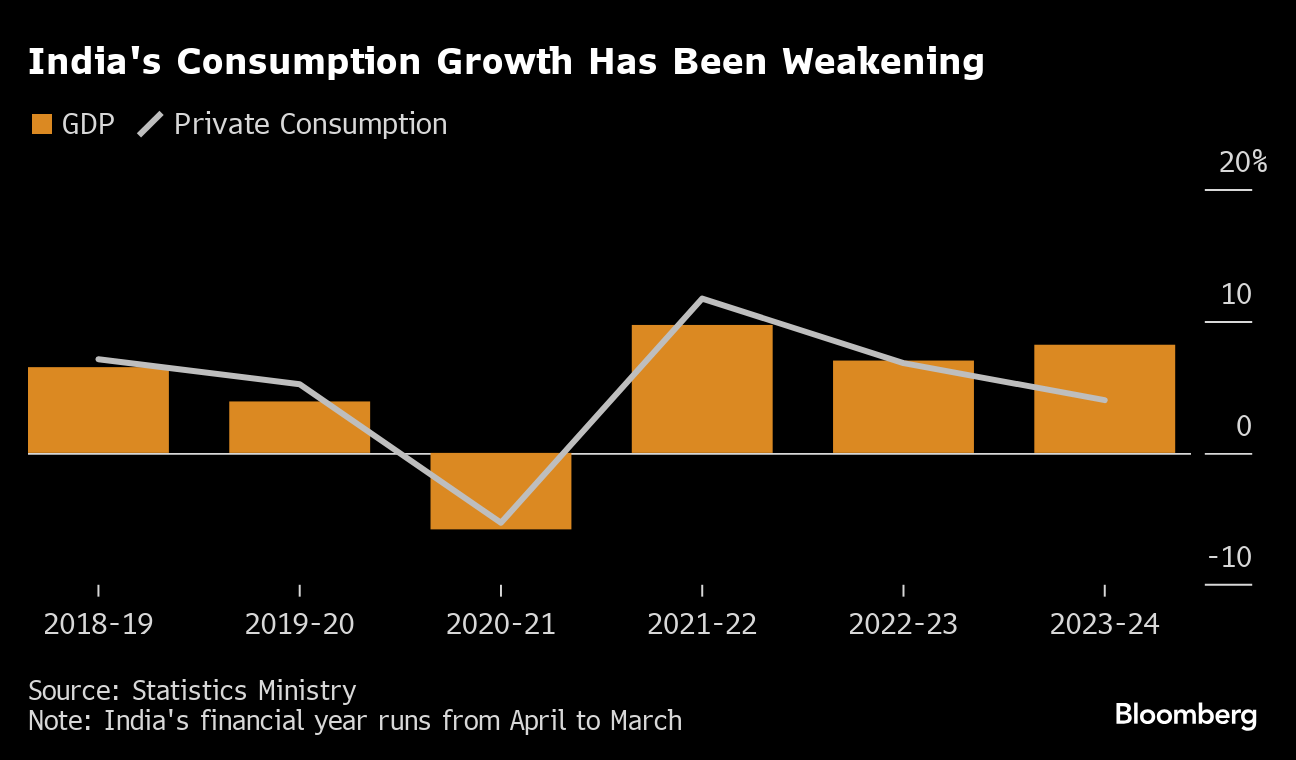
Private consumption — which includes spending by households and businesses — expanded 4% in the past fiscal year, less than half the 8.2% pace of economic growth in the period.
(Updates with chart and economist comment in eighth paragraph.)
More stories like this are available on bloomberg.com
©2024 Bloomberg L.P.

-
Gold Is Rs 22,000 Cheaper Than A Month Ago. Should You Buy Amid The Wedding Season?

Gold's potential slide to $3,500 could save around Rs 4,700 per 10 grams, but a soft inflation print could just as easily push prices back up. One way to split the risk is to buy in parts, some now and the rest after the Fed's Dec. 9 decision.
-
AI Agents Are Gaining Power. Who Governs Them?
Artificial intelligence agents promise to transform productivity by moving machines from assisting decisions to executing them. But as organisations delegate greater authority to these AI-agents, they must first establish who controls that authority and who remains accountable when things go wrong.
-
Why Swapping Your Old Gold Can Trigger A Rs 5 Lakh Tax Bill, And How You Can Avoid It Legally
Swapping old gold for new is taxed as a sale and a fresh purchase. Getting your own gold remade can cut most of that bill, though it has its own costs.
-
The AI Trade is Done. The Real Opportunity for Investors Starts in 2027 | Unhedged Position
As pureplay AI stocks plunge and circular, capex-led financing unwinds, 2027 is set to be a year of reckoning for AI companies. Yet the bust clears the way for a better opportunity for investors in 2027 -- shifting the spotlight from AI builders to the companies using AI.
-
Leadership As Mission: Why The Age Of AI Demands More Human Leadership
Debjani Ghosh examines how AI is changing leadership, arguing that its success must be measured by its impact on people and the accountability of those guiding its use.
-
We May Need Another Tukaram Mundhe To Fight Air Pollution | The Reason Why
Developers may install basic measures such as sprinklers and green nets, resume work, and continue violating rules when this equipment stops working.
-
Extracting Value From Battery Scrap Could Be Challenging For India | The Reason Why
A discarded lithium-ion battery still contains valuable materials such as lithium, nickel and cobalt. These can be recovered and reused. When such batteries are crushed and shredded, they produce a dark powder called black mass.
-
One El Nino, India Can Handle. Two Could Break The Granary
India's grain stocks can absorb one bad year, but a second El Nino could drain the buffer in two to three years, economists say.
-
India's Troika Of Good Luck | Joining The Dots
As Jensen Huang's exit drags Nvidia down, a cooling AI trade and resilient earnings have revived investor interest in India. A likely RBI rate hike looms.
-
Talking Points This Week: Leadership Shock At Nvidia, Earnings Strength, And The Fog Over Hormuz
The Anthropic IPO pricing and first trading day, Nvidia's upcoming earnings, and any fresh signals from Iran will set the tone for the following week.









