Russia Hides Budget Spending But Shows How Ruble Hit Oil Revenue
(Bloomberg) -- Russia said it would no longer disclose monthly figures breaking down how much the government spent on various budget items including defense, even as it released data showing the ruble's surge erased the benefits of higher crude prices for revenue.
The Finance Ministry on Tuesday cited the need to “minimize the risk of the imposition of additional sanctions” for excluding expenditure details. The government and the central bank have suspended publication of a range of financial and economic data since the US and its allies hit the country with sweeping sanctions in the wake of the Kremlin's Feb. 24 invasion of Ukraine.
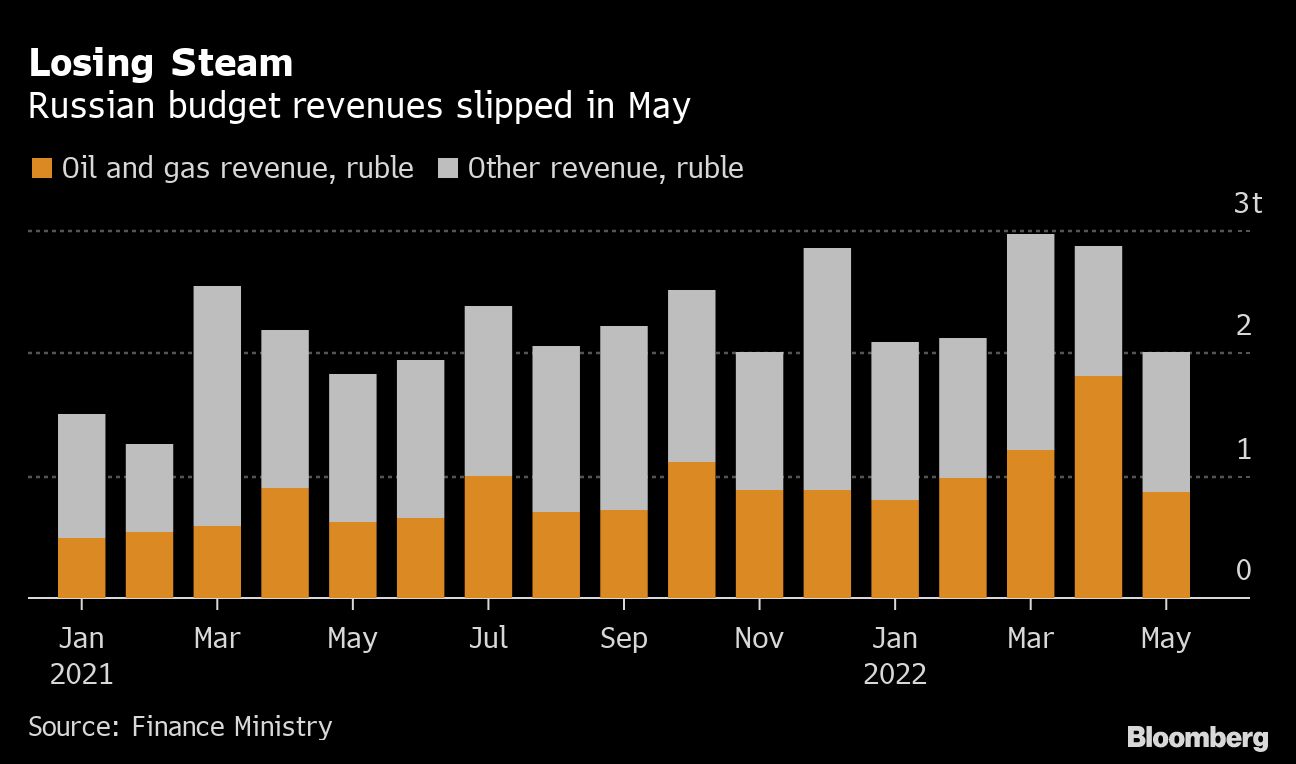
The latest budget report still covered the other half of the ledger, indicating that tax revenues from oil and gas exports dropped by more than half in May from the previous month. A stronger ruble cuts into the budget because the government gets much of its revenue from energy taxes denominated in foreign currency but spends in rubles.
Bloomberg calculations based on data provided by the ministry showed income from oil and gas fell last month to 871 billion rubles ($14.9 billion) from 1.81 trillion rubles in April, which was the highest in at least a decade. Income from other taxes and excise duties rose 7.5% from the previous month to 1.14 trillion rubles, according to Bloomberg calculations.
The government reported a budget surplus of 1.5 trillion rubles in the first five months of the year, according to the ministry.
“Non-energy revenues were effectively at the planned level, but since these are nominal figures, the effect of higher inflation compensated for the drop in economic activity,” said Sofya Donets, economist at Renaissance Capital.
Despite last month's drop, oil-and-gas earnings through May were still higher than planned, she said, but are likely to decline later in the year as falling export volumes and ruble strength hit the result. “We're sticking to our forecast that for the year we will wind up with a deficit around zero,” Donets said.
The world's largest energy exporter, Russia has benefited from high prices for oil and gas, boosted in part by the impact of the war in Ukraine.
Urals, Russia's blend of crude oil, averaged $78.81 a barrel in May, up almost 12% from the previous month, even as some cargoes were sold at steep discounts to Asian consumers, in particular China and India. Traditional customers turned away from Russian crude amid official restrictions and self-sanctioning.
At the same time, the ruble gained almost 15% against the dollar in May as capital controls limited demand for foreign currency amid a flood of export revenues. As a result, the budget wasn't able to reap the benefits of higher dollar crude prices in ruble terms.
More stories like this are available on bloomberg.com
©2022 Bloomberg L.P.

-
The Economic Imperative: Analysing The Material Driving Force Behind India-Canada Strategic Reset

This economic complementarity is further reinforced by deep institutional investment ties and talent mobility, which form the bedrock of the bilateral framework.
-
Medicine Pricing: Where Must Profit Stop?
India must confront excessive margins, hidden incentives and regulatory gaps that threaten the integrity of medicine.
-
Why Amazon And Flipkart Are Struggling To Beat Meesho In India's Smaller Cities
With 274 million users and lowest-cost logistics, Meesho is defending its value commerce crown against giants like Amazon and Flipkart.
-
High US Salaries, No Green Card Certainty: The Financial Calculation Facing Indian H-1B Families
The suspension of PERM processing at eight technology employers does not cancel existing H-1B visas. What it does is force a question many Indian families have been avoiding: is the US salary worth tying your career and family plans to one employer?
-
Swiggy vs Eternal: Food Delivery's Two Rivals Are No Longer In The Same Race
Eternal is building a private AI assistant, dark.ai. Swiggy is still working out how to make Instamart pay, with an operating loss of Rs 895 crore in the July-September quarter while Blinkit stayed profitable.
-
Where You Live Shapes How You Get To Work | The Reason Why
Two-wheelers are the most popular way to get to work in India, accounting for nearly 43% of workplace commutes.
-
Unhedged Position: Can India See An Indonesia-Style Time Correction?
The Nifty is trading below levels it first clocked in 2024. Is there, then, as I have suggested in the headline, potential that the current time correction drags on painfully for the next three-five, even ten years?
-
Navigating Friction And Energy Realities: An Analysis Of Marco Rubio's October Visit To India
Occurring at a critical juncture marked by stalled trade negotiations and escalating geopolitical pressures over global energy supplies, the visit offers a profound window into modern US-India relations.
-
India Exports Capital. Why Not Export Trusteeship?
The big question, then, is whether India can build an institution that global borrowers, investors, banks, and lawyers can trust, even without an Indian connection.
-
France's Economy & Politics Are In Crisis | The Reason Why
Let's look at how the French economy and politics evolved under Nicolas Sarkozy, Franois Hollande and Emmanuel Macron.










