Tesla Sued Over Claim Faulty Doors Led To Deaths In Fiery Crash
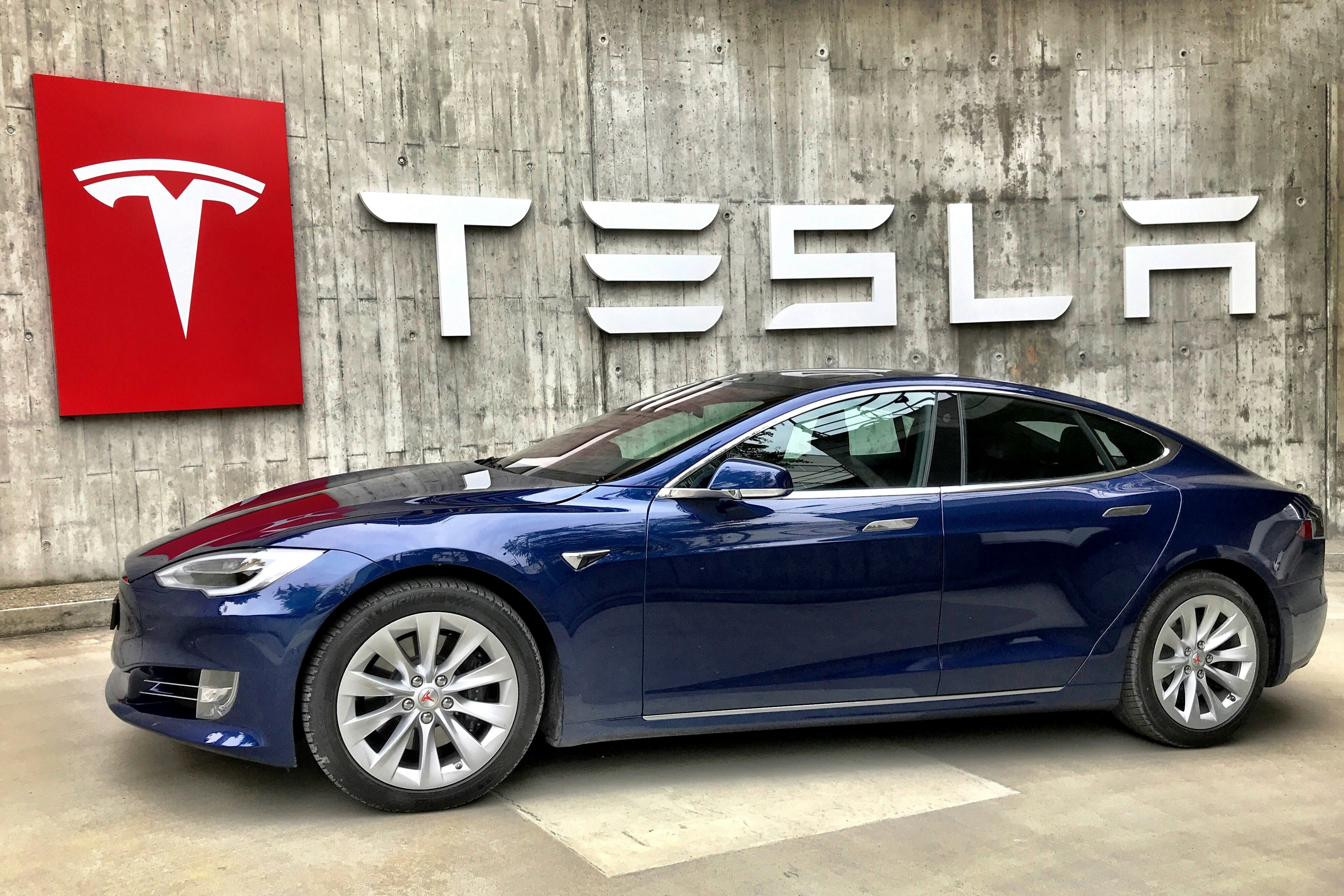
Tesla Inc. was sued over a crash in Wisconsin last November that killed all five occupants of a Model S who allegedly became trapped in a fast-moving inferno when the doors wouldn't open, adding to scrutiny over whether a design choice by the automaker is a fatal flaw.
The suit was filed on behalf of a couple who died when the four-door sedan hit a tree and caught on fire. Jeffrey Bauer, 54, and Michelle Bauer, 55, survived the initial impact, but were unable to escape because the doors locked them inside, according to the complaint brought by their children in state court.
A nearby homeowner who called 911 said she could hear people screaming from within the vehicle, according to the lawsuit. A report by the local sheriff's office said a cluster of bodies in the front seat suggested there may have been a struggle to escape.
“Tesla's design choices created a highly foreseeable risk: that occupants who survived a crash would remain trapped inside a burning vehicle,” lawyers for the children said in the complaint.
The lawsuit accuses Tesla of negligence, arguing that Elon Musk's electric vehicle maker was aware of the dangers of its door handle designs and the risk of post-collision fire hazards from the EV's lithium-ion battery pack but did nothing to address either issue.
Tesla didn't immediately return a request for comment. The suit was filed on Friday in state court in Wisconsin.
Tesla's door handles have drawn increased attention after a Bloomberg News investigation uncovered a series of incidents in which people were seriously injured or died after they were unable to open doors following a loss of power, particularly after crashes. The Wisconsin crash was one of several such incidents reviewed as part of the investigation. The company is being sued over the deaths of three college students who allegedly were trapped inside a burning Tesla that crashed last November in a San Francisco suburb.
The National Highway Traffic Safety Administration, the US auto safety regulator, disclosed in September that it's investigating whether some Tesla doors are defective, citing incidents in which exterior handles stopped working and trapped children and other occupants inside. Franz von Holzhausen, Tesla's design chief, told Bloomberg that the company is working on a redesign of its door handles to make them more intuitive for occupants “in a panic situation.”
In the Wisconsin crash, the Dane County Sheriff's Office determined that road conditions, excess speed, and impaired driving were factors that contributed to the cause of the crash.
Lawyers for the Bauer family members argue that vehicle manufacturers have a responsibility to provide adequate “crashworthiness protection,” ensuring that their vehicles provide reasonable safeguards against injury both during and after a collision.
“Regardless of the cause of a crash, the manufacturer's obligation includes designing vehicles that permit timely escape and rescue in the event of fire,” they said in the lawsuit, arguing that Tesla “disregarded these principles, instead manufacturing vehicles prone to fires that ignite and spread rapidly upon impact — and from which escape depends on electronic systems that Tesla knew were liable to fail in precisely the conditions when escape is most critical: collision and fire.”
Tesla vehicles have two batteries: one for low-voltage power to windows, doors, the touchscreen and other functions, and the high-voltage pack that propels the car. If the low-voltage battery dies or is disabled — which can happen after a crash — the doors may not unlock and must be opened manually from the inside. While there are mechanical releases inside Teslas, many owners and passengers are unfamiliar with where they're located.

-
The Economic Imperative: Analysing The Material Driving Force Behind India-Canada Strategic Reset

This economic complementarity is further reinforced by deep institutional investment ties and talent mobility, which form the bedrock of the bilateral framework.
-
Medicine Pricing: Where Must Profit Stop?
India must confront excessive margins, hidden incentives and regulatory gaps that threaten the integrity of medicine.
-
Why Amazon And Flipkart Are Struggling To Beat Meesho In India's Smaller Cities
With 274 million users and lowest-cost logistics, Meesho is defending its value commerce crown against giants like Amazon and Flipkart.
-
High US Salaries, No Green Card Certainty: The Financial Calculation Facing Indian H-1B Families
The suspension of PERM processing at eight technology employers does not cancel existing H-1B visas. What it does is force a question many Indian families have been avoiding: is the US salary worth tying your career and family plans to one employer?
-
Swiggy vs Eternal: Food Delivery's Two Rivals Are No Longer In The Same Race
Eternal is building a private AI assistant, dark.ai. Swiggy is still working out how to make Instamart pay, with an operating loss of Rs 895 crore in the July-September quarter while Blinkit stayed profitable.
-
Where You Live Shapes How You Get To Work | The Reason Why
Two-wheelers are the most popular way to get to work in India, accounting for nearly 43% of workplace commutes.
-
Unhedged Position: Can India See An Indonesia-Style Time Correction?
The Nifty is trading below levels it first clocked in 2024. Is there, then, as I have suggested in the headline, potential that the current time correction drags on painfully for the next three-five, even ten years?
-
Navigating Friction And Energy Realities: An Analysis Of Marco Rubio's October Visit To India
Occurring at a critical juncture marked by stalled trade negotiations and escalating geopolitical pressures over global energy supplies, the visit offers a profound window into modern US-India relations.
-
India Exports Capital. Why Not Export Trusteeship?
The big question, then, is whether India can build an institution that global borrowers, investors, banks, and lawyers can trust, even without an Indian connection.
-
France's Economy & Politics Are In Crisis | The Reason Why
Let's look at how the French economy and politics evolved under Nicolas Sarkozy, Franois Hollande and Emmanuel Macron.










