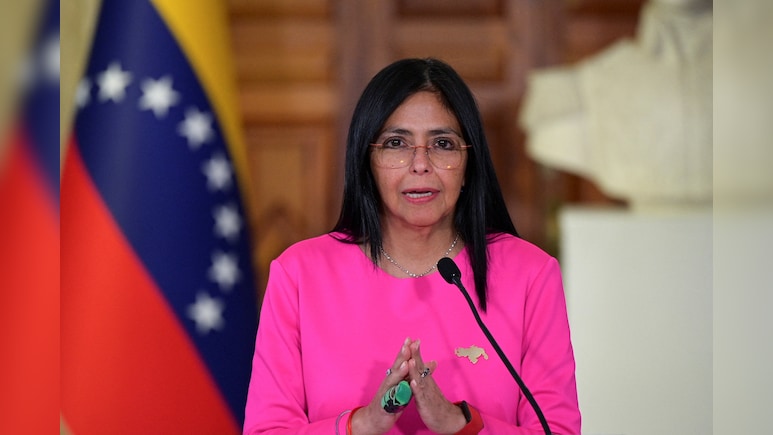
Venezuelan hard-liners and opposition forces alike criticized acting President Delcy Rodríguez for agreeing to grant the US exclusive access to the country's valuable oil resources. She may be betting that the deal with Donald Trump is her ticket to a tighter grip on power.
One potential advantage for Rodríguez is if the deal to give the US majority control over 65 billion barrels of Venezuelan crude hems in the Trump administration's incentive to press for swift elections.
"I think it can benefit Delcy to the extent that it reinforces Trump's commitment to working with her and thus probably diminishes incentives to move quickly to a new vote," said Risa Grais-Targow, Latin America director at Eurasia Group. That "is precisely why the opposition is so upset," she said.
Also Read | Layoffs Are Rising In Tech, But These Skills Are Helping People Unlock Better Pay
Rodriguez defended the deal in televised comments Saturday, saying it would bring prosperity and jobs to Venezuela. The agreement is expected to grant the nation around $19 in profit per barrel of oil produced, she said.
With decades of anti-US nationalism at her back, there's also the risk that the deal backfires into a political liability.
Supporters of Chavismo, the political movement founded by the late President Hugo Chávez and built in part around state control of Venezuela's oil, have their own reasons to be angry with Rodríguez.
Both strands of criticism played out on social media immediately after the announcement in Washington late Friday. Some commenters accused Rodríguez of giving away the country's oil, while others questioned why neither Trump nor Rodríguez paired the economic agreement with commitments on elections or a democratic transition.
"But it's also politically challenging for Delcy given sensitivities around resource nationalism and the perception that she's betraying Chavismo's principles, giving away valuable resources," Grais-Targow said.
The agreement was negotiated without the involvement of Venezuela's opposition, according to people familiar with the matter. María Corina Machado, the most prominent opposition leader, wasn't involved in the discussions, they said.
During Venezuela's 2024 presidential campaign, it was Rodríguez - then allied with former President Nicolás Maduro - who accused Machado of taking orders from "masters" in the US and seeking the presidency so she could hand over Venezuela's oil.
Now Rodríguez is facing similar attacks.
Hard-line Chavistas reacted angrily to Friday's announcement, according to text-message discussions shared by participants, questioning its legality and describing it in social media posts as an abdication of sovereignty. Some said Venezuela had effectively been forced to give away oil under US threat.
It's a sensitive moment for Rodríguez, whose popularity has slid in polls after what was perceived as a slow government response to two deadly earthquakes that killed more than 6,500 people in June.
That could complicate her efforts to balance an increasingly close relationship with Washington against a political movement built for decades around resource nationalism and resistance to US influence.
Until now, Trump's enormous leverage over Rodríguez could be viewed as a tool to extract political concessions from her government. Negotiations have recently begun producing tangible results, including the National Assembly's initial approval of a US-backed overhaul of the process for selecting Supreme Court justices.
The oil agreement opens the door to a different scenario in which US companies, investors and eventually the government in Washington develop an economic interest in the stability provided by Rodríguez, political analyst Benigno Alarcón said.
As US companies commit billions of dollars to Venezuela, Alarcón said, the US may gradually move from favoring "transition with stability" toward prioritizing "stability that preserves the option of transition."
Some members of Machado's party are already questioning whether any agreement signed by Rodríguez would survive a future political transition.
"Anything Delcy Rodríguez has signed has no validity whatsoever," said José Amalio Graterol, a member of Machado's Vente party. "She may have signed it with Donald Trump, but it will never be valid because she lacks original legitimacy."
Francisco Monaldi, director of Latin American energy policy at Rice University's Baker Institute for Public Policy in Houston, questioned the economic terms disclosed by Rodríguez and called the lack of transparency surrounding Venezuela's oil policy "very alarming."
The $209 billion in taxes she said the projects would generate amounts to roughly $3.20 for each of the 65 billion barrels covered by the agreement, Monaldi said. If that figure represents nominal revenue collected over the life of the projects, its present value would be even smaller, he said.
Rodríguez may face an even more uncomfortable challenge from Chavismo supporters.
Former left-wing lawmaker Willian Rodríguez invoked Chávez, who died in 2013, in a sharp critique of the deal with Trump. "The oil is ours, and with it we recovered our homeland," he quoted Chávez as saying.
"This agreement does exactly the opposite: it gives away the homeland and renounces our national destiny," Rodríguez said. "There's no way to dress it up."
(This story has not been edited by NDTV staff and is auto-generated from a syndicated feed.)
Essential Business Intelligence, Sharp Market Insights, Practical Personal Finance Advice, Daily Fuel, Gold and Silver Prices and Latest Stories — On NDTV Profit.