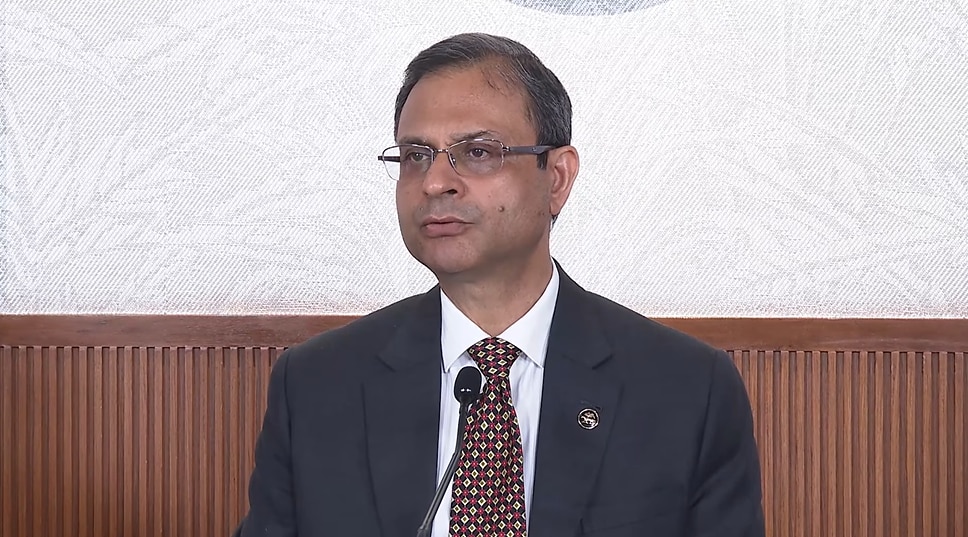
RBI Governor Sanjay Malhotra said on Friday that the central bank would not draw any conclusions on future interest rate cuts despite the expectation of very benign inflation in the coming months.
"Expectation is it is going to be very benign; whether that opens up policy for further rate cut, that would be getting into speculation and I don't want to get into it," Malhotra said during his post-policy interaction with reporters.
The Reserve Bank of India cut the policy repo rate by 25 basis points to 5.25% on Friday, extending the monetary easing delivered so far in FY26. The central bank kept its stance neutral as inflation continued to ease and domestic demand remained firm. The move marked the third rate cut this financial year, adding up to 125 basis points of reductions.
The Monetary Policy Committee voted unanimously for the rate cut, while five members supported the neutral stance and one favoured a shift to accommodative. RBI Governor Sanjay Malhotra said inflation had fallen rapidly in recent months and described the combination of subdued price pressures and strong growth as a rare balancing period for the economy.
Easing Price Trend
In his policy address earlier, Malhotra said inflation had slowed to unprecedented levels, with the average reading for the September quarter at 1.7%—below the lower bound of the inflation target band for the first time under the flexible inflation targeting framework. Headline inflation dipped further to 0.3% in October, driven by a steep correction in food prices.
RBI projected a softer inflation path ahead. It now expects inflation at 2.0% for FY26, with 0.6% in Q3 and 2.9% in Q4. Inflation is forecast to move towards the 4% target in the first half of FY27, with projections of 3.9% in Q1 and 4.0% in Q2.
The MPC noted that underlying pressures were even lower once the effect of precious metals was excluded. The fall in inflation had become more broad-based compared to earlier months.
Growth Holding Firm
Malhotra said real GDP growth had accelerated to 8.2% in the September quarter, supported by festival-season demand and GST rationalisation. Resilient domestic conditions continued to underpin activity in manufacturing and services, while agriculture benefited from a healthy kharif harvest, higher reservoir levels and improved rabi sowing.
RBI expects growth to remain steady while moderating slightly from recent highs. The central bank projects real GDP growth at 7.3% for FY26, with 7.0% in Q3 and 6.5% in Q4. Growth is forecast at 6.7% in Q1 FY27 and 6.8% in Q2, with risks evenly balanced.
High-frequency indicators suggest activity remained firm in the early part of the December quarter despite some signs of softening in select sectors. Investment activity strengthened, supported by private capital spending and higher non-food bank credit.
Liquidity Support Measures
Alongside the policy action, RBI moved to ease liquidity conditions. Malhotra announced that the central bank would purchase Rs 1 lakh crore of government bonds and conduct a three-year USD/INR buy-sell swap of $5 billion in December to supply durable liquidity to the system. He said these steps were intended to ensure adequate liquidity and smooth transmission of policy rates.
He added that open market operations and short-term repo operations served different purposes, and it was possible to inject long-term liquidity through bond purchases while simultaneously absorbing temporary liquidity through variable-rate reverse repos.
Essential Business Intelligence, Continuous LIVE TV, Sharp Market Insights, Practical Personal Finance Advice and Latest Stories — On NDTV Profit.