

Warren Buffett Didn’t Abandon Value Investing. He Fixed It
Buffett’s longevity and success stem from his ability to keep learning, adapt his thinking and refine his strategy as markets changed.



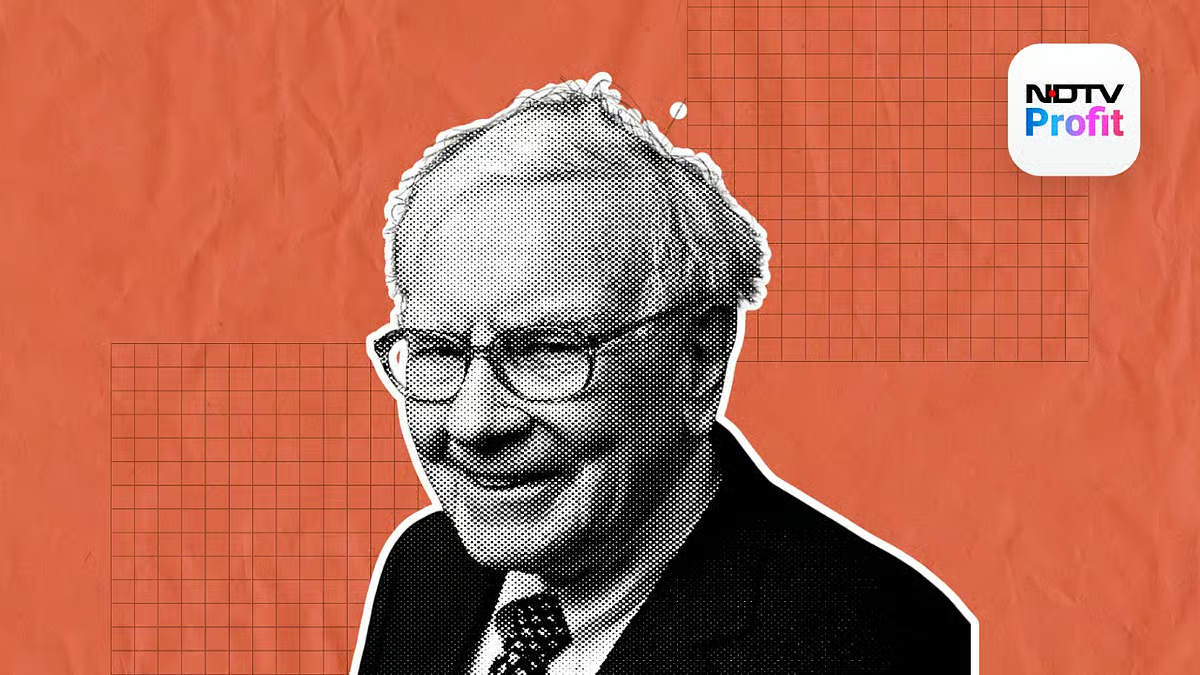
This article is part of NDTV Profit's special series on Warren Buffett's investment guidelines, philosophy, top bets, and more, ahead of his retirement.
Warren Buffett’s investment philosophy has stood the test of time, but it has not remained static. Warren Buffett’s investing journey is often described as value investing, but that description only tells part of the story. Over seven decades, Buffett didn’t abandon his principles, he refined them.
The Buffett of today does not invest in the same way he did when he first started. His strategy has shifted from deep value investing, which focused on buying stocks at steep discounts, to investing in high-quality businesses with strong competitive advantages, even at fair prices.
Buffett’s journey is not about abandoning value investing but about expanding its scope. His evolution reflects a shift from price to quality, from activity to patience, and from analysis to wisdom. Above all, it underscores a simple lesson: the most successful investors are those willing to learn, adapt and let time work in their favour.
Warren Buffett didn’t start out as the world’s most patient investor. In fact, the young Buffett was a relentless bargain hunter and a disciple of Benjamin Graham, prowling balance sheets for stocks that looked cheap enough to trip over.
If it traded below book value, Buffett was interested. If it was unloved, ignored or slightly broken, even better. These were his famous “cigar-butt” stocks. Businesses so cheap they were the equivalent of a just-thrown cigar butt lying on the road -- free and with one good puff still left in.
Then came Charlie Munger — and everything changed.
Enter Charlie Munger
Buffet's strict value approach helped him achieve success in his early years, but it had limitations. Many of the companies he bought had no real future growth prospects, and this meant that he had to keep reinvesting profits into new undervalued opportunities instead of allowing his investments to compound over time.
This realisation, coupled with Charlie Munger’s influence, led Buffett to gradually shift his strategy. He eventually moved from buying undervalued businesses to buying high-quality businesses with long-term competitive advantages.

(Bobbleheads depicting the late Charlie Munger and Warren Buffet. Photo source: NDTV Profit)
Munger pushed Buffett to see that buying bad businesses cheaply was still a bad idea. The real wealth, Munger argued, came from owning great businesses that could compound for decades.
That thinking eventually crystallised into one of Buffett’s most famous lines:
It’s far better to buy a wonderful company at a fair price than a fair company at a wonderful price.Warren Buffet
It was a subtle shift, but it changed everything.
When Coca-Cola Entered The Picture
The proof of Buffett’s evolution came in the late 1980s, when Berkshire Hathaway began buying Coca-Cola. By traditional value metrics, Coke wasn’t cheap. But it had something far more valuable: a global brand, unmatched distribution and extraordinary pricing power.
Buffett wasn’t buying a stock. He was buying a business that sold happiness in a bottle, every day, in every corner of the world.
Decades later, Coke remains one of Berkshire’s most enduring holdings, a testament to Buffett’s belief that time, paired with quality, is an investor’s best ally.
Fewer Bets, Bigger Conviction
Once Buffett embraced quality, his portfolio naturally became more concentrated. Instead of owning dozens of average companies, he focused on a handful of exceptional ones, Coca-Cola, American Express, Moody’s and later Apple, a company he once swore he’d never invest in.
This approach reflected another Buffett truth:
Diversification is protection against ignorance. It makes little sense if you know what you are doing.Warren Buffet
From Hunting Bargains To Letting Time Do The Work
Early in his career, Buffett needed markets to recognise mispricing for him to make money. Later, he realised that great businesses don’t need constant trading, they simply need time.
Compounding became the real engine of returns. His favourite holding period turned into “forever”.
That patience transformed Berkshire Hathaway from a smart investment partnership into a compounding machine, fuelled by strong businesses, capable managers and a willingness to sit still while others chased the next big idea.
Buffett’s longevity and success stem from his ability to keep learning, adapt his thinking and refine his strategy as markets changed. His willingness to shift and adapt enabled Berkshire Hathaway to scale meaningfully.
The takeaway for investors is simple: successful investing isn’t about clinging to a single strategy forever. It’s about staying disciplined, remaining open to change, and continually sharpening your approach while keeping long-term value creation firmly in focus.