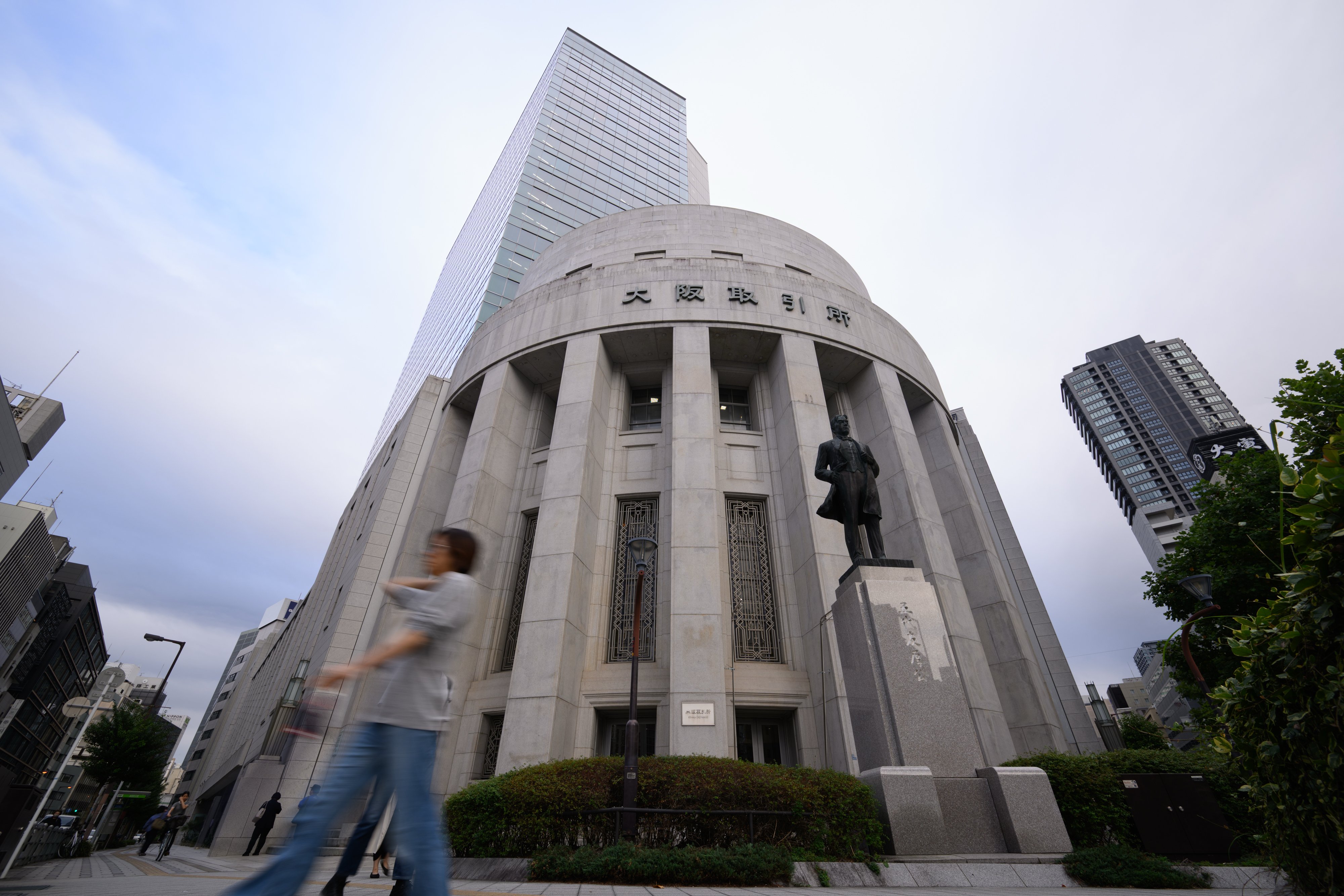
Osaka Exchange Inc. is considering changes aimed at boosting foreign participation in its 20-year Japanese government bond futures, as surging volatility in the world's third-largest debt market drives trading in the contracts to record levels.
Open interest jumped to 14,762 contracts in the third quarter — the first meaningful pickup since the product was launched — and rose further to 23,842 in the fourth quarter as of Dec. 10, exchange data show. Average daily volume followed a similar trend, climbing to 1,873 contracts as of the same date.
Even so, foreign participation remains low at about 10% of total trading volume, compared with more than 70% in the highly liquid 10-year futures contract, said Akihiro Hanawa, general manager of the market planning department for derivatives at Osaka Exchange, Japan's leading derivatives marketplace.
Also Read | Layoffs Are Rising In Tech, But These Skills Are Helping People Unlock Better Pay
The Japan Exchange Group Inc. subsidiary is in discussions with stakeholders to revamp its 2022 market-maker program for 20-year JGB futures, which has failed to attract sufficient participation. “The scheme is already outdated. We want to remake it if possible,” Hanawa said in an interview this week. “Expanding liquidity in the 20-year futures market is very important for us.”
Proposed revisions include changes to maximum spread and minimum quote-size requirements, as well as adjustments to incentive levels. A timeline for the updated program has not been finalized, with discussions still under way with potential market makers, he said.
Twenty-year JGB futures were first launched in 1988, though trading was suspended between 2002 and 2014. Liquidity remained scant even after the relisting, with daily turnover often rounding down to zero and open interest stuck near negligible levels. As a result, market participants largely ignored the product, relying instead on 10-year futures as the primary hedging instrument in JGBs — despite their limitations for managing duration risk at the super-long end of the curve.
Now, with Bank of Japan policy normalization, fiscal uncertainty, and renewed volatility in super-long JGBs, demand for additional long-end hedging tools is emerging. Investors who typically hedge 20- to 40-year duration using swaps or 10-year futures are finding those instruments less efficient as the curve steepens and volatility increases.
“We want to create the same ecosystem as 10-year futures in 20-year JGB futures,” Hanawa said. “There is more room for foreign investors to join in the 20-year futures market.”
If liquidity in the 20-year contract continues to deepen, the Osaka bourse may move ahead with new long-end JGB products, including a potential 30-year futures contract, he said. “But we have to activate the 20-year JGB futures market first, otherwise there is a risk of cannibalization of similar products.”
BOE Set To Resume Rate Cuts After Inflation Drop: Decision GuideEssential Business Intelligence, Sharp Market Insights, Practical Personal Finance Advice, Daily Fuel, Gold and Silver Prices and Latest Stories — On NDTV Profit.