Ashok Leyland Wins India’s Largest Order For Electric Trucks At Rs 150 Crore
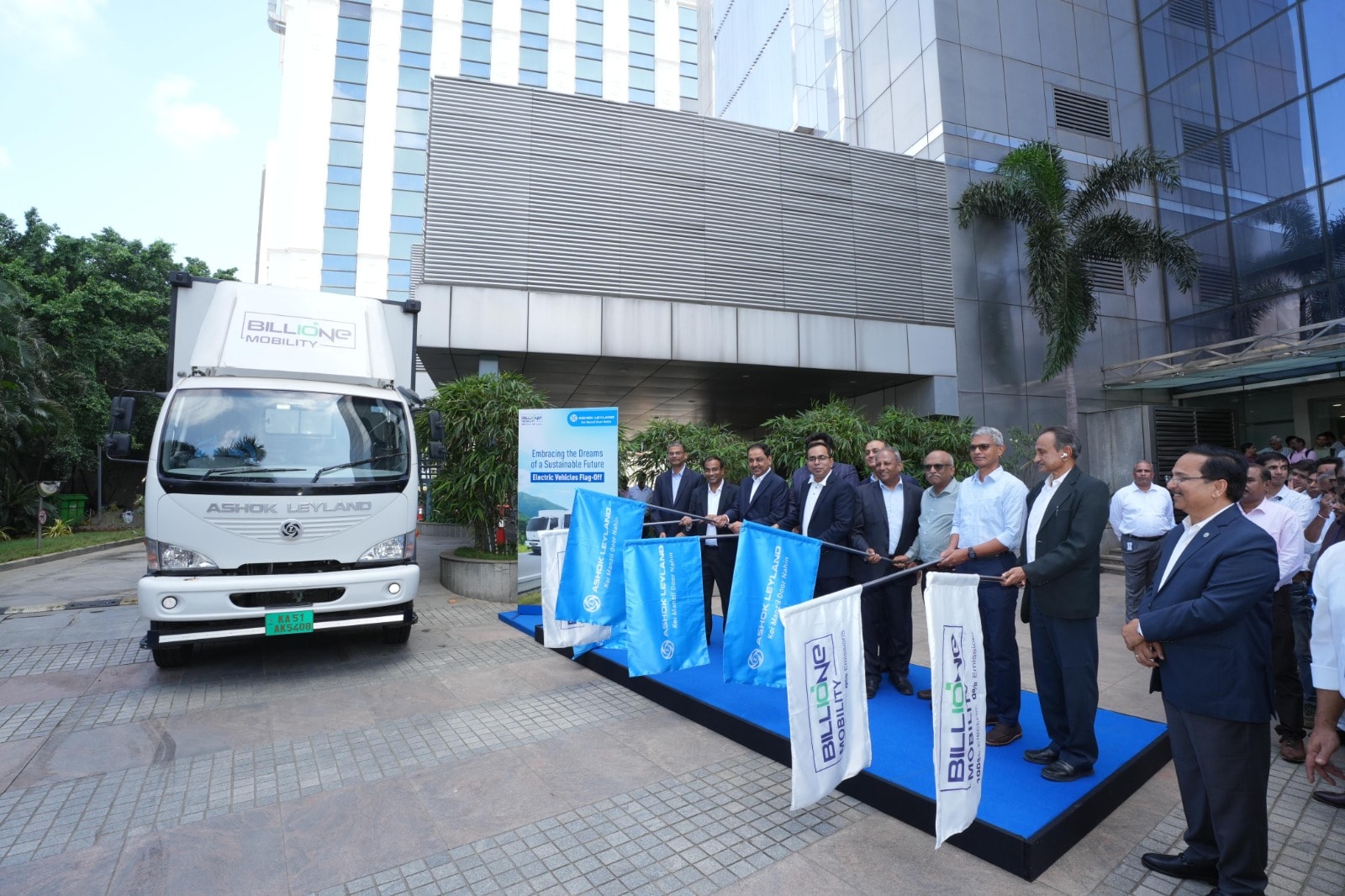
Ashok Leyland Ltd. has won India's largest order for electric trucks amid a government initiative to electrify cargo transport in the country.
The Chennai-based truckmaker will supply 180 electric trucks to Billion Electric Mobility Pvt., an e-mobility-as-a-service platform of the company that operates ChargeZone EV charging stations. The deal, valued at Rs 150 crore, will see Ashok Leyland deliver its 14- and 19-tonne BOSS electric trucks and a 55-tonne electric tractor by the fourth quarter of the ongoing fiscal.
“Ashok Leyland is proud of its partnership with BillionE Group as we commence delivery of our electric trucks and tractors,” said Chief Executive Officer Shenu Agarwal, in a statement on Monday. “We remain committed in pushing the boundaries of innovation to lead the shift to green mobility…”
While EV manufacturing is limited at the moment, Ashok Leyland plans to set up a separate assembly line at its Hosur plant to build electric trucks. The new facility will come onstream by early next year with an initial production capacity of 5,000 units/year.
The EV overdrive by a traditional truckmaker is noteworthy, for it follows the government's PM E-Drive scheme to subsidise electric vehicles in the world's third largest automotive industry. A special emphasis has been laid on electrifying commercial vehicles, which are almost entirely dependent on diesel powertrains.
Ashok Leyland said its electric truck is “within striking distance” of achieving price parity with diesel trucks, in terms of total cost of ownership.
“The objective is not to reduce costs but achieve cost parity with diesel trucks,” an Ashok Leyland executive said during a media scrum on Monday. “The good news is EV costs are coming down, batteries are becoming cheaper…In fact, we are now within striking distance of parity with diesel trucks, or even cheaper.”
The BOSS electric trucks have a range of 225-300 km/charge, depending on the model. They can be juiced up via dual charging ports in 60 minutes. Additionally, the vehicles are modular—the batteries are swappable for larger packs as needed.
To be sure, Ashok Leyland wants to limit itself to making electric trucks only, while its wholly owned subsidiary, Switch Mobility, builds electric light commercial vehicles and buses. The company's Lucknow plant, which will go onstream in the third quarter of fiscal 2026, will exclusively make electric buses initially.
That should come as a fillip to a company that's seen a slump in sales of late. In September, total sales fell 10% year-on-year to 17,233 units as against 19,202 units a year ago.
But how large is the scope of the electric trucking industry to add to Ashok Leyland's incremental volumes? None at present, CEO Agarwal said at the media scrum.
“We are just starting on this journey. Yes, there are different predictions, as to what would be the size of the electric truck industry in 3-5 years from now—from 5% to 20% adoption,” he said. “If companies like BillionE continue to drive the narrative around electric mobility, it can happen much faster as well.”
On Monday, Ashok Leyland shares fell 1.29% to Rs 222.45 apiece on the BSE, as the benchmark Sensex ended the day 0.78% lower at 81,050.00.

-
High US Salaries, No Green Card Certainty: The Financial Calculation Facing Indian H-1B Families

The suspension of PERM processing at eight technology employers does not cancel existing H-1B visas. What it does is force a question many Indian families have been avoiding: is the US salary worth tying your career and family plans to one employer?
-
Swiggy vs Eternal: Food Delivery's Two Rivals Are No Longer In The Same Race
Eternal is building a private AI assistant, dark.ai. Swiggy is still working out how to make Instamart pay, with an operating loss of Rs 895 crore in the July-September quarter while Blinkit stayed profitable.
-
Where You Live Shapes How You Get To Work | The Reason Why
Two-wheelers are the most popular way to get to work in India, accounting for nearly 43% of workplace commutes.
-
Unhedged Position: Can India See An Indonesia-Style Time Correction?
The Nifty is trading below levels it first clocked in 2024. Is there, then, as I have suggested in the headline, potential that the current time correction drags on painfully for the next three-five, even ten years?
-
Navigating Friction And Energy Realities: An Analysis Of Marco Rubio's October Visit To India
Occurring at a critical juncture marked by stalled trade negotiations and escalating geopolitical pressures over global energy supplies, the visit offers a profound window into modern US-India relations.
-
India Exports Capital. Why Not Export Trusteeship?
The big question, then, is whether India can build an institution that global borrowers, investors, banks, and lawyers can trust, even without an Indian connection.
-
France's Economy & Politics Are In Crisis | The Reason Why
Let's look at how the French economy and politics evolved under Nicolas Sarkozy, Franois Hollande and Emmanuel Macron.
-
You May Inherit The Business. You Must Earn Its Credibility.
Succession tests the founder's ability to share authority as much as it tests the next generation's readiness to assume it.
-
Signing Deals Is One Thing; Making Them Work Is Another | The Week In Whys
Sometimes, things don't turn out as planned. Indian companies have lost some bids to rivals, some projects won't produce until 2030.
-
FOMC Wall, PERM Suspension, Hospital Stocks | Talking Points This Week
A PERM suspension would directly affect green-card sponsorship rather than H-1B visas, so the near-term earnings impact could remain relatively limited. The key question is whether this marks a new phase in US scrutiny of Indian IT.









