

Maduro Captured, Indicted After US Airstrikes On Venezuela
The strikes prompted condemnations from Maduro supporters, including Russia's foreign ministry and Colombian President Gustavo Petro, who called for a United Nations Security Council meeting.



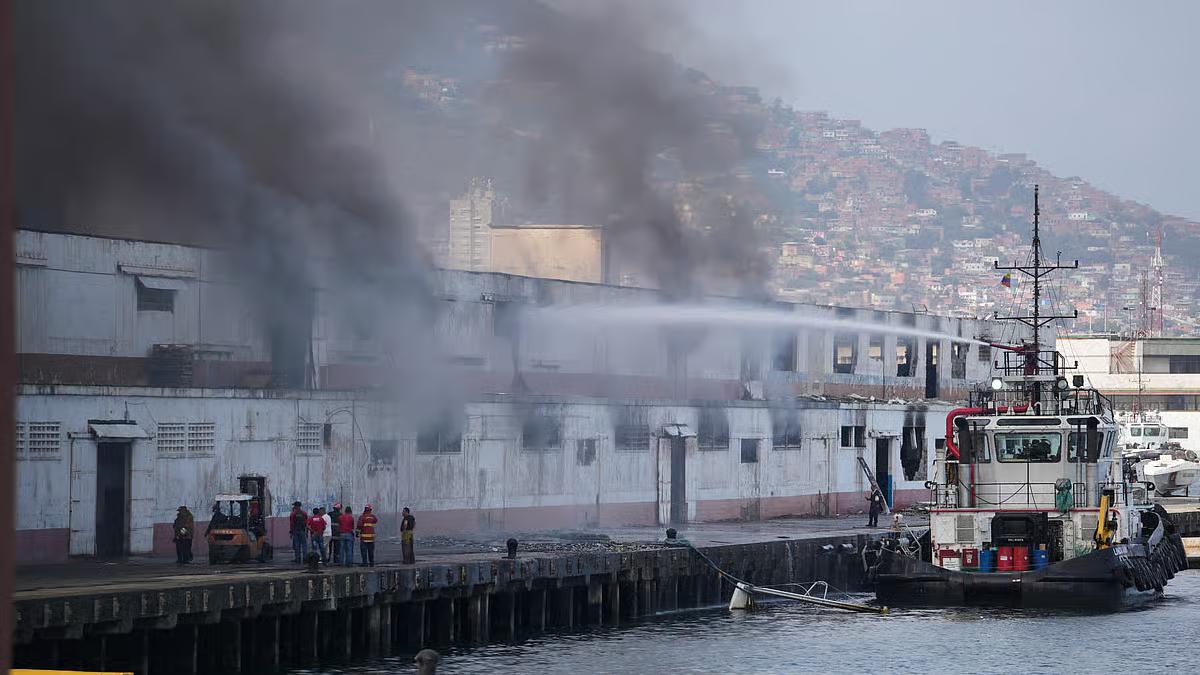
President Nicolás Maduro has been charged in the US after he was captured and flown out of Venezuela, following a series of airstrikes that mark an extraordinary escalation in the Trump administration’s months-long campaign against the country.
"The United States of America has successfully carried out a large scale strike against Venezuela and its leader, President Nicolas Maduro, who has been, along with his wife, captured and flown out of the Country," President Donald Trump wrote on social media Saturday.
US Attorney General Pam Bondi said on X that Maduro and his wife, Cilia Flores, have been indicted, with the Venezuelan leader facing charges of "Narco-Terrorism Conspiracy, Cocaine Importation Conspiracy, Possession of Machineguns and Destructive Devices, and Conspiracy to Possess Machineguns and Destructive Devices against the United States".
Trump said there would be a news conference at 11 am New York time at Mar-a-Lago, his estate in Palm Beach, Florida. In an interview with Fox News ahead of the briefing, Trump said Maduro had wanted to negotiate “at the end” but that he had decided that the US has “got to do it.” The US president said Maduro was on a US ship and being taken to New York.
The operation had been planned for four days ago but delayed due to bad weather, he said, adding that were “a few injuries” in the Venezuela operation but no deaths among US forces.
Capturing Maduro marks an unprecedented intervention and a stunning fall for the Venezuelan leader who became president in 2013. The strikes prompted condemnations from Maduro supporters including Russia’s foreign ministry and Colombian President Gustavo Petro, who called for a United Nations Security Council meeting, while Trump allies including Argentina President Javier Milei celebrated the news.
Maduro had already been the target of a US pressure campaign dating to Trump’s first term. The Trump administration has accused him of leading a drug-trafficking organization that represented a national security threat, while the US president has also made reference to the country’s vast oil reserves.
He reiterated his interest in Venezuelan energy Saturday, saying that the US is going to be “strongly involved” in the country’s oil industry.
“What can I say we have the greatest oil companies in the world, the biggest, the greatest, and we’re going to be very much involved in it,” Trump said in the Fox News interview.
'Off Ramps'
Trump had offered Maduro “multiple off ramps” on the condition that “the drug trafficking must stop, and the stolen oil must be returned to the United States,” Vice President JD Vance said in a post on X. “Maduro is the newest person to find out that President Trump means what he says.”
Trump has been assembling American military forces in the region for months, authorized attacks on alleged drug-running boats and orchestrated a blockade of sanctioned oil tankers going to and leaving Venezuela.
Last month, Trump warned his campaign would “only get bigger, and the shock to them will be like nothing they have ever seen before.” Secretary of State Marco Rubio had called Venezuela’s cooperation with narco-traffickers and terrorists a direct threat to US national security.
Some Democratic lawmakers took to social media to criticize the military operation before the capture of Maduro had been announced.
“This war is illegal, it’s embarrassing that we went from the world cop to the world bully in less than one year,” said Senator Ruben Gallego of Arizona. “There is no reason for us to be at war with Venezuela.”
US Senator Mike Lee, a Utah Republican, posted on X Saturday that Rubio told him in a phone call that he anticipates no further action in Venezuela now that Maduro is in US custody.
European Union foreign policy chief Kaja Kallas also said she spoke with Rubio and called for restraint, while reiterating the bloc’s view that Maduro lacks legitimacy.
'Aggression' Condemned
The Russian Foreign Ministry condemned the US’s “act of armed aggression against Venezuela,” saying that it’s important to avoid further escalation. In a social media post, Colombia’s Petro rejected “the aggression against the sovereignty of Venezuela and of Latin America.”
“Internal conflicts between peoples are resolved by those same peoples in peace,” he wrote. “That is the principle of the self-determination of peoples, which forms the foundation of the United Nations system.”
The first explosions in the capital were heard about 2 a.m. local time and aircraft could be seen and heard overhead for hours, according to residents. Multiple explosions centered around the Fuerte Tiuna military base in Caracas.
The Venezuelan government said military and civilian targets had been hit across three states, adding that this marked an attempt by the US to seize the country’s oil resources. Unconfirmed video footage showed aircraft flying over Caracas and what appeared to be a barrage of missile strikes on targets in urban areas.
“We call upon the peoples and governments of Latin America, the Caribbean, and the world to mobilize in active solidarity in the face of this imperial aggression,” the government said in a statement.
Oil Infrastructure
Venezuela’s oil infrastructure wasn’t affected after the US airstrikes, according to people with knowledge of the matter. The Jose port, Amuay refinery and oil areas in the Orinoco Belt are operational, said the people, who asked not to be identified discuss confidential information.
While few international companies operate in Venezuela because of US sanctions, Houston-based Chevron Corp. is a major partner to the country’s state oil producer, under a special license from the Treasury Department. In a statement, Chevron said it’s focused on the safety of its Venezuela staff and the integrity of its assets.
While Venzuela has some of the world’s largest oil reserves, it’s role as a player in global markets has significantly declined following a precipitous output slump that began in 2015. It currently produces just shy of a million barrels a day — less than 1% of global output — most of which goes to China. Oil markets have been grappling with a hefty surplus that’s set to continue early this year, leaving room for the market to cope with any disruption to the country’s output.
Maduro received a high-level Chinese delegation in Caracas on Friday, including Special Representative of the Chinese Government on Latin American Affairs Qiu Xiaoqi. It is unclear if the diplomats remained in the country by the time of the attack.
The American operation came on the anniversary of the day in 1990 that the Panamanian leader Manuel Noriega surrendered to US troops after seeking asylum in the Vatican embassy in Panama City. He was flown to Miami where he was tried and sentenced to prison.
Maduro’s departure could become a turning point for Venezuela and its people, who have spent years trying to oust him through elections widely disputed and marred by allegations of fraud and repression.
Opposition in Focus
Attention now turns to opposition leader María Corina Machado, who is in an unknown location, and to her stand-in candidate in the 2024 presidential elections, Edmundo González, widely seen as the winner based on a parallel vote count and currently exiled in Spain.
After her delayed appearance in Oslo to collect the Nobel Peace Prize in mid-December, Machado said she would return to hiding in Venezuela.
The US president said his administration was deciding the next steps on Venezuela and said he expected any Maduro loyalists still in the country to shift their allegiances.
“If they stay loyal, the future’s really bad, really bad for them,” Trump said on Fox News.
Asked whether he would back Machado to run the country, Trump added, “We’re going to have to look at it.”
Maduro’s presidency was marked by a prolonged political, social, and economic crisis. His government faced widespread accusations of authoritarianism, human-rights abuses, and suppression of dissent. During his tenure, Venezuela suffered hyperinflation, severe shortages of food and medicine, and the exodus of more than 8 million Venezuelans, one of the largest migration waves in the world.
Seizing Maduro after a series of airstrikes also stands in contrast to Trump’s repeated promise to end wars and not to start any new ones. The first 11 months of his term have seen the US carry out attacks against Iran, the Houthis in Yemen, and suspected Islamic State targets in Nigeria and Syria.
Trump had warned against such attacks, telling an audience in Saudi Arabia that “interventionists were intervening in complex societies that they did not even understand themselves.”
“In recent years, far too many American presidents have been afflicted with the notion that it’s our job to look into the souls of foreign leaders and use US policy to dispense justice for their sins,” he said at the time.