

US Changes Child Vaccine Schedule To Call For Fewer Shots
Vaccine experts say the changes will confuse parents and could lead to fewer immunizations, undoing years of public health progress.




The US Department of Health and Human Services is changing its recommendations for the childhood vaccine schedule by no longer broadly endorsing influenza, Covid-19 and other once-routine immunizations.
The new schedule now endorses 11 vaccines for children and more closely resembles the schedule for Denmark, compared with previously recommending immunizations to protect against 17 different diseases.
“We are aligning the US childhood vaccine schedule with international consensus,” Health Secretary Robert F. Kennedy Jr. said in the statement. The agency is now working to implement the changes, which it said would help build trust in the US approach.
Vaccine experts say the changes will confuse parents and could lead to fewer immunizations, undoing years of public health progress.
“I believe that this is really, in essence, a completely unwarranted change,” said Jesse Goodman, director of a program at Georgetown University that focuses on vaccine access. “These vaccines were recommended for children based on the fact that they protect them from serious illness and potentially from hospitalization and, in some cases, potentially from death, and nothing has changed.”
The policy change follows a year of Kennedy’s overhaul of American vaccine policy that’s resulted in dismantling trust in vaccines and sowed doubt over access, coverage and effectiveness in the long-standing shots. It comes on the heels of a Dec. 5 directive from President Donald Trump that instructed US public health officials to review vaccine schedules from other countries before making recommendations for American children.
The memorandum told the Centers for Disease Control and Prevention and HHS to “align US core childhood vaccination recommendations with best practices from peer, developed countries.” Flu shots and hepatitis B shots at birth were specifically named, two vaccines where the US does diverge from other countries. The Trump administration called the US an “outlier” in those areas.
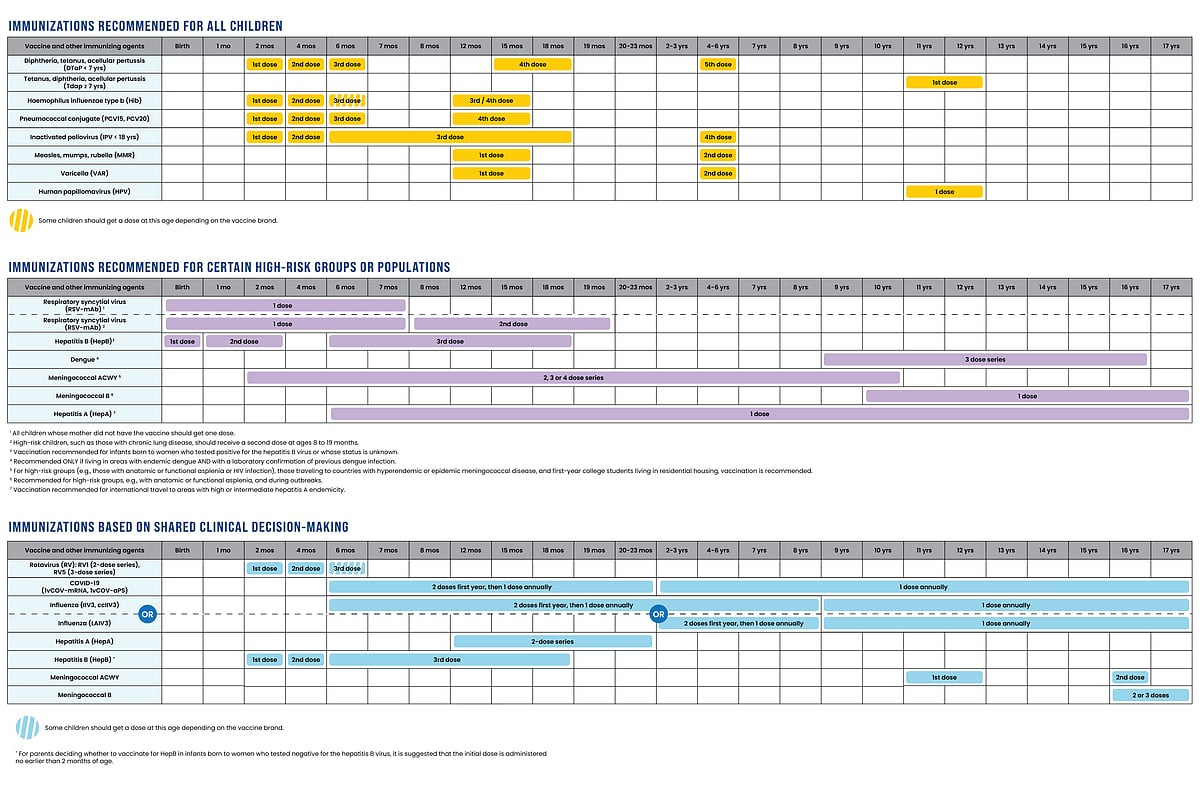
Chart from the US Department of Health and Human Services showing the new recommendations for when childhood vaccines should be given. (Image: Bloomberg)
The schedule splits immunization recommendations into three categories — what’s recommended for all children, those for high risk groups and those under so-called shared decision making.
The process of shared clinical decision making is more challenging to implement across the health system, said Linda Niccolai, an epidemiology professor at Yale University. “The nature of the recommendation itself is confusing to both patients and health-care providers, and health-care providers are given little, if any, guidance on how to discuss these vaccines with their patients,” she said.
The practice can also lead to eroding trust in vaccines and signal that some immunizations are less valuable than others, she added.
The US will still broadly recommend shots for diphtheria, whooping cough, chickenpox, tetanus, measles, mumps and rubella. The schedule still endorses the HPV shot, but moves from two doses to one.
RSV immunizations are now only recommended for high-risk populations or to children whose mother did not receive a shot. RSV is the leading cause of infant hospitalizations in the US, according to the CDC.
Influenza vaccines are now considered under shared clinical decision making — meaning patients must consult a health care provider before receiving a shot — a move away from the broad endorsement. The change comes during an especially high active flu season in the US that’s hitting children and teenagers hard.
“Today’s shift in vaccine recommendations from HHS just adds confusion and operational hurdles for families who want their kids protected from serious illness,” said Mandy Cohen, former CDC director under President Joe Biden. “I am saddened to see our country take a step backwards in its efforts to protect the health of children and families.”
The American Academy of Pediatrics said it will continue to recommend broad immunizations for RSV, hepatitis A and B, rotavirus, flu and meningococcal disease.
“At a time when parents, pediatricians and the public are looking for clear guidance and accurate information, this ill-considered decision will sow further chaos and confusion and erode confidence in immunizations,” AAP President Andrew Racine said in a statement. “This is no way to make our country healthier.”
US health officials spent about a month updating the vaccine guidelines, according to a report released Monday. By making these changes, and encouraging more parents to decide alongside their health care providers whether or not to get their children vaccinated, the federal government says it hopes to restore trust in health experts, which has plummeted in recent years.
The agency said all vaccines that had been recommended by the CDC through Dec. 31 will continue to be covered by the Affordable Care Act and other federal insurance programs.
“No family will lose access,” said Centers for Medicare and Medicaid Services head Mehmet Oz. “This framework empowers parents and physicians to make individualized decisions based on risk, while maintaining strong protection against serious disease.”
The changes are a final decision by government officials and will likely influence which vaccines health care providers recommend. The government is not recommending that private insurance plans restrict coverage.
Denmark was named as a comparison country in the HHS directive. But the argument doesn’t account for the small size of Denmark or its universal health care policy.
It’s a prominent anti-vaccine argument: Other countries require few vaccinations, so the US should pull back too.
Denmark does not recommend immunizations for RSV, Covid, or influenza in kids. The hepatitis B birth dose, rotavirus and chickenpox vaccines are also not on the schedule for children.
It also has a population of about 6 million people, about the same as Colorado’s. More than 340 million people live in the entire US.
“It cannot be compared,” said Lone Graff Stensballe, a pediatrician at the Danish National University Hospital.