

Trump's Greenland Logic Spells Trouble For Europe, NATO
The Arctic island falls under NATO's collective defense guarantee, which asserts that an attack on one alliance member is an attack on all.



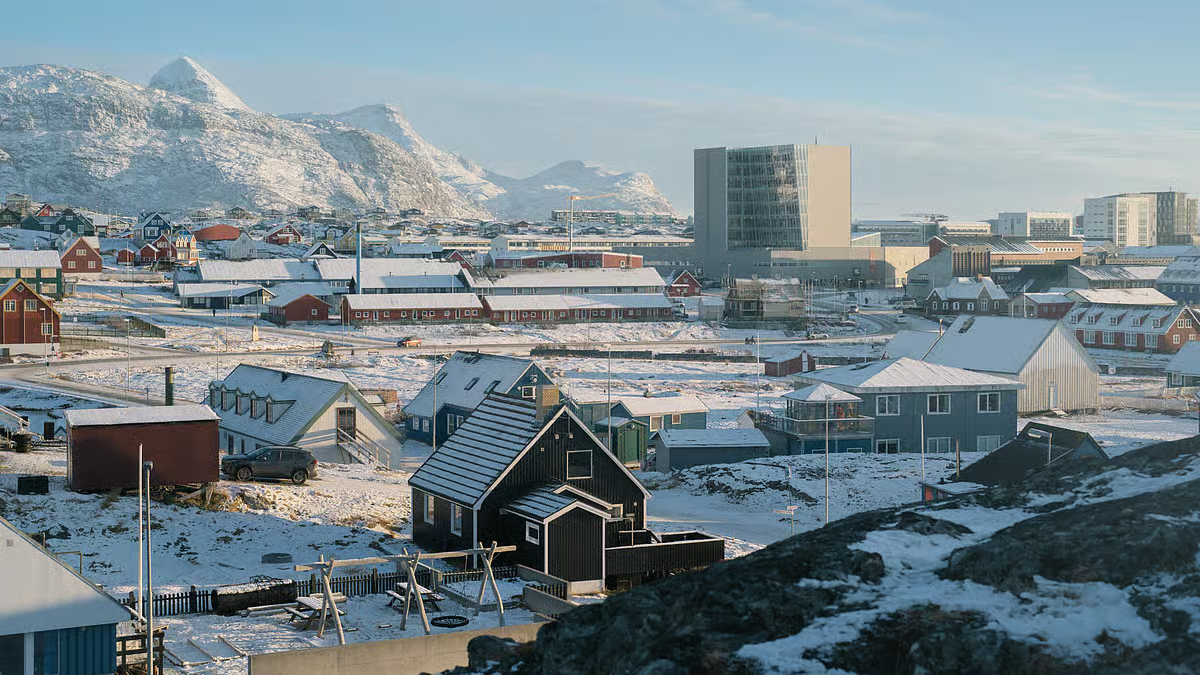
Donald Trump’s rationale for decapitating Venezuela’s government is fueling concerns among European officials that they could soon face an existential dilemma over Greenland.
The US president over the weekend explained his decision to detain Venezuela’s leader and have the US run the country as a modern revival of the 19th-century Monroe Doctrine — the “Donroe Doctrine,” as he dubbed it. The principle essentially claims a US right to lead the entire Western Hemisphere, and to control any critical assets within it.
He made the connection explicit following the military strike in Venezuela, saying he “absolutely” needs to control the semi-autonomous territory within the Danish kingdom for security purposes. The logic is not just Trump bluster — the White House recently laid it out in a national security strategy. And Trump has now used the policy to justify his audacious intervention in Venezuela, showing just how far he will go.
For Europe and the North Atlantic Treaty Organization, that carries titanic ramifications. Trump moving on Greenland would pit the US against other members of the transatlantic military alliance it leads and helped found, tarnishing NATO’s credibility and heaping an unprecedented burden on the European Union to enter the military realm.
“If the US chooses to attack another NATO country militarily, then everything stops, including NATO, and thus the security that has been established since the end of the Second World War,” Danish Prime Minister Mette Frederiksen said Monday night on Danish broadcaster TV2.
Greenland, of course, is not Venezuela, as numerous European officials have been quick to argue. The Arctic island falls under NATO’s collective defense guarantee, which asserts that an attack on one alliance member is an attack on all. The US also has ready access to the island already, maintaining a local military base. That should all, in theory, provide a considerable deterrent against any traditional military assault.
On Tuesday, Frederiksen and a coalition of European leaders, including German Chancellor Friedrich Merz, Italian Prime Minister Giorgia Meloni and UK Prime Minister Keir Starmer, emphasized that sentiment in a joint statement.
Arctic security, the statement says, must “be achieved collectively, in conjunction with NATO allies including the United States, by upholding the principles of the UN Charter, including sovereignty, territorial integrity and the inviolability of borders.”
It adds: “Greenland belongs to its people. It is for Denmark and Greenland, and them only, to decide on matters concerning Denmark and Greenland.”

Donald Trump aboard Air Force One.
“There was reason for concern even before Venezuela, when it came to Trump’s interest in Greenland,” said Rasmus Sondergaard, a US foreign policy expert at the Danish Institute for International Studies. “The situation has intensified as Donald Trump now has acted on this doctrine, sending a signal that he is willing to go a long way to pursue his interests.”
Senior White House aide Stephen Miller forcefully endorsed the US turning next to Greenland in an interview late Monday on CNN.
“The United States is the power of NATO,” he said. “For the United States to secure the Arctic region to protect and defend NATO and NATO interests, obviously, Greenland should be part of the United States.”
He also questioned Denmark’s links to the island.
“The real question is by what right does Denmark assert control over Greenland?” he said. “What is the basis of their territorial claim?”
The Danish government is genuinely worried about the situation, according to people familiar with the matter, taking Trump’s threats seriously and not assuming they are mere rhetoric or a negotiating tactic. Recent public statements from Copenhagen reflect that concern, with the government mostly reluctant to say anything publicly to avoid fueling tensions.
“I believe he means it seriously, and that is of course unacceptable,” Frederiksen said Monday. “It is unacceptable pressure being placed on Greenland.”
While Greenland is a self-ruling territory, with the local government controlling most domestic issues, Denmark oversees the Arctic island’s defense and security. The region has become increasingly important as climate change opens up new trade routes and exposes fresh natural resources.
In response, Russia and China have both moved additional resources into the area, vying for control with the US and its NATO allies.

A US intervention in Greenland would have far-reaching consequences for that balance of power, potentially destabilizing the entire western alliance in the process.
For NATO, the prospect raises uncomfortable questions about whether its strongest member still sees alliance commitments as binding — or optional. It also underscores a structural weakness within the alliance: NATO’s Article 5 mutual defense clause doesn’t explicitly address what happens if one member attacks another.
“The use of force would be hugely threatening to the alliance, and it would come in addition to existing concerns over US commitment to the alliance,” said Ian Lesser, a German Marshall Fund distinguished fellow specializing in US and transatlantic security policy. “In the very unlikely case of the Greenland issue unfolding militarily, it would put NATO and the transatlantic relationship into real jeopardy and would be a real gift to Russia and China.”
Such an event would similarly test the EU’s strength and unity. If NATO fractured from within, Denmark would be forced to turn to its EU partners, effectively asking them to weigh the defense of Greenland against preserving their relationship with Washington.
The EU’s members lack the military heft to confront the US directly, and have been Washington’s close allies for nearly 80 years. They’re also facing other existential security concerns, including Russia’s war in Ukraine on Europe’s eastern flank.
Any use of force would additionally represent an unprecedented test of the EU’s Article 42, which obliges members to provide aid and assistance to countries facing attacks from outside the bloc.
“I’m concerned that in many European capitals, other interests would outweigh the anger over a potential US attack. There is still a need for the Americans, for example, when it comes to the Russian threat,” Sondergaard said. “That in itself could be an objective for Trump — to divide Europe by doing this.”
Miller, the White House aide, put it more bluntly: “Nobody’s going to fight the United States militarily over the future of Greenland.”
For now, EU leaders are reiterating their support for Denmark and Greenland, while trying to avoid antagonizing the US.
“Denmark can count on the solidarity of the whole of Europe,” Polish Prime Minister Donald Tusk told reporters on Tuesday before traveling to Paris for a meeting with fellow leaders on Ukraine. “Everything must be done to ensure that transatlantic ties, which are the foundation of NATO and our security, do not suffer in the coming days and months.”
The European Commission, the EU’s executive branch, also downplayed comparisons between Trump’s designs on Venezuela and Greenland.
“Greenland is an ally to the US and is also covered by the NATO alliance and that is a big big difference,” Paula Pinho, the commission’s chief spokesperson, said during a news conference on Monday. “We therefore completely stand by Greenland and in no ways do we see a possible comparison with what happened.”
But that’s no assurance that Trump won’t eventually try to coerce Greenland and Denmark into submission.
“I am not a nervous person, nor am I naive,” Frederiksen said. “So I am keeping an eye on all movements on the map right now.”