

Ruble’s World-Beating Rally Poses New Risk For Russian Economy
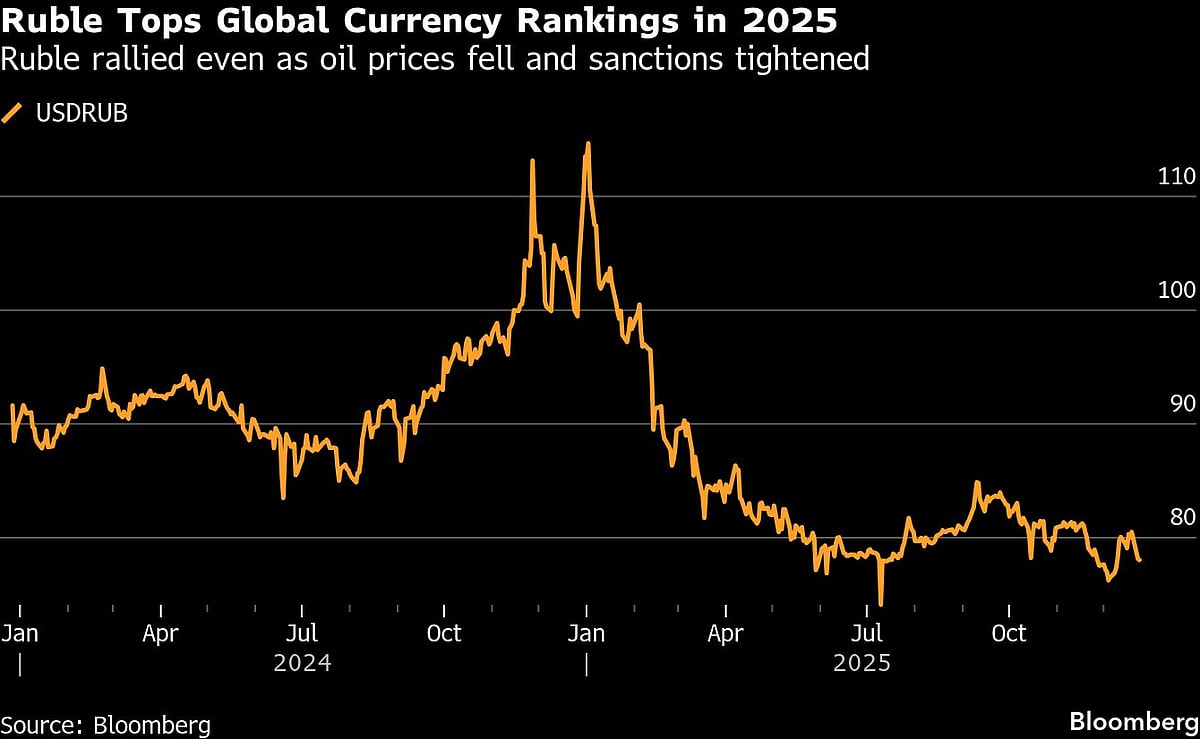
The ruble has strengthened 45% since the start of the year and is trading near 78 per dollar.



Russia’s ruble has outpaced every major currency against the dollar this year, a rally that caught policymakers off guard and threatens to undermine the nation’s wartime economy.
The ruble has strengthened 45% since the start of the year and is trading near 78 per dollar, within touching distance of levels seen before Russia’s full-scale invasion of Ukraine nearly four years ago. Over the past 12 months, the appreciation has been the strongest since at least 1994, the data show.
A key driver has been a sharp drop in demand for foreign currency in Russia amid international sanctions, while exceptionally tight monetary policy has boosted the appeal of ruble assets for residents. The central bank’s key rate stayed at a record-high level from October last year until June, before policymakers cut by a cumulative 5 percentage points to 16%.
The government had forecast an average exchange rate of 91.2 per dollar for this year. The resilience has persisted despite weaker oil prices and fresh US and European sanctions, amplifying the drag on state finances by squeezing exporters’ revenues when converted into rubles.
Support for the currency has also come from the Bank of Russia’s foreign-exchange sales, mirroring the Finance Ministry’s operations as it disposes of yuan and gold from the National Wellbeing Fund to replace lost energy revenues. Oil and gas budget proceeds plunged 22% in the first 11 months of the year, Finance Ministry data show.
The ruble’s advance this year places it among the five best-performing global assets by spot return after platinum, silver, palladium and gold, according to data compiled by Bloomberg.
For the central bank, a stronger ruble is welcome in the fight against inflation, and Governor Elvira Nabiullina has signaled that the disinflationary effect hasn’t yet been exhausted. But economists at the Moscow-based Stolypin Institute for the Economy of Growth warn that the appreciation is increasingly turning into a threat.
If current trends persist — a firmer ruble combined with expensive credit — a cooling of the economy may soon give way to stagflation, they said in a report this month. The central bank forecasts the economic expansion to slow this year to 0.5%-1% from 4.3% last year.
An overvalued ruble undermines competitiveness, the Stolypin researchers wrote, arguing that Russia is effectively “losing its natural advantages as an energy power, offering foreign consumers better conditions than domestic producers and worsening the country’s investment appeal.”
A weaker ruble would benefit not only exporters and the budget, but “the entire economy,” Alexander Shokhin, the head of the Russian Union of Industrialists and Entrepreneurs, told local media outlet RBC on Tuesday. The lobby group is due to meet with President Vladimir Putin on Wednesday to discuss economic issues among other things.