

Maduro's Leadership Team Asserts Control In Wake of Venezuela Leader's Capture
The key for Maduro’s inner circle to maintain control will be to retain the loyalty of the nation’s armed forces.




With Venezuelan President Nicolás Maduro in US custody, his top lieutenants quickly took to social media and state television early Saturday to fill the power vacuum, taking a defiant stand against the Trump administration.
President Donald Trump told Fox News Saturday that the US is reviewing what a transition of power will look like in Venezuela. Meanwhile, the regime’s most prominent leaders were already asserting their authority over their nation’s military and government.
The key for Maduro’s inner circle to maintain control will be to retain the loyalty of the nation’s armed forces. Thus far there has been no sign of dissent in the ranks, and the streets of Caracas were quiet early Saturday as Venezuelans waited cautiously to see what would happen next.
Vice President Delcy Rodríguez would be next in line to succeed Maduro under Venezuela’s constitution. She spoke by phone with state television Saturday, calling for national unity and rejecting foreign interference, and talked to Russian Foreign Minister Sergei Lavrov. Her current whereabouts haven’t been disclosed, and the Russian government said a report that she was in Russia was false.
“They have a vice president as you know,” Trump told Fox, when asked who would succeed Maduro. He said he would also consider whether opposition leader María Corina Machado should be in charge. The objective would be to avoid a situation where the US has to remove another leader, Trump said.
“We can’t take a chance after having done this incredible thing last night of letting somebody else take over, where we have to do it again,” he said.
Machado, for her part, said the candidate she backed in last year’s election, Edmundo González, should immediately assume power, and called on the armed forces to back him. But González has been in exile in Spain, and Machado has yet to return to Venezuela after traveling to Sweden last month to accept her Nobel Peace Prize.
Rodríguez is considered by many as the most powerful person in the country after Maduro. She is one of his closest allies, rising through the ranks in roles such as information and foreign minister, and was named oil minister in 2024 after the contested presidential vote.
Rodríguez, 56, has played a key role in the nation’s budget planning and has led diplomatic outreach to consolidate alliances with some of Venezuela’s biggest allies, including China and Russia. She recently pressed China to increase purchases of Venezuelan oil and provide diluents needed to keep shipments flowing amid US sanctions.
She began her political career under former President Hugo Chávez after graduating as a lawyer from the Central University of Venezuela. Her father, Jorge Antonio Rodríguez, was a prominent figure on the Venezuelan radical left in the 1960s and 1970s and the founder of a Marxist party. He died in 1976 under interrogation in prison after being tortured by state security forces, an event that became a defining part of Delcy’s political narrative.
Those who have worked alongside Rodríguez often remark on her long hours, with Maduro recently saying she responded to messages well into the night and early morning.
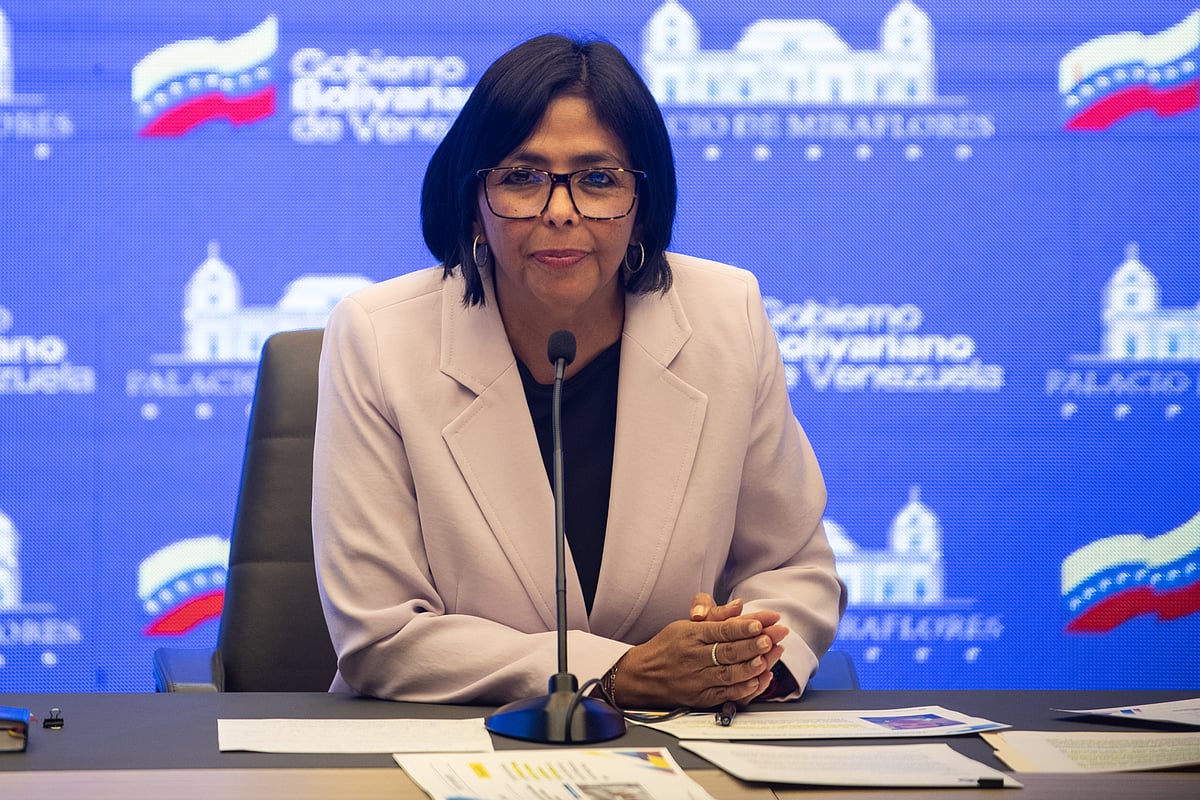
Delcy Rodríguez, Venezuela’s vice president, during a 2023 news conference at Miraflores Palace in Caracas.
Loyal Ally
Her brother Jorge Rodríguez is another key figure in the regime, head of the National Assembly and one of Maduro’s closest advisers. The 60-year old psychiatrist became politically active in college, where he was a student leader, and after graduation, he transitioned into government roles.
A loyal ally of Chávez and his successor Maduro, he’s held several high-profile political posts, serving as vice president, communications minister and head of the electoral authority. He’s also acted as negotiator for the Maduro government in several rounds of talks with the US and the country’s opposition.
Despite his mediator role, Rodríguez is also known for his explosive temperament, lashing out in Congress and publicly threatening and insulting members of the opposition. He is the only member of Maduro’s inner circle that hasn’t spoken publicly since the president was taken by the US.
Jorge Rodríguez would be a key figure in ensuring continuity and political unity within the ruling party. He was re-elected as a legislator in May 2025 and wa expected to take office on Jan. 5.
Military Man
Amid rumors that his home had been attacked and that he had been killed, Defense Minister Vladimir Padrino López, 62, was the first senior government official to appear in a video on social media, more than three hours after the unrest began. In the message, he urged Venezuelans to remain calm, backed President Maduro’s declaration of a state of emergency, and said national defense measures would be activated to restore order and stability.
Padrino has been Venezuela’s defense minister since October 2014, making him one of the longest-serving officials in the government. He was appointed during a tense period marked by large anti-government protests, when Maduro was seeking to strengthen control over the armed forces and secure loyalty at the highest levels. A career army officer trained in Venezuela’s traditional military system, Padrino was seen as a figure capable of keeping the military united as the country’s political and economic crisis worsened.
During Padrino’s time in office, the armed forces have taken on roles far beyond national defense. The military now oversees important parts of the economy, including food distribution, ports, mining, and oil-related logistics. This expansion has tied senior officers more closely to the government’s survival, giving the military a direct stake in maintaining the current political system.
Padrino has consistently supported Maduro during major moments of unrest, including the 2017 protests, the 2019 challenge following international recognition of Juan Guaidó as interim president, and repeated reports of unrest within the military. He has been sanctioned by the US and other governments, which accuse him of backing authoritarian rule, human rights abuses, and corruption. The US has offered a $15 million reward for information leading to his capture.
Venezuela’s interior minister, Diosdado Cabello, also appeared on state television early Saturday to urge calm and call for international attention to what he called attacks on areas inhabited by civilians.
“What they tried to do with bombs and missiles, they achieved partially,” he said, questioning whether the international community would “become accomplices to this massacre.”
Coup Participant
Cabello, 62, is the government’s socialist party strongman, controlling loyalists and followers across the country, as well as heading prisons, police and intelligence forces, which the United Nations has said enabled crimes against humanity.
As an army lieutenant, Cabello was part of a handful of young officials led by Chávez responsible for a 1992 coup attempt. After Chávez was elected president, Cabello was appointed to key posts, including minister of housing and telecommunications, head of the National Assembly, and governor of Miranda state.
Cabello was a key figure in furthering government controls over the free press and the persecution of politicians, journalists and human rights activists. The US accused Cabello of narcotrafficking and terrorism in 2018. He’s charged in a Southern District of New York federal indictment with conspiracy to commit narco-terrorism. In 2025 the State Department announced it was raising a reward for information leading to Cabello’s capture to as much as $25 million.