

Japan’s Inflation Holds Steady At 3% Ahead Of Expected BOJ Hike
Consumer prices excluding fresh food rose 3% from a year earlier in November.




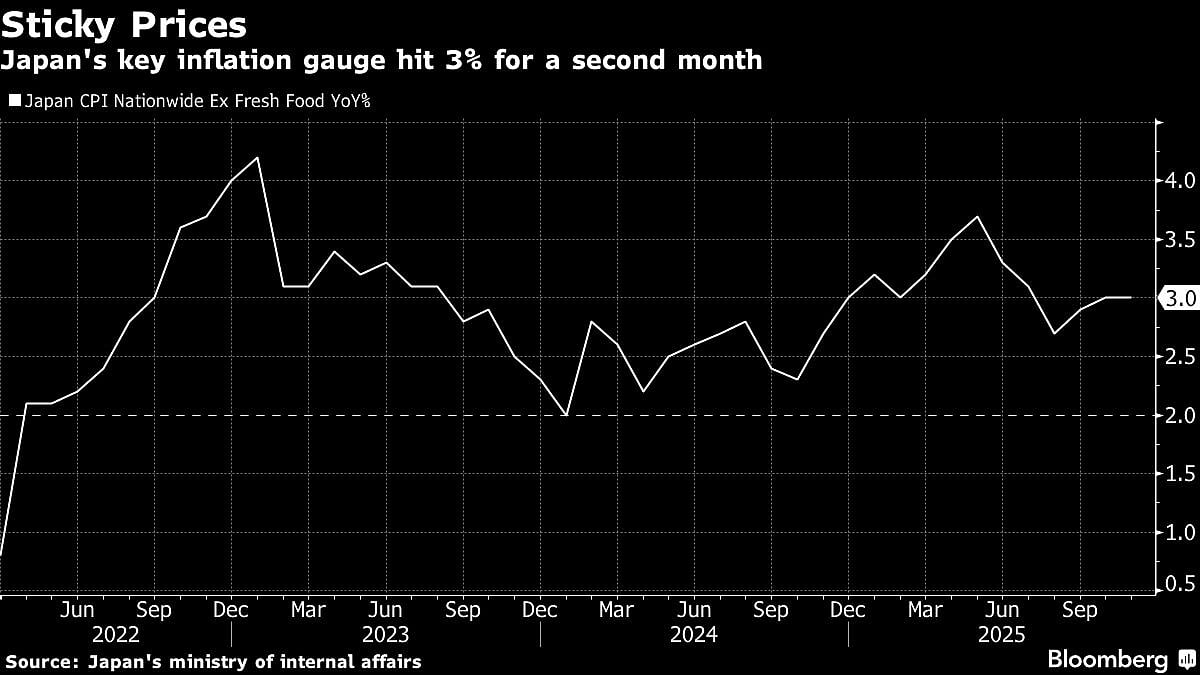
Japan’s key inflation gauge stayed at 3% for a second month, signaling sustained price pressure hours before the Bank of Japan is widely expected to boost borrowing costs to the highest level in three decades.
Consumer prices excluding fresh food rose 3% from a year earlier in November, with the pace of gains unchanged from the previous month, the Ministry of Internal Affairs and Communications reported Friday. The reading matched the median estimate of economists.
The overall gauge increased 2.9%, while gains in a deeper measure that strips out energy slightly decelerated to 3%.
The data came hours before the central bank was expected to raise its benchmark interest rate to 0.75%, as predicted by all 50 economists surveyed by Bloomberg. Friday’s figures will likely keep investors focused on the pace of any subsequent interest rate hikes in 2026, as the central bank continues to nudge policy toward neutral settings.
“The underlying price trend — which the BOJ is monitoring — appears to be moving steadily,” said Takafumi Fujita, economist at Meiji Yasuda Research Institute. He expected the central bank to continue raising interest rates in a steady manner.
The core gauge has now stayed at or above the BOJ’s 2% inflation target for 44 consecutive months. Overall price gains were supported by energy price increases, which picked up after utility subsidies were cut back.
Market participants will be focused later Friday on comments by BOJ Governor Kazuo Ueda when he speaks at a post-decision press briefing likely to start at 3:30 p.m. in Tokyo. Any remarks suggesting concern about the stickiness of inflation may shed light on how fast the bank may continue to lift rates next year.
“Since this is the first time in about 30 years that the policy rate has risen above 0.5%, I think the BOJ will proceed carefully from here, keeping a close eye on conditions,” said Fujita. He expects the next hike after Friday to come sometime around October.
What Bloomberg Economics Says...“With core inflation gauges around 3% — above the Bank of Japan’s 2% target — the reading would bolster the BOJ’s confidence that price growth is persistent enough to justify lifting its policy rate to 0.75% from 0.5%, likely later today.”— Taro Kimura, economistClick here to read the full report
Persistent price gains are a concern for Prime Minister Sanae Takaichi. Her ruling Liberal Democratic Party sustained setbacks in two national elections before she became premier, amid simmering frustration with soaring costs of living.
The number of price increases by Japan’s major food companies is set to reach 20,609 this year, rising 64.6% from the previous year, Teikoku Databank reported last month.
To address the situation, Takaichi has put together price-relief measures that include winter electricity subsidies and one-off cash handouts for children as part of an economic package that features the largest round of extra spending since the pandemic.
Taken together, the Cabinet Office estimates these measures will reduce headline inflation by an average of about 0.7 percentage point between February and April.
Ueda may seek to reassure households that price gains will moderate. In its latest outlook report released in October, the BOJ projected that key inflation measures will slide below 2% through the first half of the fiscal year starting in April, as food inflation is likely to ease.
So far, food and beverage companies have indicated they plan to lift prices on 1,050 products next year. At the same juncture a year ago, the firms projected increases for roughly 4,400 items in 2025, according to Teikoku Databank.
Further out, the central bank said inflation is expected to be broadly consistent with the 2% target toward the fiscal year starting in April 2027.
Falling energy import prices are also likely to ease inflationary pressures going forward. Energy accounted for about one-fifth of Japan’s import bill in the first half of this year, with liquefied natural gas making up roughly a quarter of the total. The latest trade data showed that Japan’s import values of LNG fell about 18% while coal dropped by roughly 25% in November from a year earlier.
One risk is the ongoing weakness of the yen. The currency is trading around 155 against the dollar, near its weakest level since January. A softer yen keeps import cost pressures elevated, potentially prompting firms to pass higher costs on to consumers.
“Governor Ueda will likely choose his words carefully at the post-decision press conference today to avoid stirring the currency markets,” said Fujita.