

NASA Releases Stunning 25‑Year Time‑Lapse Of Supernova Remnant
Situated around 17,000 light-years from Earth within the Milky Way Galaxy, the supernova remnant is close enough for NASA’s Chandra Observatory to capture its subtle changes in exceptional detail.



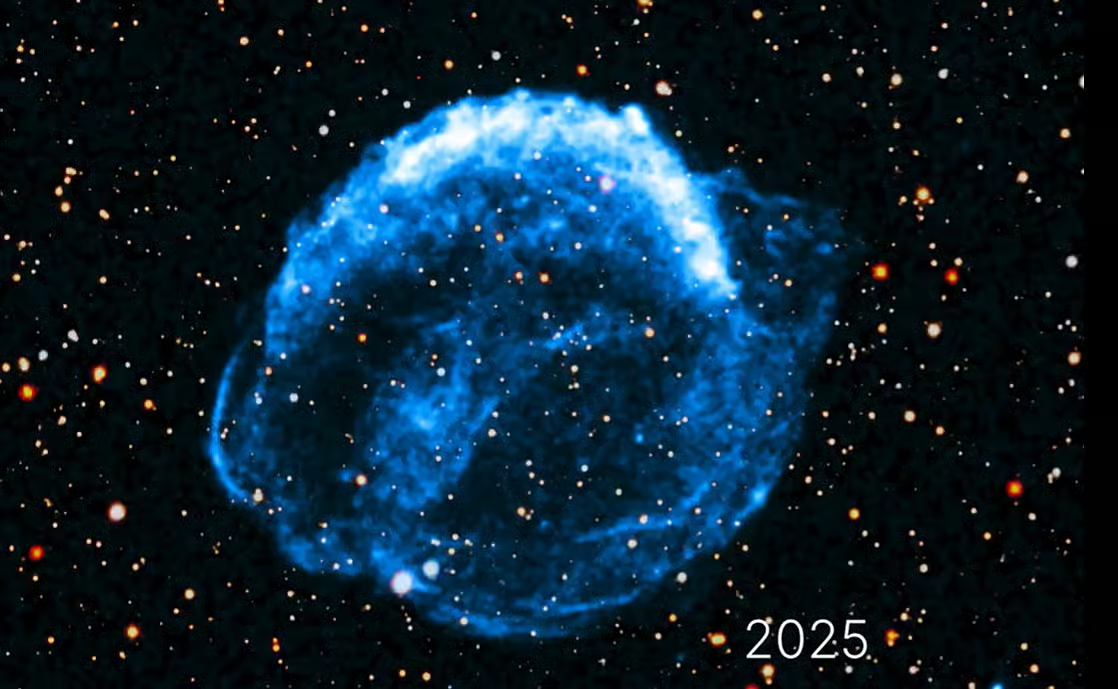
NASA has unveiled a striking time-lapse video of a stellar explosion, charting the gradual transformation of Kepler's Supernova Remnant. The newly released footage draws on more than 25 years of observations from the Chandra X-ray Observatory.
"Ever wonder what happens in the aftermath of a supernova? In this video, you're watching the glowing remnants of a stellar explosion disperse over a period of 25 years, making this Chandra X-ray Observatory's longest-spanning video ever released," NASA said in a post on X.
Situated around 17,000 light-years from Earth within the Milky Way Galaxy, the supernova remnant is close enough for NASA’s Chandra Observatory to capture its subtle changes in exceptional detail. Drawing on X-ray data collected in 2000, 2004, 2006, 2014 and 2025, it is the longest time-lapse ever produced by Chandra.
"It's remarkable that we can watch as these remains from this shattered star crash into material already thrown out into space,” said Jessye Gassel, a graduate student at George Mason University in Virginia, who helmed the study.
The newly released Chandra footage and its accompanying findings were unveiled by Gassel during the 247th American Astronomical Society meeting in Phoenix.
Kepler’s Supernova Remnant is the aftermath of a white dwarf that exploded after crossing a critical mass threshold. Viewed in X-rays, the remains form a glowing blue ring, cut by a slanted streak running diagonally across the image, with thinner, more diffuse material at the lower edge and a pale arc crowning the top.
By analysing the footage, scientists found that the most rapidly moving material in the remnant is racing at around 13.8 million miles per hour, roughly 2% of the speed of light, towards the lower part of the image.
Slower material, drifting upwards at about 4 million miles per hour, is encountering denser gas, revealing important details about the surroundings into which the star exploded.
“Supernova explosions and the elements they hurl into space are the lifeblood of new stars and planets,” said Brian Williams of NASA’s Goddard Space Flight Center in Greenbelt, Maryland, and principal investigator of the latest observations of Kepler by the Chandra X-ray Observatory. “Understanding exactly how they behave is crucial to knowing our cosmic history,” he added.