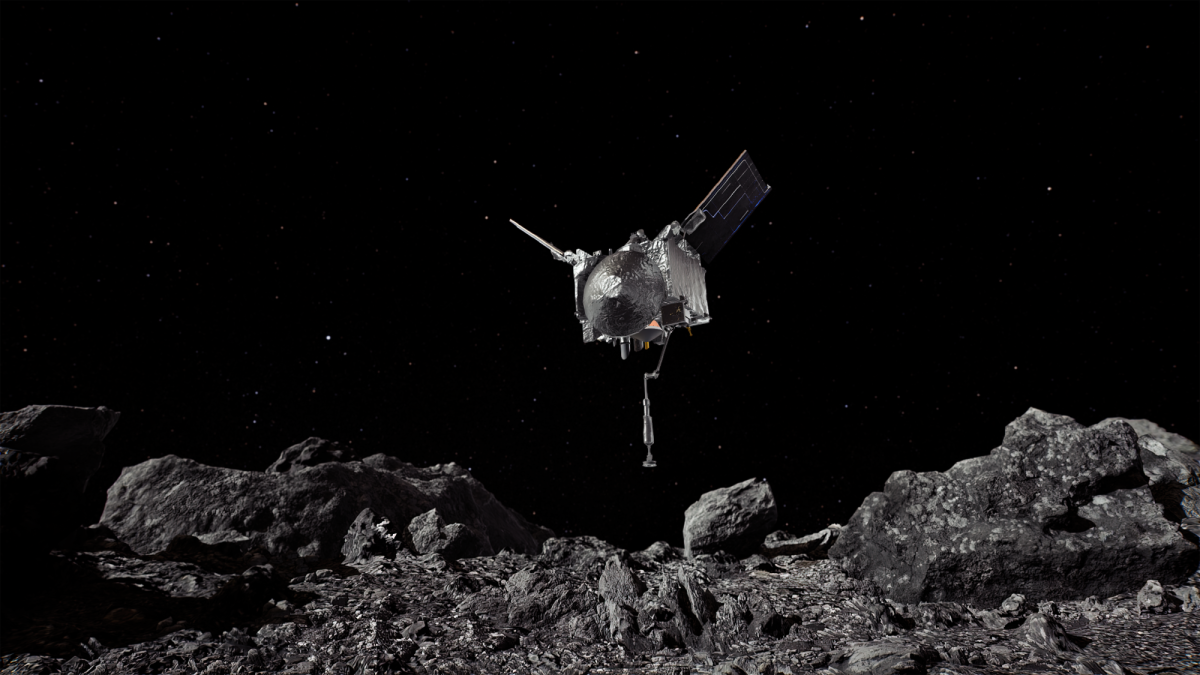
NASA announced the discovery of "life's ingredients" from samples of the ancient asteroid Bennu, collected by its OSIRIS-REx Spacecraft. The latest discoveries include sugars that are essential for the creation of life forms, ancient "space-gum" never found before on asteroids and supernova dust.
This, along with previous discoveries of amino acids and nucleobases, indicated that the components that make up biological molecules were naturally occurring in the solar system, according to the National Aeronautics and Space Administration's blog post.
"Combined with previous detections of amino acids and nucleobases, we see that life's ingredients were widespread throughout the solar system," the NASA Solar System 'X' account wrote in its post.
Also Read | Layoffs Are Rising In Tech, But These Skills Are Helping People Unlock Better Pay
BREAKING: Sugars essential for life have been found in pristine asteroid Bennu samples collected by NASA's OSIRIS-REx spacecraft. Combined with previous detections of amino acids and nucleobases, we see that life's ingredients were widespread throughout the solar system:… pic.twitter.com/l4Rz9Tbq5C
December 2, 2025The discovery of the building blocks of life from an extra-terrestrial object sparked excitement and discussion among prominent astronomers on 'X', who brought up Fermi's paradox.
The Fermi Paradox is the contradiction between the high probability of extraterrestrial life existing and the lack of evidence for it in the vastness of space. It is named after physicist Enrico Fermi.
🚨 This is wild. We are talking about actual building blocks of life found on a raw asteroid. Sugars, amino acids and nucleobases sitting out in space tell us that the recipe for life was already everywhere long before Earth formed. This matters more than people think https://t.co/dm3c9qgwrp
December 4, 2025From a Fermi Paradox perspective, this is great and terrible news.
December 4, 2025
Terrible, as the Paradox is stronger than ever.
Great, because whatever filter causes the Paradox is more likely to be early in our evolutionary history rather than in the future (humanity already passed the test) https://t.co/Po3BTPei06This discovery came to light due to scientists led by Yoshihiro Furukawa of Tohoku University in Japan, who wrote about their findings in the Nature Geoscience journal.
They found ribose (a primary ingredient for the formation of RNA) and glucose for the very first time in an extraterrestrial sample, which, when coupled with amino acids and nucleobases indicated that all the major building blocks of RNA could be found on the asteroid.
Glucose's discovery is significant due to it being an energy source that powers biological life on earth.
"Ribose in RNA is used in the molecule's sugar-phosphate “backbone” that connects a string of information-carrying nucleobases," the blog post said.
When juxtaposed with the absence of deoxyribose, a key component of DNA, the discovery seems to provide more credence to the hypothesis that RNA was more necessary for creation of life than DNA, as indicated by its detection on an ancient asteroid.
“Present day life is based on a complex system organized primarily by three types of functional biopolymers: DNA, RNA, and proteins,” Furukawa said.
“However, early life may have been simpler. RNA is the leading candidate for the first functional biopolymer because it can store genetic information and catalyze many biological reactions," he added.
A second paper from the Nature Astronomy journal Scott Sandford at NASA's Ames Research Center in California's Silicon Valley and Zack Gainsforth of the University of California, Berkeley, noted the detection of a gum-like substance found on a space rock for the first time.
Sandford dubbed it a "space plastic" due to its similar chemical structure to polyurethane. It was described as a polymer-like material rich in nitrogen and oxygen. Scientists hypothesised that the complex molecules in this substance may have spurred the creation of early life forms.
A third paper in the journal Nature Astronomy, led by Ann Nguyen of NASA's Johnson Space Center in Houston discovered samples that had six-times the amount of supernova dust than any other studied sample before it.
"These fragments retain a higher abundance of organic matter and presolar silicate grains, which are known to be easily destroyed by aqueous alteration in asteroids," Nguyen said.
"Their preservation in the Bennu samples was a surprise and illustrates that some material escaped alteration in the parent body. Our study reveals the diversity of presolar materials that the parent accreted as it was forming," the scientist added.
Essential Business Intelligence, Sharp Market Insights, Practical Personal Finance Advice, Daily Fuel, Gold and Silver Prices and Latest Stories — On NDTV Profit.