Nestle India Quarterly Results: Profit Tops Estimates, Rises 27%
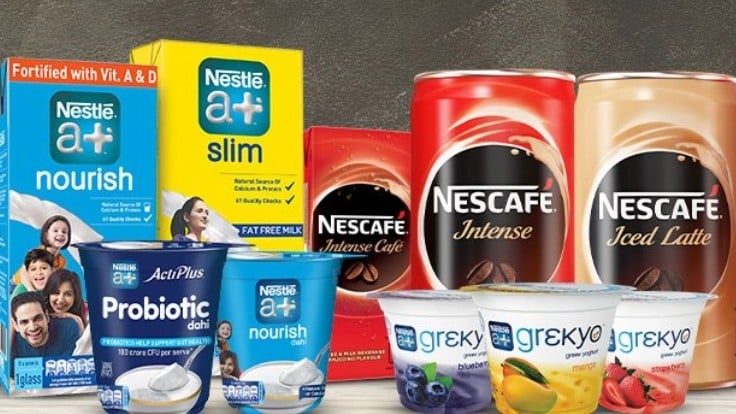
Nestle India Ltd.'s net profit rose 27% in the January-March quarter, surpassing analysts' estimates.
Net profit of the Cerelac baby cereals and Maggi instant noodles maker increased to Rs 934 crore during the three-month period, according to an exchange filing on Thursday. That compares with the Rs 837.9-crore consensus estimate of analysts tracked by Bloomberg.
The packaged food company reported an exceptional gain of Rs 10.08 crore during the quarter under review.
Nestle India will now follow the financial year that runs from April 1 to March 31 instead of January through December. The company's last fiscal has been extended until March 31, 2024—spanning a period of 15 months from Jan. 1, 2023, to March 31, 2024.
Nestle Quarterly Earnings Highlights (YoY)
Revenue rose 9% to Rs 5,268 crore (Bloomberg estimate: Rs 5,236.1 crore).
Ebitda grew 23% to Rs 1,349 crore (Bloomberg estimate: Rs 1,236.8 crore).
Margin at 25.6% versus 22.7% (Bloomberg estimate: 23.6%).
E-commerce contributed 6.8% of sales.
During the quarter, Nestle India's domestic sales increased 8.9% over the previous year to Rs 5,021.6 crore, while exports rose 19% to Rs 232.82 crore.
Unlike peer Hindustan Unilever Ltd., Nestle India has sustained strong growth in a tough environment, marked by rising food inflation and volatile commodity prices, mainly due to lower product penetration in key categories and higher growth in small towns and village—a strategy the company terms as “rurban". Nestle's rural sales at 22% are under-indexed.
Confectionery, particularly the Kitkat brand, has propelled India to become the second-largest market globally, the company said. The milk products and nutrition category saw robust growth despite inflationary pressure.
India also emerged as the largest market worldwide for Maggi.
Separately, the Indian arm of the Swiss food giant formed a joint venture with Dr. Reddy's Laboratories to extend science-backed nutritional solutions to more consumers leveraging the latter's distribution network.
Dr. Reddy's would own 51% of the JV, with the chocolate-maker owning the rest.
Nestle India also said that the company will soon launch its popular and premium coffee brand Nespresso in India, to cater to growing demand. "In recent years, coffee consumption in India has witnessed a surge, with a discernible trend towards in-home consumption," the company said.
The first outlet will be located in Delhi, and later expand to other key cities. Nespresso coffees and machines will also be sold on online channels.
Looking ahead, Nestle India said that prices of commodities like coffee and cocoa are expected to increase, and milk prices are likely to escalate further during the scorching summer months in the country.
However, commodity headwinds are not the only challenge facing Nestle. The company is also battling negative news on other fronts. Its addition of sugar in infant food in developing markets has come under scrutiny.
The Food Safety and Standards Authority of India has started collecting samples of Nestle's Cerelac baby cereals to assess any violation of regulations, with regards to high sugar levels. FSSAI's scientific panel are examining the matter. It will take 15-20 days to submit a detailed report.
"The FSSAI issue might cloud returns in near term," said Amnish Aggarwal, head of institutional research, Prabhudas Lilladher Pvt. Currently, the stock trades at 65.5 times CY25 earnings per share, with PAT CAGR at 11.1%.
Shares of Nestle were trading 0.3% lower at Rs 2,494.35 apiece on the Bombay Stock Exchange after the results announcement, as compared with a 0.03% gain in the benchmark Sensex.

-
We May Need Another Tukaram Mundhe To Fight Air Pollution | The Reason Why

Developers may install basic measures such as sprinklers and green nets, resume work, and continue violating rules when this equipment stops working.
-
Extracting Value From Battery Scrap Could Be Challenging For India | The Reason Why
A discarded lithium-ion battery still contains valuable materials such as lithium, nickel and cobalt. These can be recovered and reused. When such batteries are crushed and shredded, they produce a dark powder called black mass.
-
One El Nino, India Can Handle. Two Could Break The Granary
India's grain stocks can absorb one bad year, but a second El Nino could drain the buffer in two to three years, economists say.
-
India's Troika Of Good Luck | Joining The Dots
As Jensen Huang's exit drags Nvidia down, a cooling AI trade and resilient earnings have revived investor interest in India. A likely RBI rate hike looms.
-
Talking Points This Week: Leadership Shock At Nvidia, Earnings Strength, And The Fog Over Hormuz
The Anthropic IPO pricing and first trading day, Nvidia's upcoming earnings, and any fresh signals from Iran will set the tone for the following week.
-
Signature Play: The Classic Cocktail Is Dead. Or Is It?
Classic cocktails are disappearing from India's cocktail menus. But they're still being ordered, taught to bartenders and borrowed from. So, who's really having the last drink?
-
A New Samvat Wishlist: Inclusive Prosperity And Human Development
India has strengthened its economic foundations through infrastructure, digital access and enterprise. Its next growth chapter must deepen productivity, create better livelihoods and widen participation in prosperity.
-
Love, Sex Aur Dhokha: The Audacious Plot To Spy On Jensen Huang
A Taipei dinner, a Singapore chip buyer and a suspected Chinese asset: inside the alleged spy operation that got close to NVIDIA's Jensen Huang.
-
Ten Things I Learnt This Samvat
Patience can be a trap. Cheap stocks can stay cheap. Leverage can wipe you out. What did Samvat 2082 teach us? Niraj Shah writes on 10 lessons from the year gone by.
-
Talking Points This Week: Tech Nerves, FII Buying, And A Faraway Banking Shock
The global markets are not shining this Diwali. The exception in the large markets is, India.









