

BMC Elections: Thackerays Risk Losing Grip Due To Demographic Changes, Sena Split
The Thackerays face a perfect storm of challenges: declining Marathi demographics, a fractured party organization, loss of alliance with Congress and an ascendant BJP-Shinde Sena coalition.




The Thackeray brothers have joined forces in a desperate bid to save their last remaining political bastion: the Brihanmumbai Municipal Corporation.
However, their attempt to reclaim Mumbai's civic body faces formidable challenges stemming from shifting demographics, the party split, and electoral setbacks that have fundamentally altered the political landscape of India's financial capital.
The Myth of Shiv Sena's BMC Dominance
While conventional wisdom suggests that the Thackerays have ruled the BMC for three decades, a closer examination reveals a more nuanced reality.
The Shiv Sena has never achieved an outright majority on its own in the civic body. Throughout its tenure, the party has governed Mumbai in alliance with the Bharatiya Janata Party, which remained its junior partner until 2014. The party's best electoral performance came in 1997 when it secured 103 seats, falling eight short of the magic number needed for a simple majority.
Performance of Parties in BMC
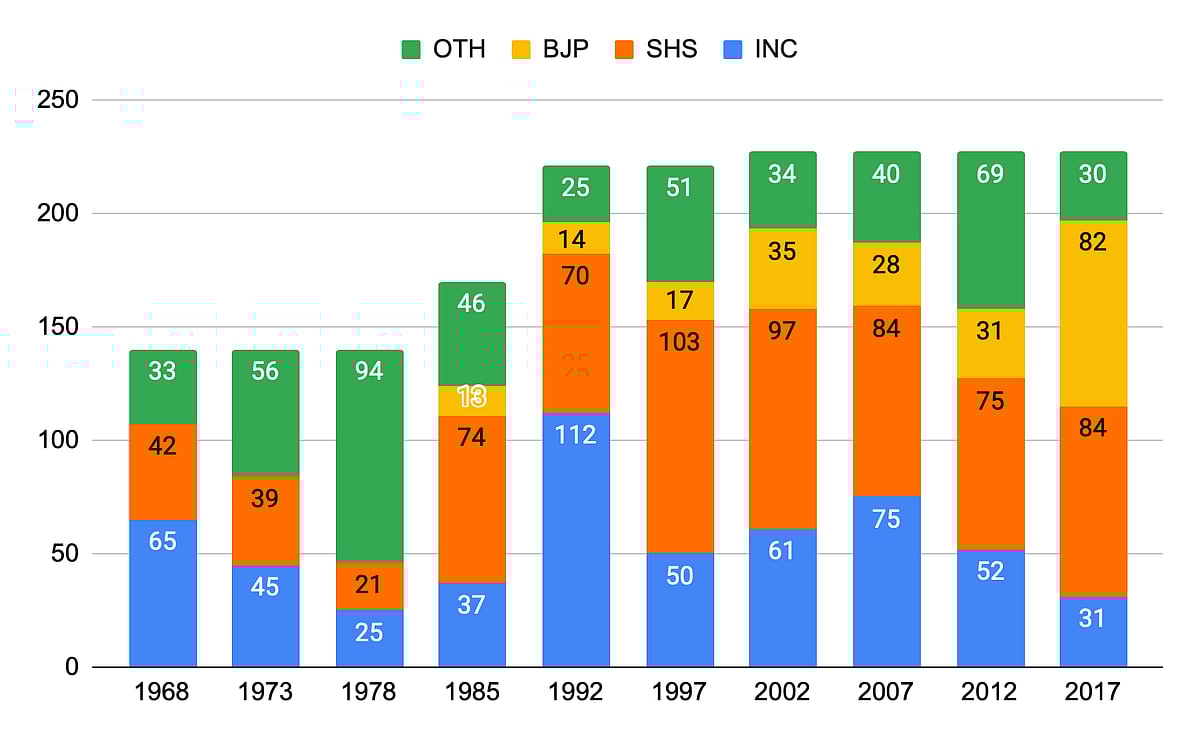
(Source: ECI)
The power dynamics between the two saffron allies underwent a seismic shift after the 2014 state elections when the BJP emerged as the single largest party, thus becoming the elder brother in the alliance. This reversal of fortunes marked the beginning of trust deficit between BJP and Sena.
ALSO READ
BMC Election 2026: Safety To Sanitation — What Mumbai’s Voters Want Fixed Before Anything Else
Demographic Transformation of Mumbai
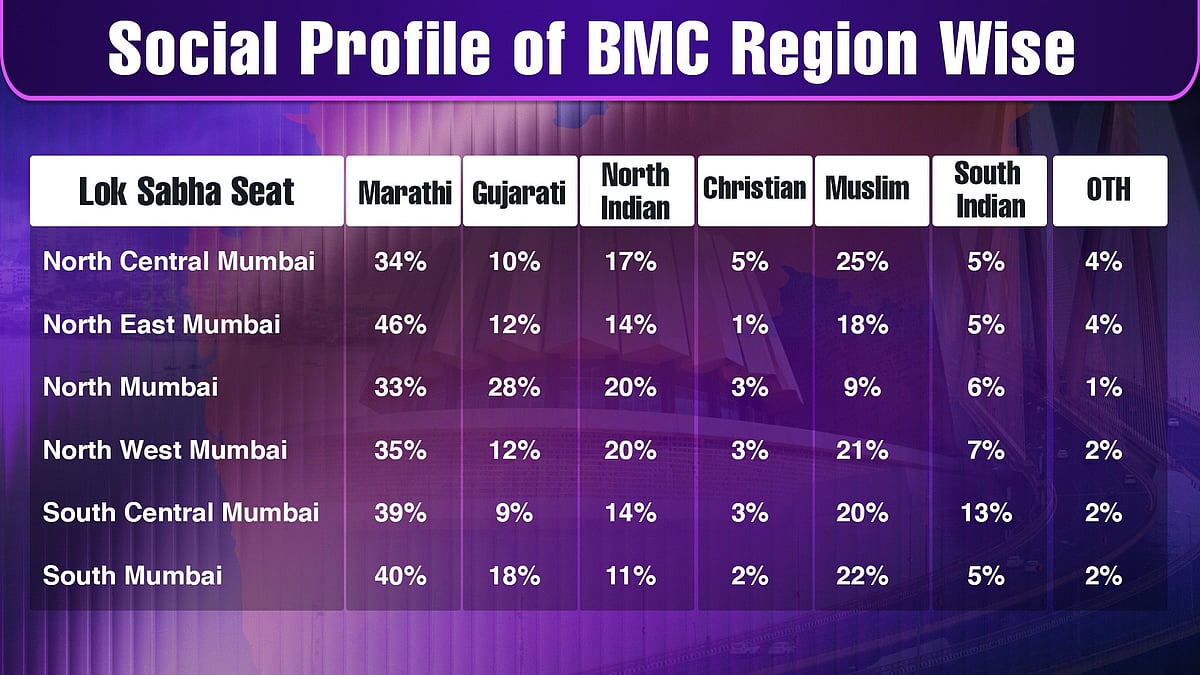
The changing demography of Mumbai presents perhaps the most significant long-term challenge to the Thackerays' political dominance. The proportion of Marathi speakers in the city has witnessed a steady decline over seven decades, falling from 44% in 1951 to just 36% in 2011.
Mumbai hosts the highest Muslim population in Maharashtra at 21%, while simultaneously having the lowest Scheduled Caste population at just 6%.
Electoral Performance Reflects Demographics, Rise of BJP
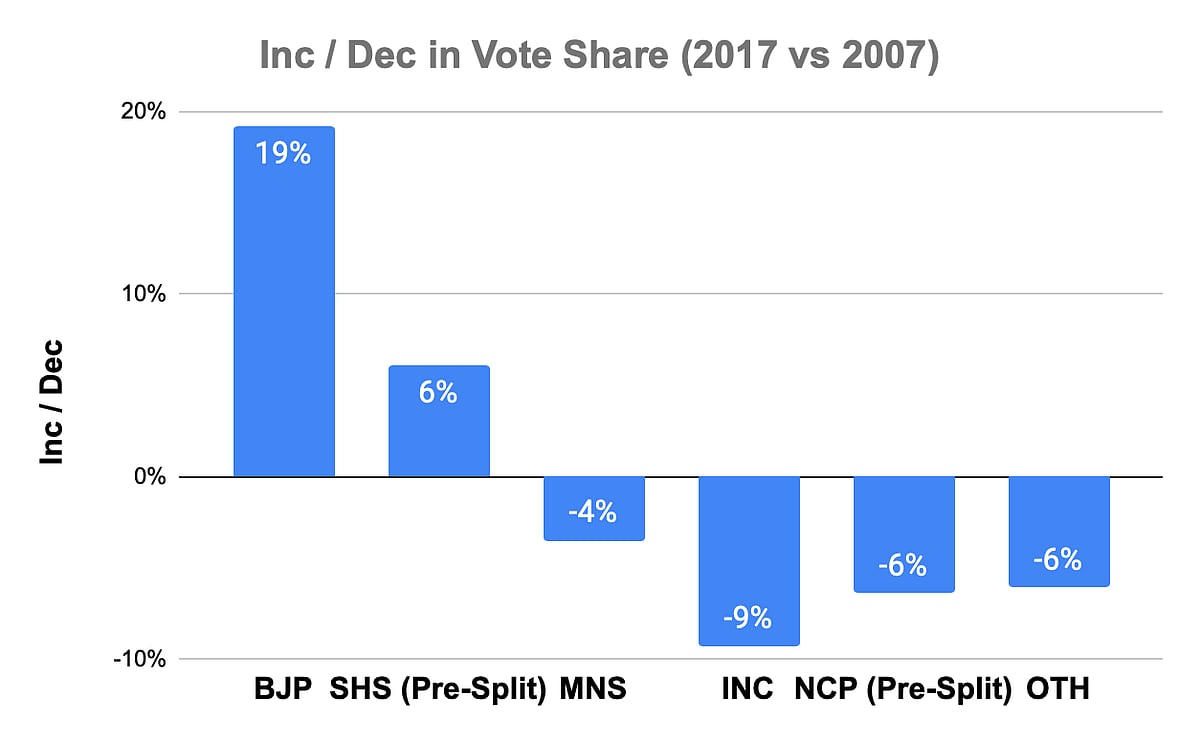
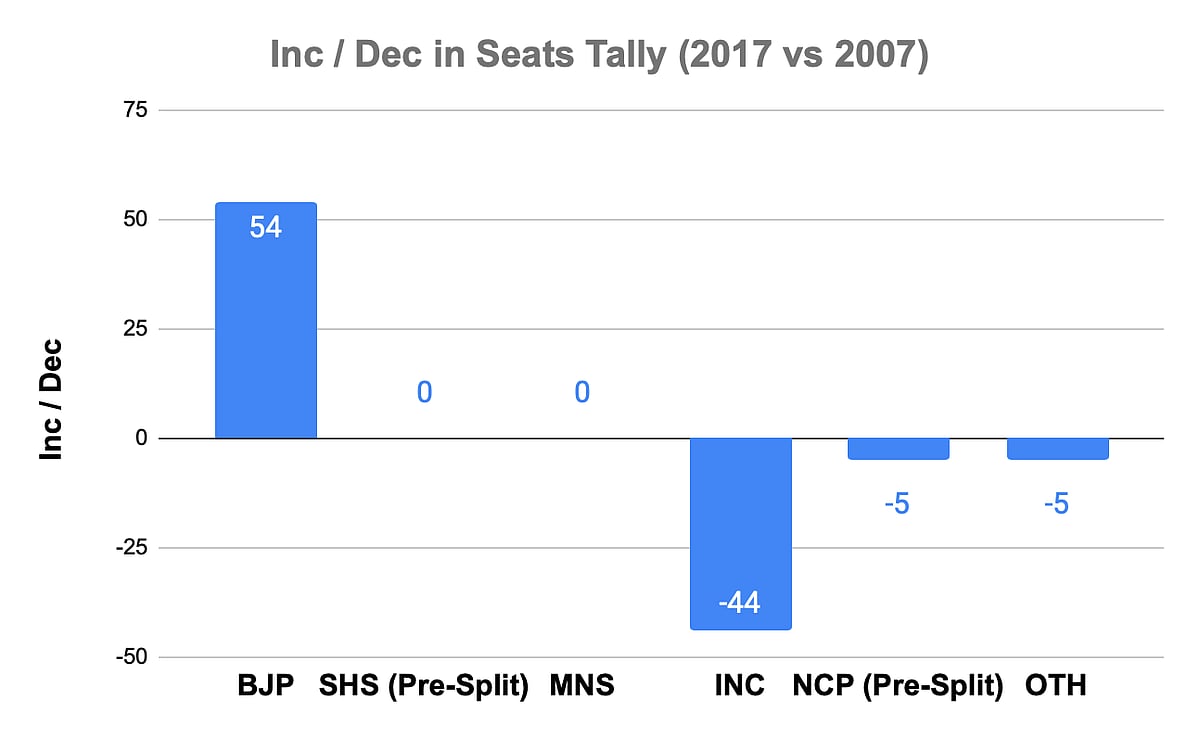
The BJP won 28 seats in 2007 with 8% vote share, which rose to 31 seats/9% vote share in 2012. In both these elections, it contested in alliance with the Shiv Sena. In 2017 elections, it contested alone, bagging 82 seats, recording 27% vote share, while Shiv Sena won 84 seats with 28% vote share. This coincided with the emergence of the Modi era, catapulting BJP at the expense of the Congress at national/state level and in the BMC.
The 2017 BMC election results also mirrored the changes in demographic patterns with remarkable precision. Of the BJP's 82 seats, 43 came from North Mumbai (dominated by Gujaratis) and North West Mumbai (with substantial North Indian presence). Meanwhile, the Shiv Sena's 44 of 84 seats were heavily concentrated in North East Mumbai, South Mumbai, and South Central Mumbai — all regions with high Marathi populations.
BJP's Gains in BMC: At Whose Expense?
The 2022 Split; The 2024 Rout
The Shiv Sena split in 2022 dealt a devastating blow to Uddhav Thackeray's political fortunes. When Eknath Shinde led a rebellion and subsequently received recognition as the official Shiv Sena from the Election Commission of India, it fractured not just the party organization but also its traditional vote bank. The split represented more than a political divorce; it was a contest over the legacy of Balasaheb Thackeray himself.
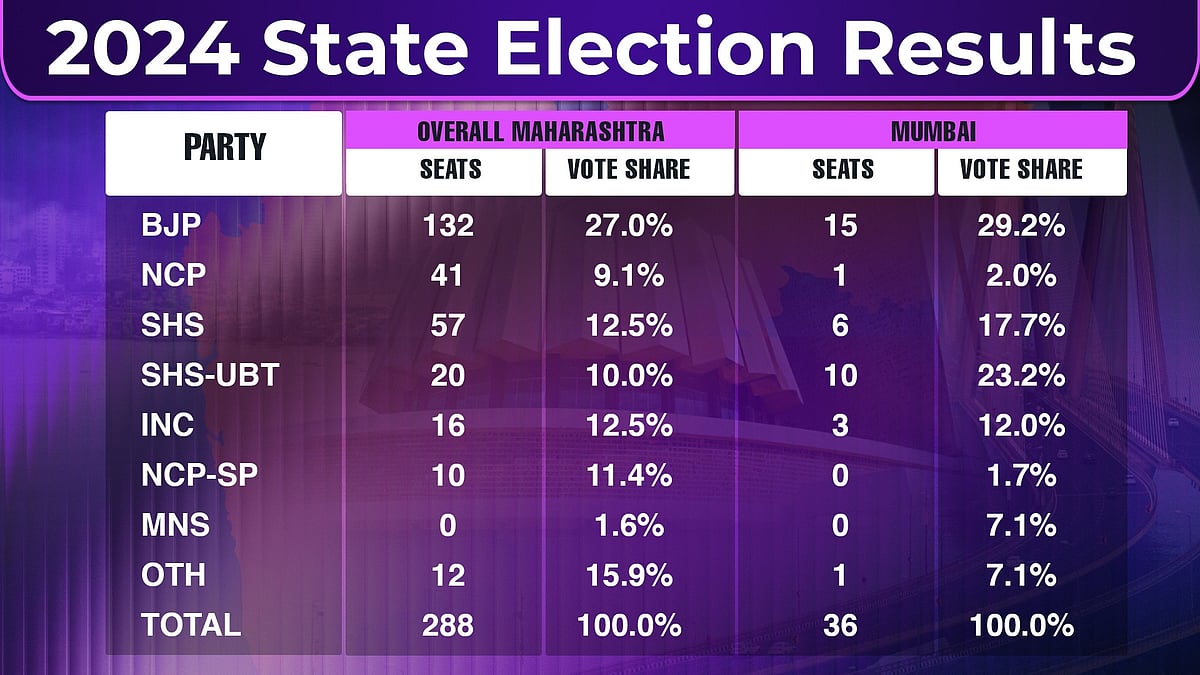
The 2024 assembly elections was a big setback for Uddhav after having won the general elections. As part of the Maha Vikas Aghadi alliance, the Shiv Sena (UBT) faction witnessed a comprehensive rout as the Mahayuti coalition secured a three-fourths majority statewide. In the Mumbai zone corresponding to BMC's jurisdiction, Mahayuti won 22 of 36 seats, underscoring the magnitude of the Thackerays' political decline.
ALSO READ
BMC Election 2026: Why Are Marathi Manoos The Most Engaged And Most Unhappy Voters In Mumbai?
The Brothers Unite: A Last Stand
In response to these existential threats, the Thackeray brothers — Uddhav and Raj — have joined hands to reclaim Balasaheb's legacy and re-establish themselves as the authentic voice of the Marathi Manoos. This alliance represents a significant political realignment, bringing together two brothers who had been political rivals for years, banking on emotional appeals to Marathi pride and identity. Had the two brothers fought together in 2017, they would have won 118 seats, four more than the majority.
Despite the bleak overall picture, the Thackerays can point to some encouraging signs. While Shiv Sena (UBT) and MNS performed poorly across Maharashtra, garnering 10% and less than 2% vote share respectively, they fared considerably better in Mumbai with 23% and 7% vote shares.
Of the 20 seats won by Shiv Sena (UBT) statewide, half came from Mumbai itself, demonstrating that the party retains considerable influence among the city's Marathi population. Of the 11 Uddhav versus Shinde contests, Uddhav won six in the city.
The Muslim Vote: A Double-Edged Sword
However, this performance came with an important caveat. Part of the success was attributable to Muslim community support, as the party contested alongside Congress and the NCP in alliance.
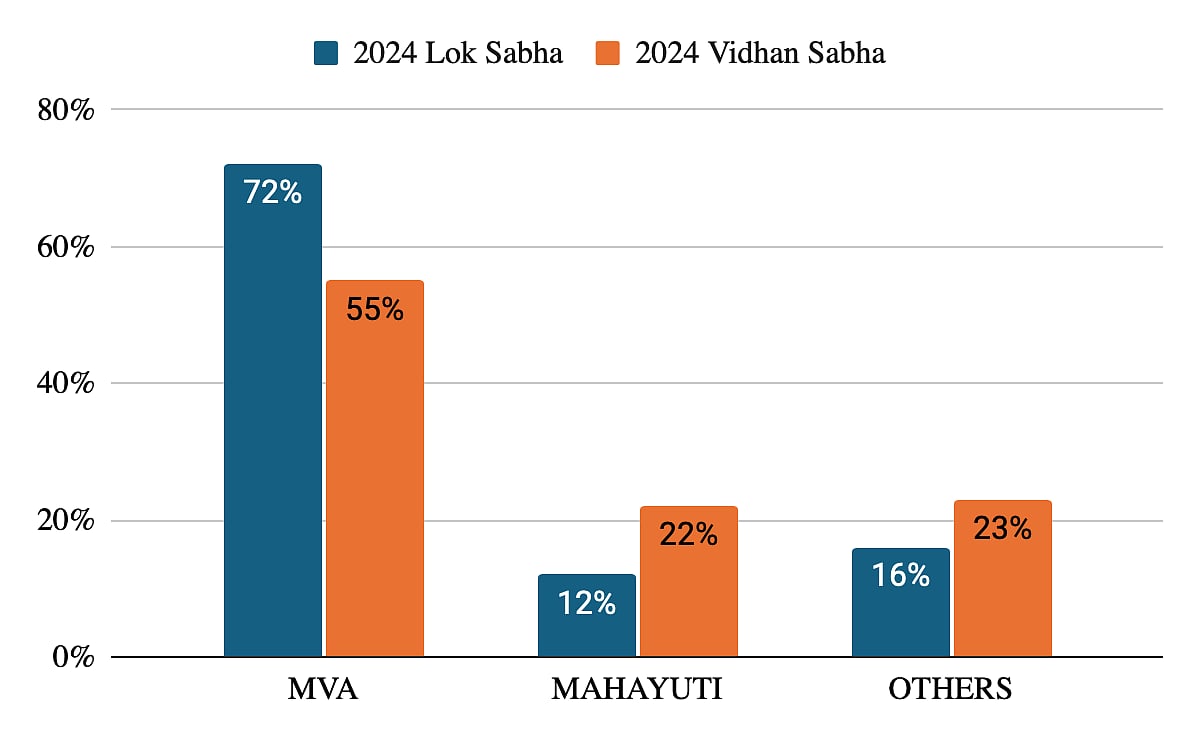
According to CSDS data, 72% of the Muslims backed the MVA in 2024. The critical question now is whether Muslims will continue supporting the Thackeray brothers after they've broken ranks with the Congress.
Voting Pattern of Muslim Community
(Source: CSDS)
Alternative options like Samajwadi Party and the AIMIM have established support in certain pockets, potentially fragmenting the Muslim vote. The Thackerays' strategy appears to hinge on consolidating Muslim and Marathi votes, which together constitute approximately 60% of Mumbai's population.
The Urban Apathy & Turnout Conundrum
Of the 92 lakh voters in 2017, only 51 lakh voted; a turnout of 55%. That's still low. The overall TO increased by 10%, highest in 25 years. Female turnout was more than males by 2.5% even in BMC, in line with the trend of many states. This time around there are 1.03 crore voters. It is generally noticed that turnout in slum areas is higher than building societies.
Almost half each of Mumbai’s population lives in slums and building societies. The BJP is believed to have a stronger presence in building societies than slums. If for any reason, there is lower turnout in societies or comparatively much higher in slums, then it could upset all calculations of parties.
Hyperlocal Elections turned Presidential?
The delay of around four years in elections, scheduled in 2022, happening in 2026, risks making the corporators irrelevant for a large section of the voting populace.
The BMC has been functioning, if not better, not worse, even without corporators on the ground, with their terms expiring in 2022. This means for many voters, the main consideration could be leadership or party loyalties, thus reducing the local nature of polls.
The Thackerays face a perfect storm of challenges: declining Marathi demographics, a fractured party organization, the loss of their alliance with Congress, and an ascendant BJP-Shinde Sena coalition. While the emotional appeal of Marathi pride and the Balasaheb legacy remains potent, whether it will be sufficient to overcome the mathematical realities of Mumbai's transformed electoral landscape, remains to be seen.
The upcoming BMC elections will determine whether the Thackeray brothers' reunion represents a genuine political revival or merely the last chapter in a storied political dynasty's decline. The battle for Mumbai has never been more uncertain, and the Thackerays have never faced longer odds.
Disclaimer: The views expressed in this article are solely those of the author and do not necessarily reflect the opinion of NDTV Profit or its affiliates. NDTV Profit does not guarantee the accuracy, completeness, or reliability of the information presented in this article.