

India's Soft Power Paradox: Culturally Strong, Strategically Underinvested | The Reason Why
China and South Korea are actively issuing new cultural instruments, whereas India has lagged. In that sense, India is culturally rich but strategically underinvested.



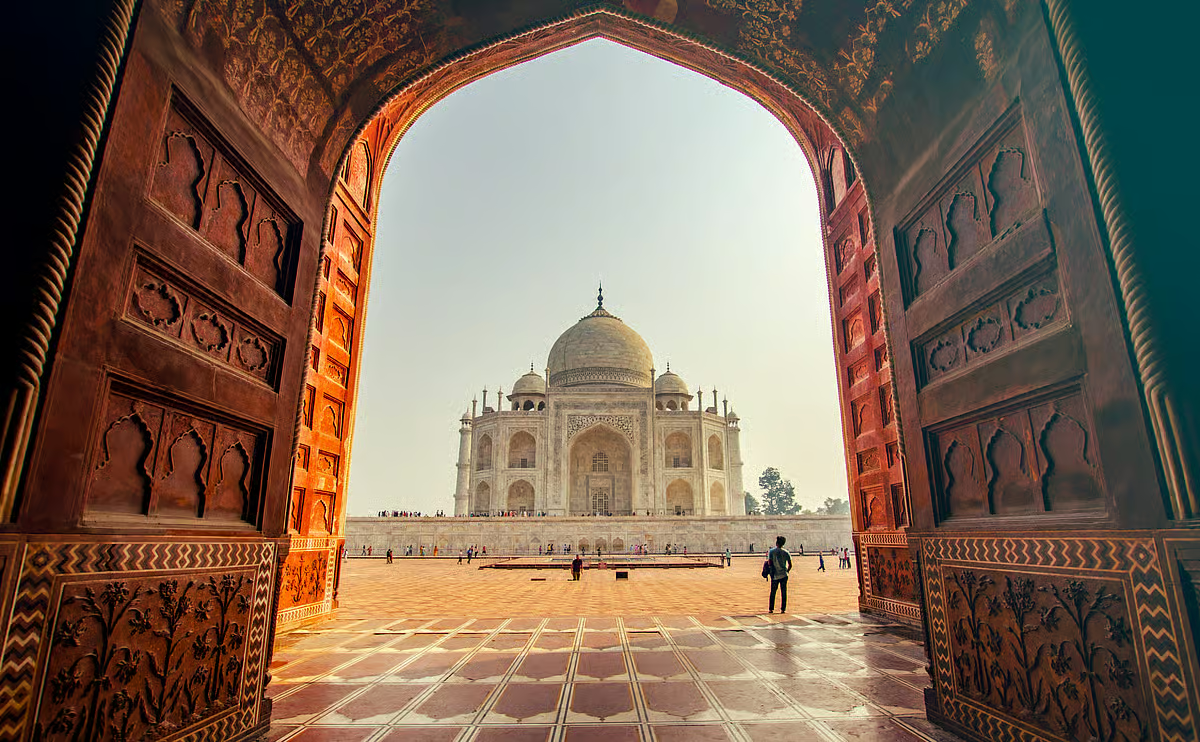
India today is more economically confident and geopolitically relevant than it has been in decades. Yet culturally, it feels less magnetic. This paradox sits at the heart of India’s soft power challenge.
India’s soft power conversation begins with its ancient civilisation. Pluralism, religious tolerance, yoga, hospitality, warmth, Bollywood, food, music, English-speaking ability, and diaspora have always attracted the world. Much of this is true.
But in a world where attention moves faster than memory, cultural inheritance alone is not enough. We can see how China and South Korea are actively issuing new cultural instruments, whereas India has lagged. In that sense, India is culturally rich but strategically underinvested.
India Remains Popular
The world seems to have gone mad over matcha and gochujang. It almost feels like India missed the bus. Except India was on that route centuries ago — long before hashtags and food reels decided global taste. Indian restaurants are everywhere, so much so that you can find British families relishing butter chicken and the naan bread in London.
Long before that, Indian spices had reached every corner through colonialism. A large diaspora in the US, Europe and the Gulf made Bollywood popular. Even today, in many small cities abroad, the moment people hear you are from India, the first name they mention is ‘Shah Rukh Khan’. Yoga and Ayurveda had already gone mainstream centuries ago, travelling the world on their own.
All of this has happened organically – and that is India’s strength. But it also comes with a weakness: when tastes change, organic systems adapt slowly. Popularity remains, but momentum fades.
How Korea Turned Culture Into An Ecosystem
This is where South Korea offers a useful contrast.
After the Asian Financial Crisis, South Korea diversified away from heavy industry into cultural production. The Hallyu Industry Support Development Plan started in 1998 under President Kim Dae-jung. By 2010, cultural influence was recognised as soft power.
The Korean wave evolved in phases. The first phase (1997–mid-2000s) relied on television to spread dramas, movies, and music across Asia. In the second wave (mid-2000s–early 2010s), YouTube and social media helped it go global. The current phase goes beyond music and dramas, extending into gaming, beauty, fashion, food, and lifestyle.
Emotional Connect Matters More
This wave is the result of quality content and not mere government support and production quality. Many K-dramas centre around professions such as lawyers, doctors, and corporate executives, allowing viewers across countries to relate, even as the cultural texture remains Korean.
South Korea’s Ministry of Culture doesn’t write BTS lyrics or the script of a K-drama. But it ensures that Korean cultural products reach everywhere and spill over into tourism, food, fashion, and even learning the Korean language.
India doesn’t have such a strong portfolio today.
Fatigue Has Set In From Indian Cinema to Tourism
Global audiences now seek authenticity — stories that feel locally rooted yet emotionally global.
Hindi cinema, by contrast, has turned inward. Its narratives increasingly speak to domestic political moods, star fandoms, or worlds unrelated to the Indian lifestyle. South Indian cinema can be said to be the Indian version of K-dramas and movies. But it is still being discovered within India rather than becoming a global cultural habit.
A similar fatigue is visible in tourism. India once benefited from a similar wave of curiosity. Beyond the Taj Mahal, places like Varanasi, Puri, Goa, Manali, Dharamshala and later Kerala and Rajasthan became magnets for globetrotters. That momentum has slowed.
Today, unfortunately, safety concerns, pollution, and infrastructure make travelling within India exhausting. I have lost count of how many times fellow women travellers have said this: “We want to visit India, but it feels unsafe.” And as much as I want to argue, I cannot dismiss the unease I sense even while travelling with my wife.
We cannot telltale about India’s greatness and soft power when you have to put in efforts to make it look attractive to a foreigner.
China's Soft Power: Spectacle Without Trust
China’s approach is the opposite of India’s. Soft power is a state project, just like Korea, but more controlled. Confucius Institutes, global broadcasting, cultural exchange programmes, outbound tourism, influencer diplomacy, and massive investment in cultural IP are all deliberate strategies.
But it has limits. A Nature-published study finds that while China promotes culture aggressively, audiences can get the propaganda, producing negative cognitive reactions and reducing its persuasive power.
Yet dismissing it as a failure would be a mistake. The consumer market is making breakthroughs. The Economist notes how brands like Pop Mart’s Labubu and video games like Black Myth: Wukong became global hits and calls them ‘just the beginning’ of Chinese cultural exports. Even cities like Chongqing have gone viral, driving tourism interest. Frankly, I am intrigued by this city and would definitely like to visit someday.
Soft Power Cannot Replace Diplomacy
But there is a hard limit to soft power, too. China’s cultural appeal collapses where coercion enters the picture. Taiwan is the clearest example. Despite decades of media and exchange, Taiwanese have grown more resentful of China. Thus, China shows both what India should learn and what it should avoid.
South Korea faces similar limits with Japan. Despite the massive popularity of K-pop and Korean films, Japanese attitudes toward South Korea remain deeply negative due to unresolved historical and territorial disputes. Japanese media have repeatedly highlighted the darker side of Korean cultural success.
Headlines like “Parasite Celebrations Tiptoe Around Brutal Message” or “K-pop Deaths Highlight South Korea’s Desperation for Soft Power” underline how cultural admiration does not translate into political alignment.
So, soft power cannot substitute diplomacy and people-to-people interaction.
India Doesn't Import People
This is where India has a quiet advantage. India enjoys relatively good diplomatic relations with many countries and exports labour at scale. IT professionals, doctors, nurses, construction workers, students, entrepreneurs, neighbours, and co-workers are India’s strongest soft power assets. Everyday interaction humanises India more effectively than any campaign.
Yet India hosts very few foreign students and professionals. Its universities barely feature on global student shortlists. Work visa systems are complex and restrictive. Indian cities have not positioned themselves as cultural destinations. The G20 presidency briefly gestured in this direction, but it was temporary.
Let's Make India Cool
India has several things going for it. Indians are seen as warm, the culture as non-threatening, and the economic story as credible. But soft power is about attraction – whether people want to come, stay, work, study, interact, and whether it feels ‘cool’ in a contemporary sense.
India does not need cultural nationalism or state-scripted creativity. But it does need an environment that feels safe, navigable, and exciting. Cleaner cities, better infrastructure, less censorship, more creative freedom, global platforms for Indian art and cinema, stronger consumer brands, safer public spaces for women and visitors, and deeper people-to-people exchanges would do far more for India’s soft power than any government scheme.
Ultimately, India’s potential lies in sharing its story with confidence and inviting the world to experience it.
Disclaimer: The views expressed in this article are solely those of the author and do not necessarily reflect the opinion of NDTV Profit or its affiliates. Readers are advised to conduct their own research or consult a qualified professional before making any investment or business decisions. NDTV Profit does not guarantee the accuracy, completeness, or reliability of the information presented in this article.