India's IPO Market Is Busy. It's Also Broken
(Bloomberg Opinion) -- India is one of the world's busiest markets for initial public offerings. It has had more companies debuting over the past year than China and Japan, combined. But if history is any guide, in the long run, most of them will turn out to be duds.
Yet, such is the attraction of the “pop” — large listing-day returns — that this fever won't abate.
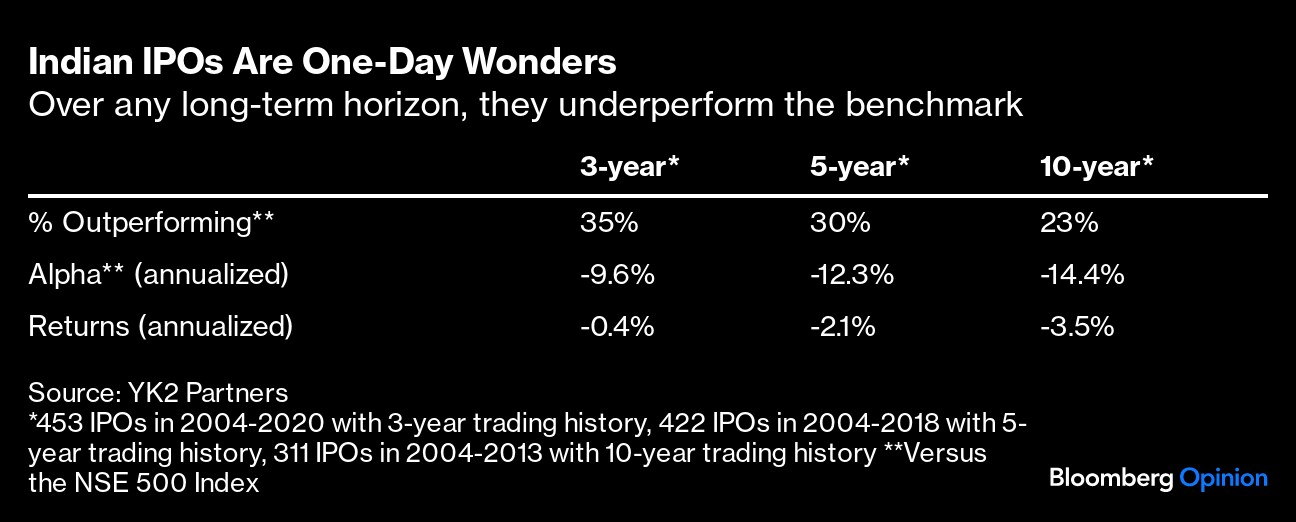
Something is badly broken. YK2 Partners, a boutique firm that invests only in Indian public markets, has done the math for two decades of initial fundraising by the country's firms. Analysts at Mumbai- and London-based YK2 considered all the 300-plus mainboard issuances since January 2004 with a 10-year trading history. The average IPO in this set has returned -3.5% a year, according to their calculations, turning a 100-rupee ($1.2) investment into 70 rupees a decade later.
It doesn't matter whether they listed in 2004 or 2013, or any year in between. Indian IPOs have failed miserably at generating additional returns for investors over what they would have earned passively from just owning a broad benchmark. About 77% have underperformed the NSE500 Index over a 10-year period, with average underperformance of more than 14% annually. In other words, the 100 rupees not invested in debutants could have, with very little effort, become 280 rupees.
“We cynically characterize the IPO process as a scheme orchestrated by management, private equity investors, anchor investors, investment bankers, media, etc.,” YK2's co-founders Arun Agarwal and Vinod Nair, wrote in a note accompanying their research. “It might make sense for investors looking for an IPO pop but not for long term investors like us.”
It's the regulator's job to ensure that companies with reasonably solid prospects come to public markets and offer stock at a price that allows long-term wealth creation. That the local IPO market is falling far short of this ideal is something the Securities and Exchange Board of India has been aware for a long time. Yet, some of the steps that the SEBI has attempted or contemplated proved too contentious.
One of them was grading of IPOs (similar to credit rating for bonds). Made mandatory from 2007, grading became optional in 2014 amid intense lobbying. Another idea was to let retail investors return stock to the controlling shareholders at the issue price after three months of significant underperformance. This safety net was considered for years and then dropped.
But it should still be possible to improve the quality of the primary capital market. Clearly, the current disclosures-based pricing regime is not up to dealing with the challenge. Just a couple of months ago, Madhabi Puri Buch, the SEBI chair, said that often the justification supplied by companies for high IPO valuations was “nothing but some meaningless English words.”
There may be a simple reason why verbiage can so easily masquerade as value: The average IPO delivers an average 25% listing-day gain, and India's rich have a savings glut. Ben Bernanke, the former Federal Reserve chairman, has in the past held a “global savings glut” — a pool of capital flowing out of China and oil-producing nations — responsible for low interest rates. In India's case, it's capital controls that put a limit on how much the affluent class can invest overseas. Any excess of local savings ends up chasing domestic assets, from real estate to IPOs.
Property transactions have some inertia built into them, but punts on IPOs are very quickly flipped. That explains the average oversubscription of 44 times in recent years. So how to throw some sand into the wheel? The SEBI chief said Friday that the regulator is investigating investment banks that artificially inflate share applications to create a false impression of demand.
Cleaning up the market is a good first step, but it won't be enough. YK2's Agarwal suggests that the SEBI should consider a mandatory lock-in period of one year for all IPO investors so that subscription is driven by fundamentals and not the lure of a pop. More disclosures will be just more words. They can't break this nexus of unusual demand and opportunistic supply. Only more skin in the game can.
More From Bloomberg Opinion:
- India's Markets Becoming an Inexorable Force: Matthew Winkler
- Modi's Sledgehammer Politics Are Battering India: Mihir Sharma
- World's Most-Loved Emerging Market Feels Jittery: Andy Mukherjee
This column does not necessarily reflect the opinion of the editorial board or Bloomberg LP and its owners.
Andy Mukherjee is a Bloomberg Opinion columnist covering industrial companies and financial services in Asia. Previously, he worked for Reuters, the Straits Times and Bloomberg News.
More stories like this are available on bloomberg.com/opinion
©2024 Bloomberg L.P.

-
Indians Are Travelling, But Not Every Journey Is A Holiday | The Week In Whys

Pilgrims, patients and working women are the real travellers, and the system hasn't quite caught up with them.
-
Getting To Work Costs Women More | The Reason Why
It is not just about women paying more than men. It is about women paying much more in cities than in villages.
-
AI Bias In Investing Cannot Be Eliminated, But It Can Be Governed
Framing is a particularly important example as identical financial information presented in terms of gains rather than losses can lead an LLM to reach a different assessment.
-
Joining The Dots | Dark Skies, Steady Diya: Why Hope Holds This Diwali
With war, a weak rupee and foreign outflows weighing on sentiment, policymakers at the NDTV World Summit and market veterans at NDTV Profit Ignite: Diwali Edition offered the same advice: stay invested and filter out the noise.
-
The Curious Case of Equitas Small Finance Bank And A CEO Who Quit For Stock
PN Vasudevan believes persistent investor concerns over a perceived conflict of interest had become a governance overhang on Equitas Small Finance Bank's stock, even as the lender improved profitability and asset quality.
-
Talking Points This Week: AI Cash Burn, A Tiger Comeback And An India That Still Finds Its Own Path
India is not immune to higher oil or tighter global liquidity, yet its earnings base is broader, its domestic policy levers are still available.
-
Foreign Investors Own Half Of HDFC Bank and ICICI Bank. An LTCG Cut Could Matter Most Here
Foreign portfolio investors have US$115 billion parked in HDFC Bank, ICICI Bank. If the government cuts long-term capital gains tax, Jefferies says returning foreign money could land here first.
-
'Never Seen This Level Of Negativity': Sandeep Tandon Says The Next Rally May Be Closer Than You Think
Veteran investor Sandeep Tandon says foreign selling is easing, large-caps are due a comeback and mid-caps are crowded, while he turns positive on gold, power and pharma this Diwali.
-
Indians Stay With Family, Not In Hotels | The Reason Why
India still lacks enough clean, reliable and affordable hotels for budget-conscious travellers.
-
The Economic Imperative: Analysing The Material Driving Force Behind India-Canada Strategic Reset
This economic complementarity is further reinforced by deep institutional investment ties and talent mobility, which form the bedrock of the bilateral framework.










