

Renowned Ecologist Madhav Gadgil, Guardian Of Western Ghats, Dies At 83: A Look At His Life And Work
Gadgil was widely celebrated for promoting sustainable development and received the United Nations Environment Programme’s 'Champions of the Earth' award in 2024.



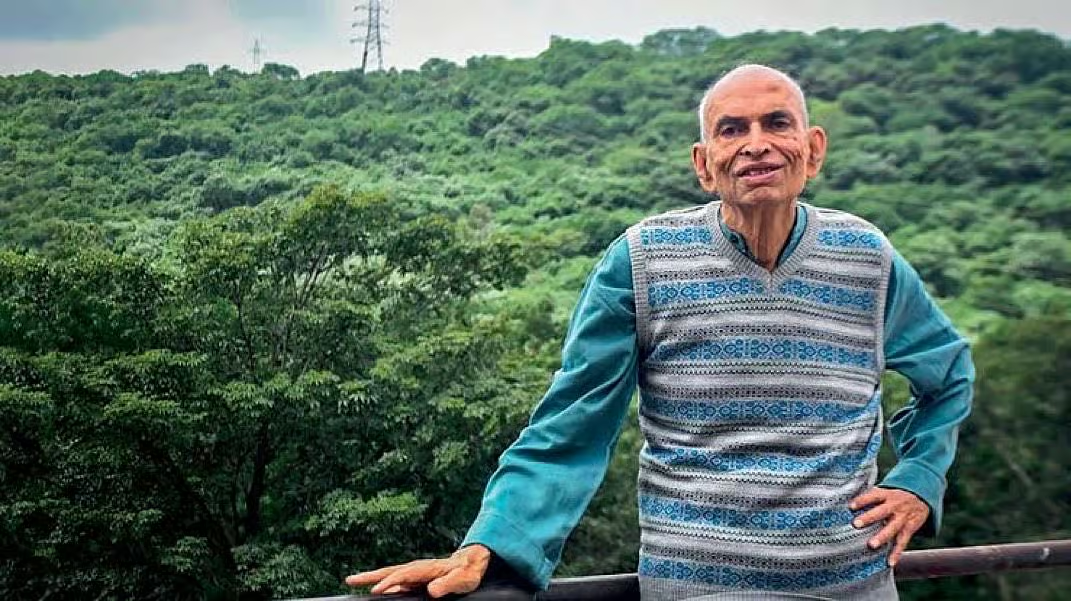
Renowned ecologist Madhav Gadgil, one of the architects of India’s Biological Diversity Act, passed away at 83 on Wednesday. His report as head of the Gadgil Commission is known for recommending provisions to protect the fragile Western Ghats.
Gadgil was widely celebrated for promoting sustainable development and received the United Nations Environment Programme’s 'Champions of the Earth' award in 2024.
Best known for chairing the Western Ghats Ecology Expert Panel, he was appointed as head of the Gadgil Commission in 2010 by the Union government. The panel’s report recommended strict safeguards for the fragile Western Ghats. The report sparked intense political and public debate across six states.
Life of Madhav Gadgil
Born in Pune, Maharashtra in May 1942, Gadgil earned his Ph.D. from Harvard University in 1969. He served as Professor at the Centre for Ecological Sciences, Indian Institute of Science (IISc), Bangalore, from 1981 to 2004.
One early memory that shaped him as a sustainable development advocate was visiting a hydroelectric project with his father, and witnessing rampant deforestation there, according to the UN website.
“My father said to me: ‘We need this electricity, and we need India to progress industrially. But should we be paying the price, which is environmental destruction and suffering for local people?...' This empathy for people, along with a love of nature, was imbued in me at a very young age,” Gadgil had told the international organisation at the time of receiving his award.
Over his six-decade career, Gadgil always saw himself as a “people’s scientist.” He has authored seven books and over 225 papers, including his landmark Gadgil Report, which calls for protection of the fragile Western Ghats.
During his time at the Indian Institute of Science, he founded the Centre for Ecological Sciences. He helped establish India’s first biosphere reserve in 1986, the Nilgiri Biosphere Reserve.
Gadgil played a key role in India’s Biological Diversity Act and Forest Rights Act. This enabled a systematic approach toward monitoring biodiversity and managing resources sustainably.
Gadgil’s lifelong contributions to ecology earned him India’s highest civilian honours, including the Padma Shri and Padma Bhushan. He is also the recipient of international accolades like the Tyler Prize for Environmental Achievement and the Volvo Environment Prize.
Even in his last years, Gadgil continued to advocate for environmental conservation, emerging as an inspiring figure for India’s youth, ecologists and policymakers.