

Calling For Reforms: Cities Are India’s Next Big Crisis, Warns PM-EAC's Sanjeev Sanyal
The problem, Sanyal argues, is not a lack of urban planning, but an over-reliance on rigid master plans that try to lock cities into static futures.



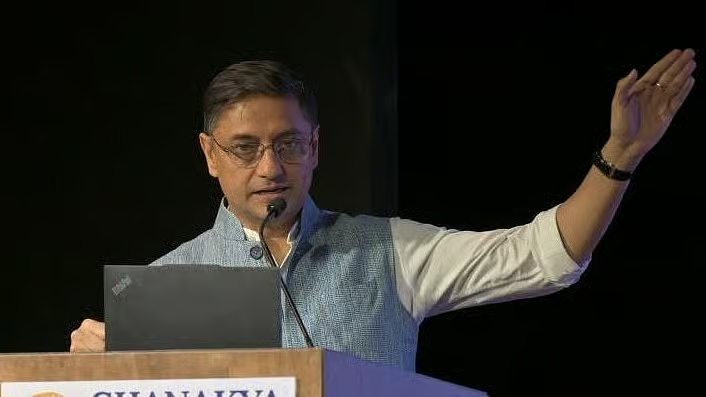
For a long time, India explained away broken footpaths, overflowing garbage bins, traffic anarchy and toxic air with a single line — we are poor. That argument, says economist and member of Prime Minister's Economic Advisory Council Sanjeev Sanyal, no longer works.
According to Sanyal, in a video interview with ANI, this gap between economic progress and urban quality of life is no longer a side issue. It is one of the most critical reforms India must confront next, second only to fixing the judicial system.
"Thirty-five years ago, I used to think our cities were badly run because we were a poor country," Sanyal says. "But now, 35 years later, we are certainly richer — and our cities have not really improved."
ALSO READ
UPSC A 'Complete Waste Of Time': Sanjeev Sanyal On Degree-Based Education With Advent Of AI
Why India’s Cities Keep Falling Behind
The problem, Sanyal argues, is not a lack of urban planning, but an over-reliance on rigid master plans that try to lock cities into static futures.
Indian urban plans often involve zoning maps and long-range projections that assume today’s economic structure will hold for decades. In reality, cities are constantly reshaped by new industries, migration, changing work patterns and technology.
As Sanyal quipped, "If you know which industry is going to grow over the next 30 years, you shouldn’t be in town planning — you should be in the stock market."
Instead of predicting outcomes, he argues, governments should focus on managing transitions — ensuring services, mobility and public spaces keep pace as cities change in unpredictable ways.
Gurugram And The Case For Organic Growth
The rise of Gurugram illustrates this argument uncomfortably well. Few planners in the early 1990s would have designed it as India’s corporate hub. Yet it emerged precisely because economic activity was allowed to cluster and expand without being constrained by an inflexible blueprint.
Sanyal’s point is not that rule-breaking is desirable, but that cities cannot be 'finished products.' He says that all living cities evolve through continuous upgradation and management of transitions.
Over-planned cities, by contrast, often struggle to accommodate new forms of work or dense commercial activity because their layouts were frozen too early.
Walkability: The Missing Foundation
Perhaps Sanyal’s sharpest critique is reserved for how Indian cities approach mobility. Even where large investments have been made in metros and flyovers, everyday movement remains hostile to pedestrians.
The core issue, he argues, is that urban transport policy ignores the most basic mode of travel. "All public transport has to be based on the last mile being walking," Sanyal says. "And yet we don’t invest in sidewalks."
The result is familiar: metro stations that open into chaos, pedestrians forced onto roads, and road widening projects that actually squeeze footpaths further. Without safe, continuous walking infrastructure, public transport struggles to work efficiently — pushing more people toward private vehicles, thereby worsening congestion and pollution.
Pollution And Waste: Failures Of Governance
On air quality and waste management, Sanyal is unsentimental. India’s urban pollution crisis, he argues, persists not because solutions are unknown, but because basic municipal functions are poorly executed.
"Removing garbage doesn’t need great imagination," he says. "If there is a city, it needs garbage removal."
Examples like Indore show that cleaner cities are possible within existing administrative systems — when civic priorities are clearly set and followed through.
A Reform That Can’t Wait
Sanyal’s broader warning is that badly run cities will increasingly act as a brake on India’s growth — affecting productivity, public health and even social stability.
Urban reform, he stresses, is not about grand visions or perfect plans, but about day-to-day governance that keeps pace with how cities actually function.