

India Defends Artistic Freedom, Counters China's Criticism On 'Battle of Galwan'
Battle of Galwan is based on the deadly June 2020 clash in eastern Ladakh. In the film, Salman Khan portrays Colonel Bikkumalla Santosh Babu of the 16 Bihar Regiment, who died leading Indian troops.



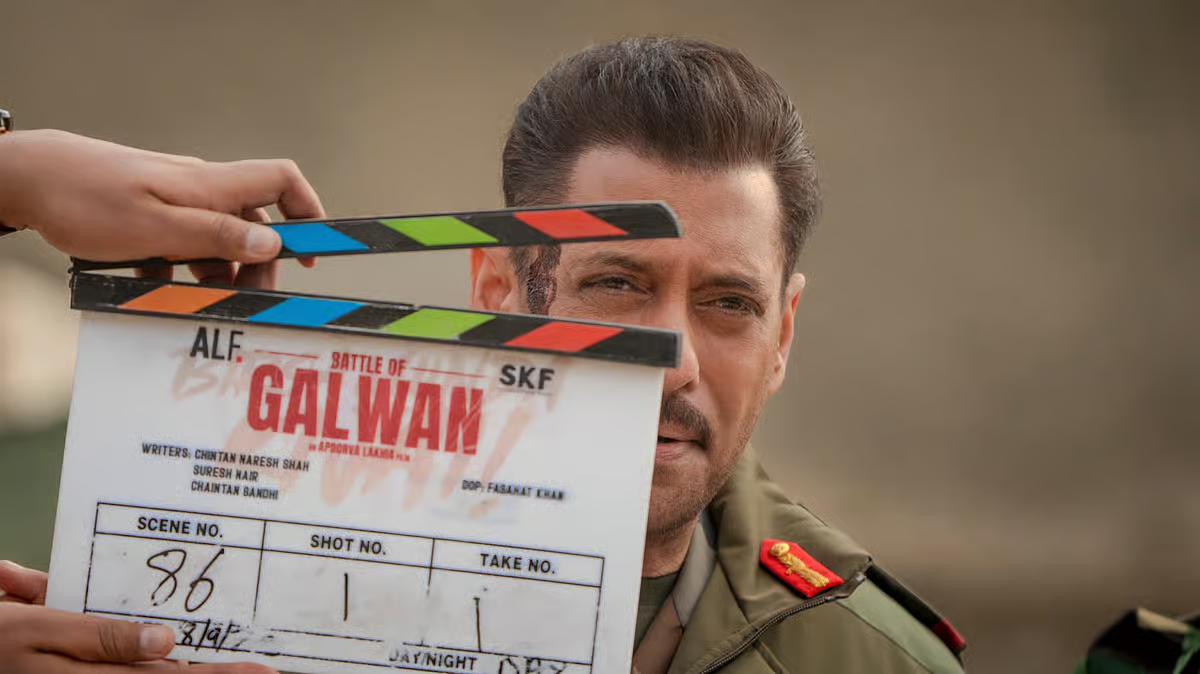
India has rebuffed criticism from Chinese state media regarding the upcoming film Battle of Galwan, reaffirming that artistic freedom is non-negotiable, government sources told NDTV.
Beijing’s Global Times had denounced the Salman Khan-starrer, accusing it of “distorting facts” about the 2020 Galwan Valley clash between Indian and Chinese forces. Indian officials emphasised that filmmakers in India operate without governmental interference.
A source cited by NDTV stated, “India is a country with freedom of expression, and cinematic expression is an integral part of it. Indian filmmakers are free to make films as per this artistic freedom.”
They also made clear that the government had no involvement in the film’s production. Anyone seeking clarifications was advised to approach the Ministry of Defence, not filmmakers or the government.
Battle of Galwan is based on the deadly June 2020 confrontation in eastern Ladakh. In the film, Salman Khan portrays Colonel Bikkumalla Santosh Babu of the 16 Bihar Regiment, who died leading Indian troops.
India officially reported 20 soldiers killed, while China later acknowledged four casualties, a figure disputed by independent analysts.
In the wake of the clash, India–China relations deteriorated rapidly, prompting troop and equipment build-ups along the Line of Actual Control (LAC). Both nations engaged in prolonged diplomatic efforts to ease tensions.
Chinese media claimed the film’s narrative painted the Galwan Valley as being on the Chinese side of the LAC, and presented an “emotionally charged” version of events that did not align with factual accounts.