Wall Street Predicts Rebound In Indian Markets After Tough Year

After one of India's worst years of market underperformance in decades, some of the biggest names on Wall Street are calling for a rebound.
Morgan Stanley, Citigroup Inc. and Goldman Sachs Group Inc. are among those who expect the country's markets to claw back lost ground next year as earnings stabilise and policy support kicks in.
India's markets have trailed across assets. Stocks have lagged peers by the widest margin in more than three decades. The rupee is Asia's worst performer. Bonds remain under pressure from heavy government debt supply. US tariffs — the harshest in the region — have hit exporters' earnings and slowed dollar inflows, amplifying the strain.
Even so, early signs of a turn are emerging. Growth-supportive measures, combined with a pause in the long stretch of earnings downgrades, are improving sentiment. Investors are also positioning for a possible rotation out of the artificial intelligence trade, a move that could redirect foreign flows toward markets like India.
“A rebound appears increasingly likely in 2026,” said Angela Lan, senior strategist at State Street Investment Management, which has a neutral to slight overweight stance on India in its emerging market funds. “The earnings downgrade cycle is largely behind us, with recent policy measures — rate cuts and GST rationalisation — filtering through consumption and credit.”
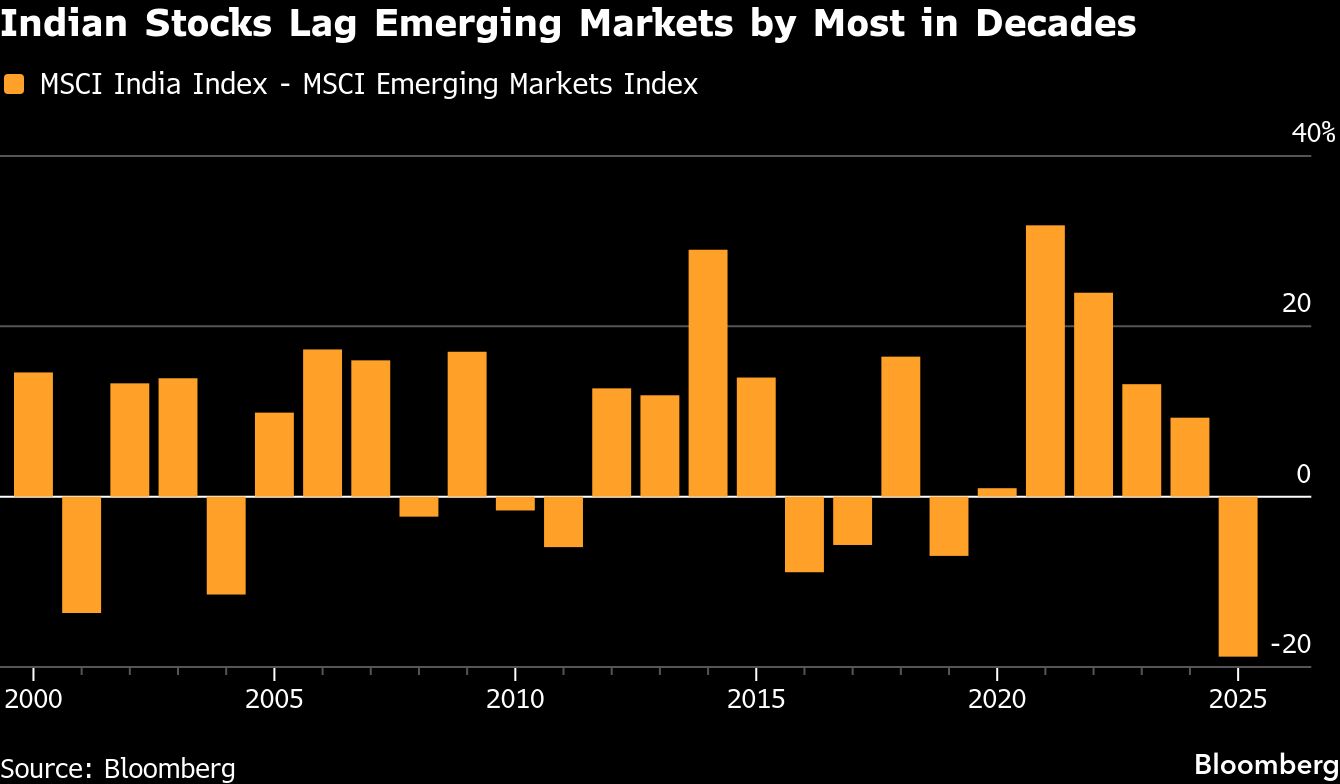
MSCI Inc's India gauge is up 8.2% this year, trailing the broader EM benchmark by the widest gap since 1993. If some of those AI gains start to look frothy, flows could shift back toward less tech-dependent markets like India, helping narrow the gap.
“The conversation around India remains as a potential refuge for money rotated out of North Asia,” Alexander Redman, chief global equity strategist at CLSA Ltd. said in an interview. The AI-trade will likely unwind in the first half of next year, which could make the South Asian market more attractive to investors, he added.
The rupee, which hit a record low in November and is down 4.3% this year, may be approaching a near-term floor. ING Bank NV views it as the regional currency with the most rebound potential. PineBridge Investments portfolio manager Anders Faergemann said local bonds and the currency stand to benefit from a steadier global backdrop and high carry.
That assessment broadly aligns with remarks from Reserve Bank of India Governor Sanjay Malhotra, who said recently that the rupee typically weakens about 3%–3.5% a year — a range that some investors view as a rough guide for when losses might start to level off.
Despite the shocks of 2025, India's economy has held up better than expected. Gross domestic product expanded 8.2% in the September quarter from a year earlier, official data showed Friday. Still, the International Monetary Fund has cut its projection for the nation's growth next financial year to 6.2% from its earlier forecast of 6.4% due to US tariffs.
Corporate earnings also show tentative signs of recovery. Profits for the top 100 firms rose 12% in the September quarter, slightly above expectations and the first in many quarters without an estimate cut, Citi analysts said. The benchmark NSE Nifty 50 Index briefly hit a record on Nov. 20, surpassing its September 2024 peak.
Still, it's been a sharp reversal for a market once seen as the standout. While peers roared back in 2025, India faltered as the economy slowed and President Donald Trump's tariffs crushed the rupee and cooled a multi-year equity rally.
Headwinds beyond tariffs persist: a stronger dollar and prolonged trade tensions may sap momentum. Data released this month showed India's total exports plunged almost 12% in October from a year earlier, pushing the trade deficit to a record high.
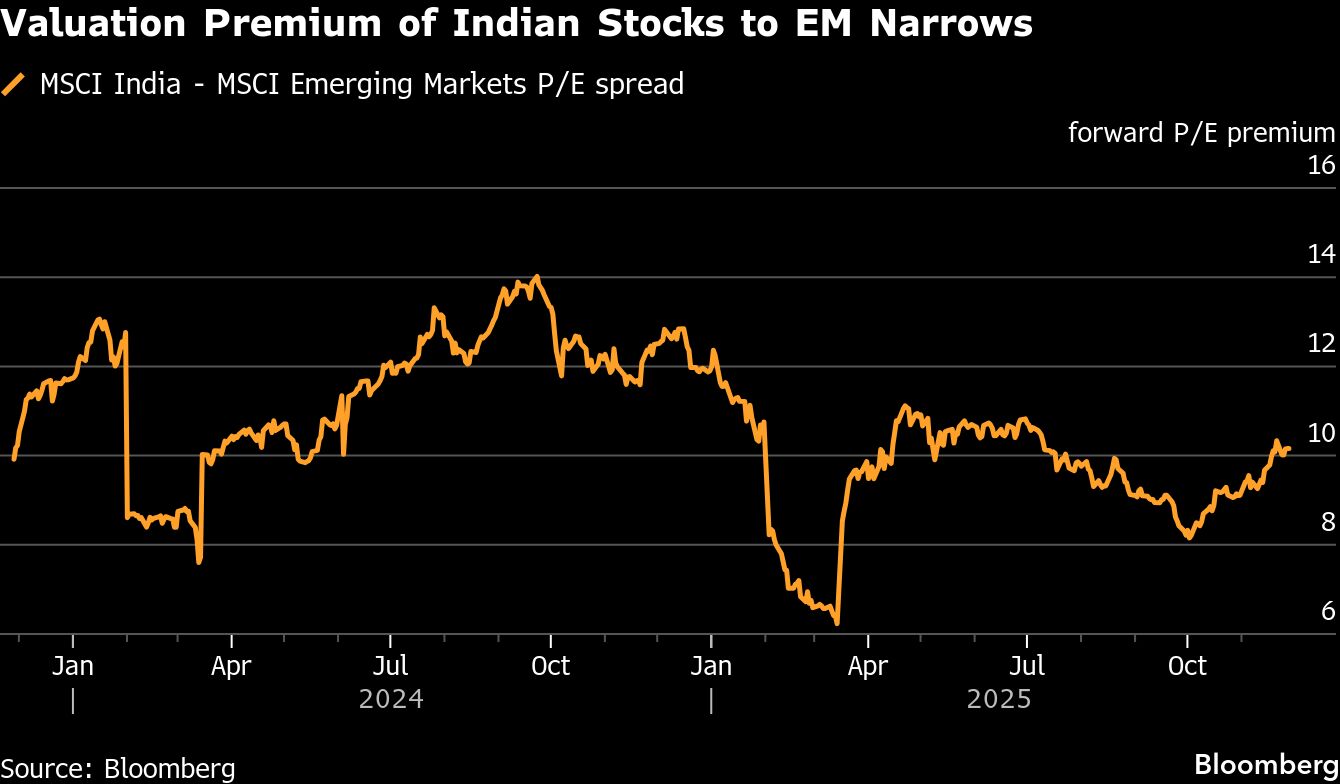
Meanwhile, the recovery in domestic demand, and stock valuations, though off their extremes, are still rich. The Nifty 50 trades above 20 times forward earnings — well above its long-term average. Record local inflows of $80 billion this year have kept the market cushioned, even as foreign selling and a rush of initial public offerings soaked up much of that money.
That mix may keep the market in a tight range, according to Gautam Chhaochharia, head of global markets India at UBS Group AG. “Indian equity markets are boxed in a triangle” he said. “This may continue for a while.”
RBI Support
The Reserve Bank of India has done much of the heavy lifting this year — cutting policy rates by 100 basis points, defending the rupee, and buying record amounts of government debt to ease liquidity pressures.
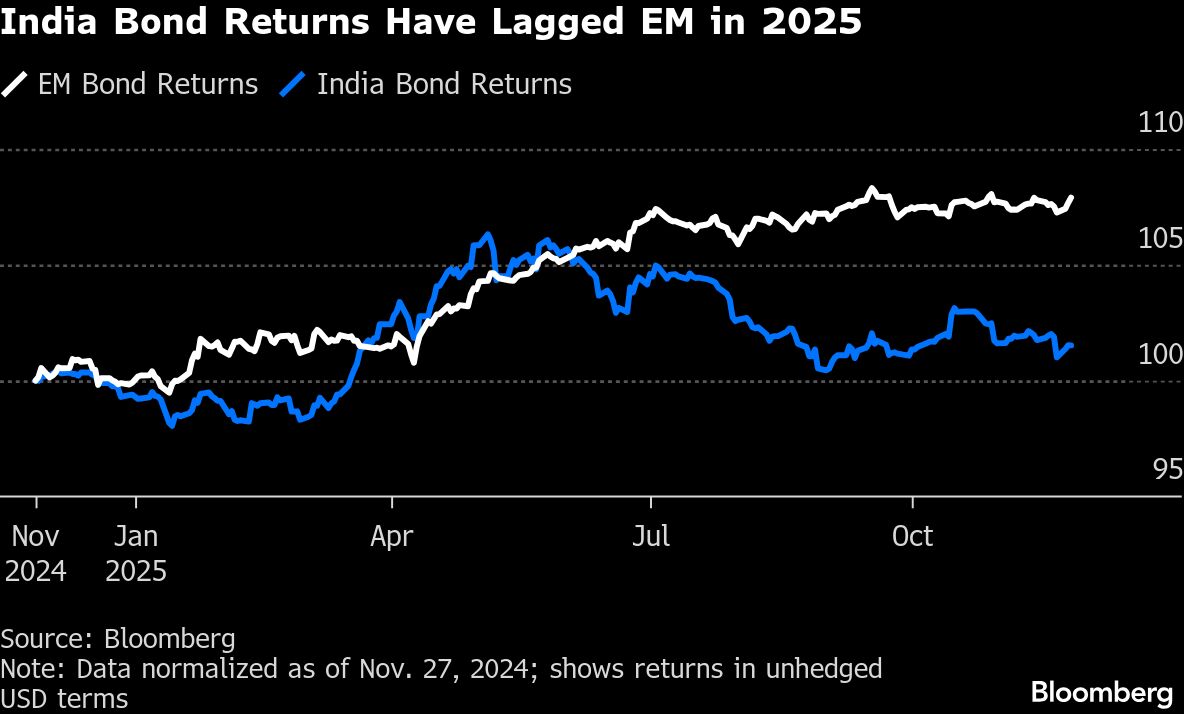
Yet sovereign bonds have lagged. They've returned just 2.1% versus a 8% gain for the broader EM debt, weighed down by a weaker rupee and expectations that the rate-cut cycle may be nearing an end.
With RBI's Malhotra hinting at another rate cut on Dec 5, traders are looking for the central bank to revive large-scale bond purchases. Yields could drop about 25 basis points from current levels if the authority were to buy 3 trillion rupees ($33.5 billion) of securities, according to Sandeep Yadav, head of fixed income at DSP Asset Managers Pvt.
That support and steadier local data is helping restore some investor calm.
Global funds are tiptoeing back after pulling more than $16 billion from equities earlier this year. The past two months have brought inflows of $1.7 billion, and with EM investors still heavily underweight, some see scope for a larger reversal if conditions improve further.
“With better prospects for Indian equities in 2026, we believe there is a fair chance of a reversal of the outflows,” said Prashant Kothari, senior investment manager at Pictet Asset Management. “Tariff impact is manageable — and hopefully temporary.”

-
A New Samvat Wishlist: Inclusive Prosperity And Human Development

India has strengthened its economic foundations through infrastructure, digital access and enterprise. Its next growth chapter must deepen productivity, create better livelihoods and widen participation in prosperity.
-
Love, Sex Aur Dhokha: The Audacious Plot To Spy On Jensen Huang
A Taipei dinner, a Singapore chip buyer and a suspected Chinese asset: inside the alleged spy operation that got close to NVIDIA's Jensen Huang.
-
Ten Things I Learnt This Samvat
Patience can be a trap. Cheap stocks can stay cheap. Leverage can wipe you out. What did Samvat 2082 teach us? Niraj Shah writes on 10 lessons from the year gone by.
-
Talking Points This Week: Tech Nerves, FII Buying, And A Faraway Banking Shock
The global markets are not shining this Diwali. The exception in the large markets is, India.
-
Midterm Rally Lasted A Day. The Hard Reality Of A Divided US May Last Two Years | Opinion
Between a contested AI boom, a debt ceiling that arrives in 2027 and a president with every incentive to act alone, the next two years may prove more volatile than the first day's rally suggests.
-
Blue Wave Will Derail the AI Trade but Won't Dismantle the AI Era | Unhedged Position
The Democrats' sweep of the US Congress will see politics collide with economic forces both over the long and short term.
-
It's Time To Take The GST Council's Bet On Trust Global
Payment records can prove India's services exports, and clear, proportionate rules can bring foreign digital sellers into the tax net.
-
Opinion | India at 38: From Innovation Overperformer to Innovation Powerhouse
India now has 453 VC-backed deep science startups, 18 of them late-stage, after 117 percent growth since 2020. Laurus Labs, at USD 9.3 billion, is the most valuable deep science company in any middle-income economy outside China.
-
Navigating Energy Crossroads: S Jaishankar's Call For Diversified Supply Chains At G20 Ministerial Meeting
As geopolitical fault lines continue to test maritime trade routes and commodity flows, Jaishankar's message remains pertinent: true economic resilience requires open markets, protected transit lines, and a genuine commitment to multilateral cooperation rather than coercion.









