Wall Street Event Risk Piles High In Markets Braced For Bad News
(Bloomberg) --For markets bolstered by dovish central banks, expanding economies and receding inflation, the news as November begins is how vulnerable they've become.
Long-standing pillars of strength are showing cracks. Tech earnings, a key catalyst for upside this year, have turned spotty, zapping a month's worth of stock gains and sending the Nasdaq 100 to its first weekly loss in eight.
A historic stretch of lockstep gains in equities and bonds just skidded to a halt amid ubiquitous event risks that include a deadlocked presidential election and big questions about what the Federal Reserve will do with interest rates.
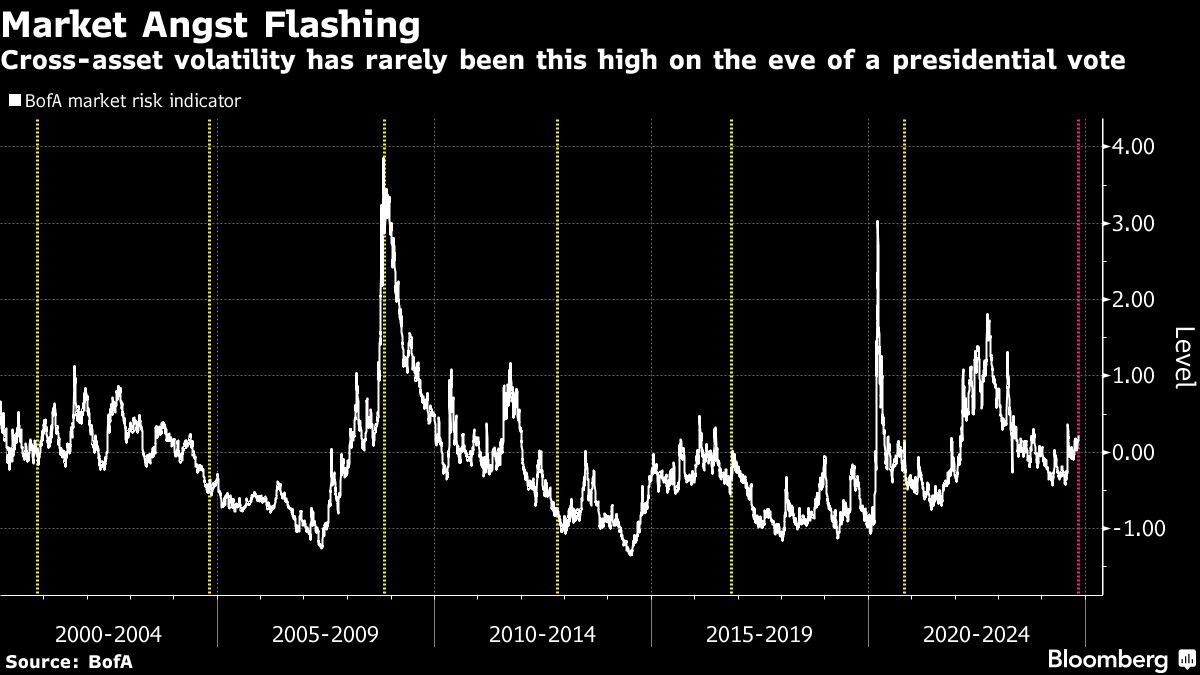
From stocks and Treasuries to currencies and commodities, rarely has anxiety been as pronounced at this point of the cycle. In one example, a gauge of cross-asset risk kept by Bank of America Corp. just jumped to the highest point of any pre-election week outside of the financial crisis.
Altogether it sets the stage for high drama for risk assets in a year that — until recently — was taking its place among the best in decades. Buttressed by solid earnings, the S&P 500 has been up as much as 23% in 2024, while measures of credit risk held near multi-year lows and Bitcoin surged 65%.
“We have taken advantage of the rise in equity prices over the last several weeks to derisk portfolios,” said Jim Caron, chief investment officer of the portfolio solutions group at Morgan Stanley Investment Management. “We believe there will be volatility around the elections and prefer to wait for the noise to die down and allow for the signal to reemerge.”
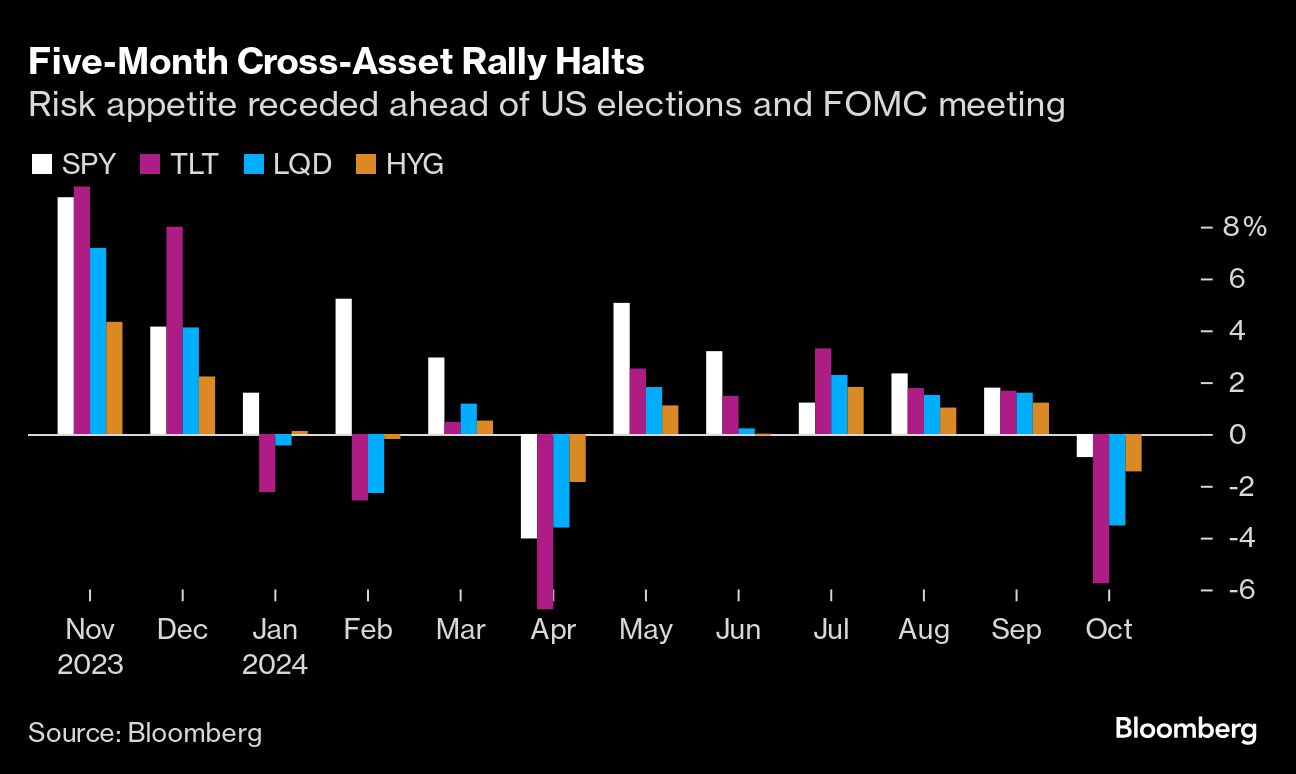
October's declines halted a run of concerted gains in shares and fixed income that was the longest since at least 2007, going by the major exchange-traded funds. While Friday's rebound pared a weekly decline for the S&P 500, risk appetite broadly receded ahead of a high-stakes week. Tuesday's presidential vote has brought the issue of fiscal policy to the fore while the Fed on Thursday will test the resolve of bond bears, who recently trimmed wagers on fast monetary easing.
Trepidation is creeping up in hedging instruments. The Cboe Volatility Index, or VIX, saw its nine-day version — one now covering a timeframe that includes the election and Fed meeting — almost double in two weeks for the biggest increase since 2022. A similar measure for Treasuries, the ICE BofA MOVE Index, reached a one-year high while gauges rose for investment-grade bonds and currencies.
At the center of the uncertainty is, of course, the race between Donald Trump and Kamala Harris for president, a contest pitting divergent economic visions with election polls still showing a statistical dead heat. While everything from higher yields to crypto's surge and the runup in gold have been linked to the race, enough remains unknowable — and too much is happening elsewhere — to allow anything but speculative links to markets as of now.
The week's price action showed the state of the economy as it evolves in real time is at least as big a consideration for investors ahead of the year's final months. According to reports over the last five days, while the US economy expanded at a robust pace in the third quarter, a closely watched measure of underlying inflation was hotter than expected.
Past signs of economic vibrancy unaccompanied by inflation have helped underpin a 5% rise in the S&P 500 since early August, an increase that informs an old-school election indicator that has held loose sway over the decades but which many also view as a statistical anomaly. It says gains over the three months leading to the vote have preceded the incumbent party's reelection 80% of the time since 1928.
Complicating matters, the S&P 500's strength has occurred alongside a resurgence in the so-called Trump trade. With the Republican candidate's odds rising in betting markets, the theory goes, investors have chosen to sell Treasuries in anticipation his policies on tariffs and tax cuts will revive inflation and swell fiscal deficits. The improving electoral odds for Trump, a vocal supporter of the crypto industry, also coincided with a rally in Bitcoin.
Bets on a Trump victory are clearly visible in the equity market too, according to Goldman Sachs Group Inc.'s baskets of stocks picked to reflect election sentiment. A Republican-linked strategy — one that goes long things like commodity producers, while shorting stocks vulnerable to risks such as a trade war with China — was up 9% last month. Meanwhile, a pair trade tied to Democrats' agenda dropped by a similar amount.
That could make the wagers vulnerable should Trump's momentum fail to live up to expectations, according to Barclays Plc strategists including Emmanuel Cau.
“Anything other than a convincing Trump win could see these trades suffer some volatility, or even reversal, after the election,” they wrote in a note Friday.
There are signs that positions were squared ahead of a catalyst-packed week. From hedge funds to options traders, investors have been trimming equity exposure, with the overall positioning level sitting at 82nd percentile of a historic average earlier this week, data compiled by JPMorgan Chase & Co. show. That's down from above 90th percentile just two weeks ago.
Meanwhile, the latest survey from JPMorgan showed clients were reducing both long and short Treasury holdings, while boosting neutral positions.
To Rich Weiss, chief investment officer for multi-asset strategies at American Century Investment Management, full control of the White House and Congress by either party will reawaken inflation and likely trigger a hawkish response by the Fed — a scenario that doesn't bode well for risky assets.
“The only way it's not going to be inflationary is if you get one party in the White House and Congress is locked in the other,” he said. “That would actually be a blessing.”

-
Talking Points This Week: Tech Nerves, FII Buying, And A Faraway Banking Shock

The global markets are not shining this Diwali. The exception in the large markets is, India.
-
Midterm Rally Lasted A Day. The Hard Reality Of A Divided US May Last Two Years | Opinion
Between a contested AI boom, a debt ceiling that arrives in 2027 and a president with every incentive to act alone, the next two years may prove more volatile than the first day's rally suggests.
-
Blue Wave Will Derail the AI Trade but Won't Dismantle the AI Era | Unhedged Position
The Democrats' sweep of the US Congress will see politics collide with economic forces both over the long and short term.
-
It's Time To Take The GST Council's Bet On Trust Global
Payment records can prove India's services exports, and clear, proportionate rules can bring foreign digital sellers into the tax net.
-
Opinion | India at 38: From Innovation Overperformer to Innovation Powerhouse
India now has 453 VC-backed deep science startups, 18 of them late-stage, after 117 percent growth since 2020. Laurus Labs, at USD 9.3 billion, is the most valuable deep science company in any middle-income economy outside China.
-
Navigating Energy Crossroads: S Jaishankar's Call For Diversified Supply Chains At G20 Ministerial Meeting
As geopolitical fault lines continue to test maritime trade routes and commodity flows, Jaishankar's message remains pertinent: true economic resilience requires open markets, protected transit lines, and a genuine commitment to multilateral cooperation rather than coercion.
-
Indians Are Travelling, But Not Every Journey Is A Holiday | The Week In Whys
Pilgrims, patients and working women are the real travellers, and the system hasn't quite caught up with them.
-
Getting To Work Costs Women More | The Reason Why
It is not just about women paying more than men. It is about women paying much more in cities than in villages.
-
AI Bias In Investing Cannot Be Eliminated, But It Can Be Governed
Framing is a particularly important example as identical financial information presented in terms of gains rather than losses can lead an LLM to reach a different assessment.









