

The Real Estate Slowdown Isn't Affecting Developers — Here's Why
A major factor is the increasing reliance on sustenance sales, whish are projects in existing geographies, rather than aggressive new launches.



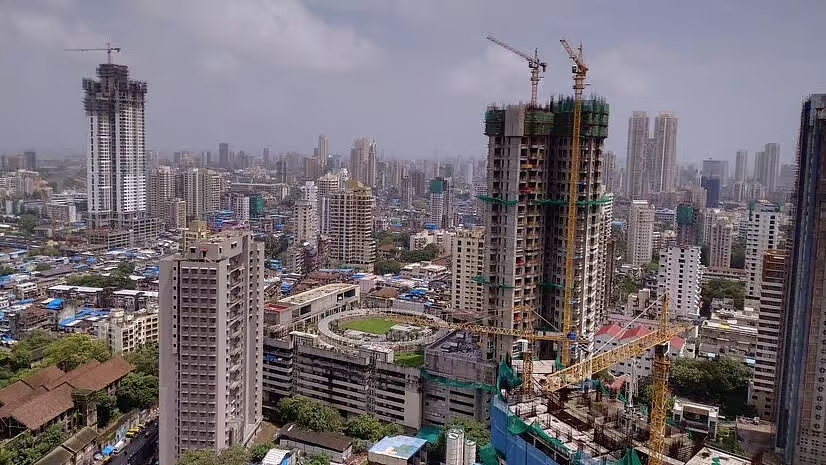
Indian real estate stocks continue to face pressure in early 2026, but the operating performance of large, listed developers suggests the slowdown narrative may be overstated. The Nifty Real Estate Index is down about 11% over the past six months and nearly 3% in the past week, reflecting investor caution around housing demand, rising prices and macro uncertainty. Yet, pre-sales data from leading developers indicates resilience that is not being captured in stock prices.
Shares of Anant Raj, Brigade Enterprises, Oberoi Realty, Godrej Properties and Lodha Developers have fallen between 20% and 33% in 2025, setting a cautious tone for the sector this year. The market’s concern is clear: after a strong multi-year upcycle, has Indian real estate finally hit a plateau?
Prices Haven't Softened
At the aggregate level, the data supports some of that caution. Housing sales across the top seven cities declined 14% in 2025, while new project launches slipped 3% year-on-year to around 3.62 lakh units. Sales volumes were largely flat, down about 1% to 3.48 lakh units, indicating demand fatigue amid higher property prices and layoffs in IT-heavy markets.
Residential prices, however, have continued to rise. According to Knight Frank, NCR prices climbed 19% over the past year, while Bengaluru and Hyderabad recorded increases of 12–13%. Mumbai prices rose 7%, adding to affordability concerns and reinforcing fears of a volume-led slowdown.
Sustenance Sales As A Shield
What headline data fails to capture, analysts say, is the growing divergence between the broader market and large, listed developers. "From a top-down perspective, volumes have softened," said Murtaza Arsiwala, Director of Research at Kotak Institutional Equities. "But if you look bottom-up, companies are delivering strong numbers and, in many cases, running well ahead of their pre-sales guidance."
A major factor is the increasing reliance on sustenance sales, whish are projects in existing geographies, rather than aggressive new launches. Lodha Group’s chief sales officer Prashant Bindal said nearly 65–70% of the company’s business now comes from established markets. "That consistency gives us confidence even when launch activity is muted," he said, adding that the model has delivered steady weekly sales growth over several years.
Premium Housing Is Driving Value Growth
The mix of demand is also shifting decisively towards higher ticket sizes. While overall volumes have softened, value growth remains strong. Sales in the Rs 20–50 million segment rose 20% year-on-year, while the Rs 50–100 million bracket grew 31%. The most striking jump was in the Rs 100–200 million segment, where sales surged 164%, highlighting the resilience of premium and luxury demand.
For investors, the disconnect remains unresolved. Residential developers continue to trade at discounted valuations despite delivering double-digit growth, while REITs command higher multiples on steadier cash flows. As Arsiwala puts it, "The market is still focused on industry sluggishness. If company-level execution continues, that gap will eventually have to close."