

Rupee Falls 5% In 2025 Amid Strong Dollar, Persistent Foreign Outflows
At the interbank foreign exchange, the local unit opened at 89.89 against the dollar and touched an intra-day low of 89.95 and a high of 89.84 against the American currency.



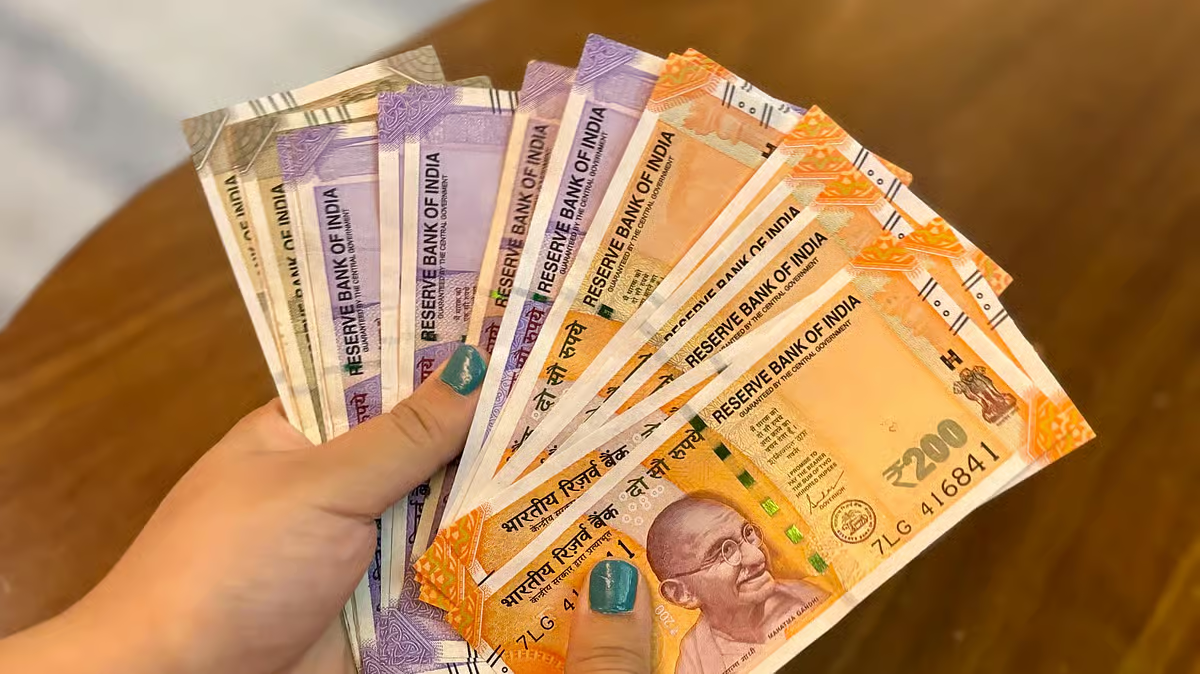
The rupee slumped 5% in 2025 as persistent capital outflows from foreign investors, alongside heightened dollar demand from importers, making it one of the worst-performing Asian currencies.
On the last trading session of 2025, the rupee depreciated 13 paise to close at 89.88 (provisional) against the US dollar as month-end demand and FPIs' dollar buying kept it lower.
The domestic currency has exhibited a negative bias throughout the year, making it Asia's worst-performing currency in 2025, with foreign portfolio investors pulling out $16.5 billion from equities this year, further denting investor sentiments, forex traders said.
At the interbank foreign exchange, the local unit opened at 89.89 against the dollar and touched an intra-day low of 89.95 and a high of 89.84 against the American currency.
At the end of Wednesday's trading session, the rupee was quoted at 89.88 (provisional) against the greenback, registering a fall of 13 paise over its previous close.
On Tuesday, the rupee rose 23 paise to close at 89.75 against the greenback.
On a year-on-year basis, the rupee has plunged 4.95%. It was quoted at 85.64 on Dec. 31, 2024.
"Since the Trump Administration took over, the rupee has been the worst performing currency in the Asian Region, depreciating by more than 5% during 2025, marking its highest depreciation in the last three years," said Anil Kumar Bhansali, Head of Treasury and Executive Director, Finrex Treasury Advisors LLP.
Meanwhile, the Reserve Bank, in its Financial Stability Report (FSR) on Wednesday, said the rupee had depreciated against the US dollar, reflecting falling terms of trade due to the impact of tariffs and a slowdown in capital flows.
The report further noted that the Indian economy is likely to maintain strong growth, underpinned by robust domestic demand, benign inflation, and prudent macroeconomic policies despite an uncertain and challenging global economic backdrop.
"The domestic financial system remains robust and resilient, bolstered by strong balance sheets, easy financial conditions, and low financial market volatility. Nonetheless, there are near-term risks from external uncertainties - geopolitical and trade-related," it said.
Bhansali further said that "consistent outflows by FPIs and stake sales by investors, demand from defence, oil and gold have all impacted the rupee as it fell to its lowest at 91.08 before reined in to control it and bring it up to current levels."
Meanwhile, the dollar index, which gauges the greenback's strength against a basket of six currencies, was trading 0.10% higher at 98.33.
Brent crude, the global oil benchmark, was trading 0.13% higher at $61.41 per barrel in futures trade.
Forex traders said the USD/INR pair is trading under pressure due to multiple factors, including a shift toward risk aversion, driven by persistent capital withdrawals from foreign investors ahead of the holiday break, alongside heightened greenback demand from importers.
On the domestic equity market front, benchmark-sensitive indices ended 2025 on a high, with the Sensex jumping 545.52 points to settle at 85,220.60, while the Nifty surged 190.75 points to 26,129.60.
Foreign institutional investors offloaded equities worth Rs 3,844.02 crore on Tuesday, according to exchange data.