

Nifty Settles Below 25,700, Sensex Plunges 600 Points — Five Reasons Why Stock Market Fell Today
Nifty 50 fell nearly 1% lower to 25,665.15, while Sensex was down 0.80% to 83,506.79.



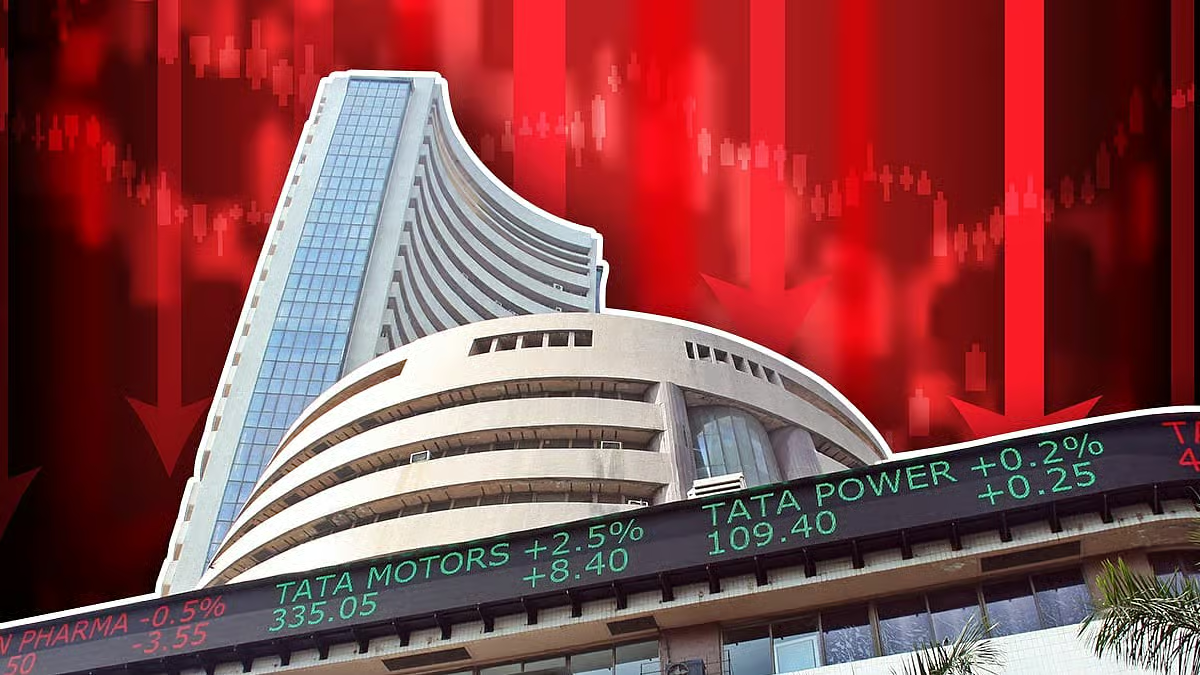
The Sensex and the Nifty 50 extended losses for the fifth consecutive session on Friday ahead of US courts decision on President Donald Trump's tariffs. Both the indices posted their worst weekly performance since September.
Nifty fell below 25,700, while Sensex was down nearly 700 points. The broader segment of the market was also in the negative, with the Nifty Midcap 100 falling 0.88% and Smallcap 250 index down 1.7%.
Nifty 50 through the day fell nearly 1% to 25,623, while Sensex was down 0.93% to 83,402.28. Nifty closed 0.75% lower at 25,683.30, while Sensex closed 0.72% down at 83,576.24.
Reflecting heightened nervousness, the India VIX surged over 3% on Friday, signalling a rise in expected volatility.
Nifty Breaks 50-DMA Levels
From a technical standpoint, market momentum weakened further as the Nifty broke below its 50-day moving average, a key short-term support level watched by traders.
Nifty Bank Breaks 20-EMA Levels
Banking stocks also came under pressure, with the Nifty Bank slipping below its 20-day exponential moving average, adding to concerns of near-term consolidation.
US Tariff Concerns
A major overhang for the markets remains escalating US-India tariff concerns. Reports indicate that US President Donald Trump has allowed a bipartisan sanctions bill targeting countries doing business with Russia to move forward in Congress, with a vote possible as early as next week.
US Senator Lindsey Graham said Trump has “greenlit” the bill, which aims to penalise nations purchasing Russian oil as part of Washington’s effort to curb Russia’s financing of the Ukraine war.
The proposed legislation seeks to impose import duties of at least 500% on all Russian goods and services. More importantly for India, it contains provisions that could indirectly hurt countries continuing to buy Russian oil.
India already faces US tariffs of around 50% due to its significant purchases of Russian crude, and the new bill raises the risk of even steeper duties, adding uncertainty to trade-sensitive sectors.
US-India Trade Deal Tensions
The long awaited India-US trade deal isn't finalised because Prime Minister Narendra Modi did not call US President Donald Trump, claims US Commerce Secretary Howard Lutnick. He added that "I set the deal up. But you had to have Modi call President Trump. India was uncomfortable with it. So Modi didn't call."
In an interview with Chamath Palihapitiya, on the All-In podcast, Lutnick explains why the deal hasn't materialised yet, and the staircase structure on the rates they were negotiating with the countries.
He goes on to say that, after PM Modi didn't call, the US went on with the staircase, to do deals with Indonesia, the Philippines, Vietnam, and Malaysia. He adds that India called back after three weeks, and hints at the rates are now getting difficult to negotiate.
US Courts Decision On Tariffs
Global attention is now firmly on the US Supreme Court, which had scheduled Friday as an opinion day, making it the first possible opportunity for a ruling on Trump’s global tariffs.
The court does not pre-announce which decisions will be delivered, but a tariff ruling is seen as a strong possibility given the expedited handling of the case. At stake are Trump’s April 2 “Liberation Day” tariffs, which imposed levies ranging from 10% to 50% on most imports, along with additional duties on Canada, Mexico and China.
A ruling against Trump would strike at the heart of his economic agenda and mark his most significant legal setback since returning to the White House. Until clarity emerges on both the court’s decision and the evolving sanctions bill, markets are likely to remain volatile, with investors preferring to stay on the sidelines amid rising global and domestic uncertainties.