Michael Burry, Raghuram Rajan Saw The 2008 Crash Coming — They're Sounding The Alarm Again
The 2000 dot-com bubble, and the 2008 market crash altered global markets and economies. During those times, a few economists and market watchers had warned of the tsunami that was about to hit. Those murmurs are back and this time the AI bubble may make things worse still.
But should you really be concerned?
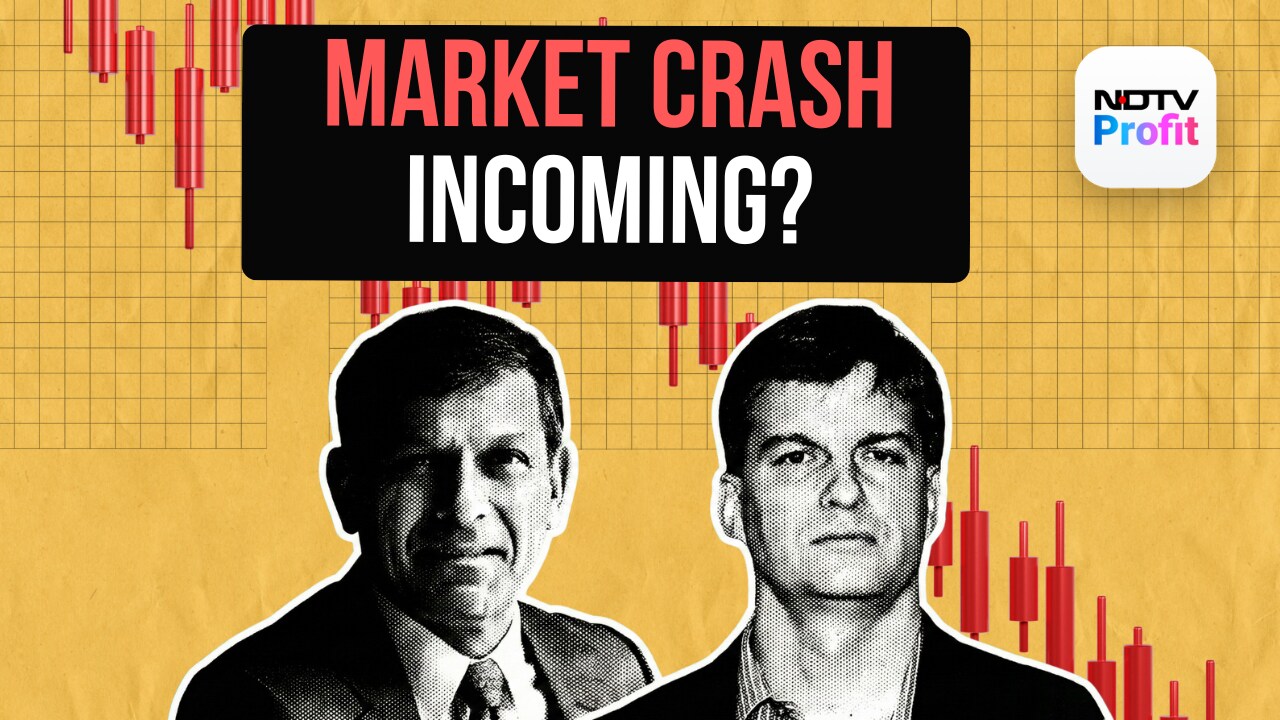
Three experts that called the crashes — Michael Burry, Raghuram Rajan, and Howard Marks — and they're are calling it again, and think you should be moderately cautious.
The Big Short Strikes Again?
American investor Michael Burry, in a recent podcast 'Against The Rules', said that he thinks, "the whole thing is just going to come down. And it would then be very hard to protect your stock portfolio."
He backed his claim up by noting that currently, over 50% of the money in the stock markets is invested in passive money. He also said that only a mere 10% is invested for the long-term. This, he claims, will be the reason for a "longer bear market that is akin to the 2000 bubble."
Burry advises the listeners that if you own something that has risen a lot, "and is shooting straight up, and you think it's overvalued, you should sell it."
A Mix Of 2001-2008?
Economist and Former RBI Governor Raghuram Rajan was deemed a person who was afraid of progress when he presented a paper in 2005, warning of a great financial bubble.
At a recent UBS conference in Zurich, he said that now have a combination of the 2001 and 2008 bubbles. Rajan remarked, "I think it's early days, but it's time to get cautious." He said that the frenzy over AI reminds him of the dot com craze in 2000, and the credit ballooning and liquidity by the central banks is eerily similar to 2008.
Rajan noted that many of the now top-scaling AI companies were using internal cash flows to invest in AI. However, now they are forming special purpose vehicles (circular financing with their peers, for example) for additional financing. He cautioned that it all depends on the unknown AI demand.
Is It A Bubble?
Another American investor Howard Marks has a similar sentiment. After calling the slow trainwreck that was soon to come before the 2008 crash, and holding on to $11 billion in cash, he made sure to start investing in September 2008 when the crash was at its peak.
In a recent memo, titled 'Is It A Bubble?' uploaded on his company Oaktree Capital's website, he wrote that “in the current market, I'd advise that no one should go all-in without acknowledging that they face the risk of ruin if things go badly. But no one should stay all-out either. Adopt a moderate approach.”
Red Flags Of The AI Bubble
In November, Ruchir Sharma, the chairperson of Rockefeller International, said that the current wave of enthusiasm from investors across domestic and global markets to invest in artificial intelligence is "the most hated bubble in history".
He pointed to certain factors that have been consistent before some of teh most impactful market crashes in history — increasing valuations, fast spikes in investment and increasing leverage.
No Magic Words In Investing
The AI bubble finally bursting may be the onset of emotionally complicated times, and market veterans have started calling it.
As Marks put it in his memo, "it's essential to bear in mind that there are no magic words in investing. These days, people promoting real estate funds say, “Office buildings are so yesterday, but we're investing in the future through data centers,” whereupon everyone nods in agreement. But data centers can be in shortage or in oversupply, and rental rates can surprise. As a result, they can be profitable . . . or not."

-
Navigating Energy Crossroads: S Jaishankar's Call For Diversified Supply Chains At G20 Ministerial Meeting

As geopolitical fault lines continue to test maritime trade routes and commodity flows, Jaishankar's message remains pertinent: true economic resilience requires open markets, protected transit lines, and a genuine commitment to multilateral cooperation rather than coercion.
-
Indians Are Travelling, But Not Every Journey Is A Holiday | The Week In Whys
Pilgrims, patients and working women are the real travellers, and the system hasn't quite caught up with them.
-
Getting To Work Costs Women More | The Reason Why
It is not just about women paying more than men. It is about women paying much more in cities than in villages.
-
AI Bias In Investing Cannot Be Eliminated, But It Can Be Governed
Framing is a particularly important example as identical financial information presented in terms of gains rather than losses can lead an LLM to reach a different assessment.
-
Joining The Dots | Dark Skies, Steady Diya: Why Hope Holds This Diwali
With war, a weak rupee and foreign outflows weighing on sentiment, policymakers at the NDTV World Summit and market veterans at NDTV Profit Ignite: Diwali Edition offered the same advice: stay invested and filter out the noise.
-
The Curious Case of Equitas Small Finance Bank And A CEO Who Quit For Stock
PN Vasudevan believes persistent investor concerns over a perceived conflict of interest had become a governance overhang on Equitas Small Finance Bank's stock, even as the lender improved profitability and asset quality.
-
Talking Points This Week: AI Cash Burn, A Tiger Comeback And An India That Still Finds Its Own Path
India is not immune to higher oil or tighter global liquidity, yet its earnings base is broader, its domestic policy levers are still available.
-
Foreign Investors Own Half Of HDFC Bank and ICICI Bank. An LTCG Cut Could Matter Most Here
Foreign portfolio investors have US$115 billion parked in HDFC Bank, ICICI Bank. If the government cuts long-term capital gains tax, Jefferies says returning foreign money could land here first.
-
'Never Seen This Level Of Negativity': Sandeep Tandon Says The Next Rally May Be Closer Than You Think
Veteran investor Sandeep Tandon says foreign selling is easing, large-caps are due a comeback and mid-caps are crowded, while he turns positive on gold, power and pharma this Diwali.
-
Indians Stay With Family, Not In Hotels | The Reason Why
India still lacks enough clean, reliable and affordable hotels for budget-conscious travellers.










