- Wakefit reported a Rs 35.5 crore profit in H1 FY26 after a Rs 35 crore loss in FY25
- The company plans massive jumbo stores up to 200,000 sq ft, challenging IKEA's model
- Rs 161.4 crore of IPO funds will pre-pay rent for existing stores, not primarily growth
If you have lived in an Indian metro at any point in the last seven years, you have likely come across Wakefit. They are the brand that famously offered to pay interns to sleep on the job.
They are the scrappy, irreverent direct-to-consumer upstart that promised to shake up the "snoozy" mattress oligopoly with a roll-packed foam cylinder delivered right to your door. But as Wakefit Innovations Ltd. prepares for an IPO, the company that built its name on "good sleep" is offering a prospectus that might keep diligent investors awake at night.
A close look at their regulatory filings reveals a company in the middle of a radical, almost tumultuous transformation. This is no longer merely a mattress seller — it is a company pivoting into a high-stakes battle with IKEA, seeking to monetise its operating expenses, and aggressively preparing its books for a public listing.
Here is the unvarnished truth about the Wakefit IPO — the brilliance, the risks, and the uncomfortable questions tucked away in the fine print.
The first thing that stands out from the RHP is a financial turnaround. For the entirety of fiscal 2025, Wakefit reported a loss of Rs 35 crore. Yet, in a well-timed move, just months before the IPO, the company flipped to a profit of Rs 35.5 crore for the first half of FY26. The Ebitda margin notably doubled from 7% to over 14%.
While supporters will call this "operating leverage", sceptics might see the classic pre-IPO grooming — a "hockey stick" recovery designed to justify a premium valuation.
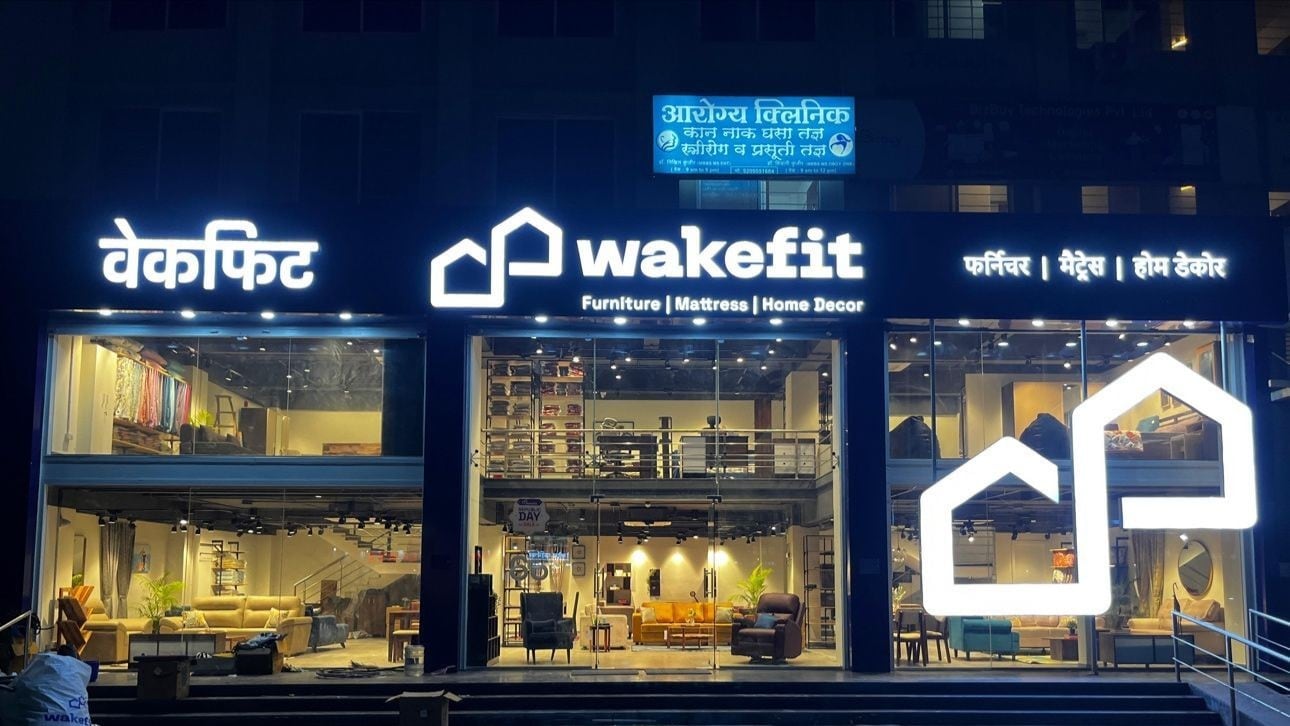
Perhaps, the most daring revelation is Wakefit's strategic shift. The brand that conquered the online space is now betting heavily on brick-and-mortar stores. But they're not just opening outlets — they are building colossal "jumbo" stores ranging from 50,000 to 200,000 square feet.
To put this in perspective, their current typical store is a cosy 3,000 square feet. They are effectively leaping from operating agile speedboats to commanding a cruise liner —without a licence. The RHP explicitly admits: "We have never built or operated Jumbo Stores in the past."
This is a direct declaration of war against IKEA. Wakefit is establishing two of these massive stores in Bengaluru, its home turf, in what appears to be a "fortress strategy" to defend against the Swedish giant. They are even amending their corporate charter to include full-service restaurants and cafes, adopting IKEA's "meatball strategy" to increase customer dwell time.
It is a bold, aggressive vision to become an "Infinity Home" solution. But retail history is littered with D2C brands that failed trying to manage the overheads of large-format retail.
And this expansion leads us to the most controversial aspect of the IPO: the use of proceeds.
Wakefit is raising new capital, but a startling amount of it is defensive. The company plans to use Rs 161.4 crore of your money to pay rent for existing stores, while only allocating Rs 30.8 crore to establish new ones.
Read that again. They are spending five times more IPO cash to pay existing landlords than to develop new assets. By using equity to pre-pay rent through FY2029, Wakefit is essentially capitalising its operating expenses. This financial engineering will make their future cash flows and Ebitda appear artificially strong, as the P&L will be relieved of a major monthly burden.
But for investors, this raises a fundamental question: Are you funding growth, or are you simply providing the company with a safety net against the strict "lock-in" clauses and 5% annual rental hikes detailed in their lease agreements?
Also, it's worth noting that for years, the founders impressed the media with claims that their return rates were negligible — less than 3%. The RHP shatters that myth. The actual return rate for mattresses is between 8.3% and 8.6%. And, you cannot easily resell a returned, expanded mattress; the document admits many are simply scrapped.
However, credit must be given where it's due. Despite this revelation, Wakefit has built a strong loyalty engine. An impressive 35% of their revenue comes from repeat customers. They have successfully cracked the code of cross-selling, turning mattress buyers into bedsheet, sofa, and bookshelf customers. This "ecosystem" stickiness is their true moat.
Finally, no analysis is complete without considering governance standards, and here one aspect is hard to overlook. The chief financial officer, Navesh Gupta, has resigned effective Dec. 31, 2025 — right in the middle of the listing process. Losing your financial leader just before an IPO is rarely a reassuring sign.
Overall, Wakefit appears to be a company of intriguing contradictions. It is a "Make in India" champion that imports 38% of its raw materials. It is a "capital-efficient" startup now using equity to pay rent. It positions itself as a "tech" firm with almost no patents but a significant data advantage from its 1.2 million "Sleep Internship" applicants.
The company operates with remarkable efficiency — boasting a negative working capital cycle of just 1.04 days — effectively funding its operations with customers' cash. That is a sign of a well-managed manufacturing operation.
But as it steps into the public eye, Wakefit is asking investors to fund a high-risk transformation. They are betting they can beat IKEA at its own game while navigating a CFO exit and rising operational complexities.
The views expressed in this article are solely those of the author and do not necessarily reflect the opinion of NDTV Profit or its affiliates. Readers are advised to conduct their own research or consult a qualified professional before making any investment or business decisions. NDTV Profit does not guarantee the accuracy, completeness, or reliability of the information presented in this article.
Essential Business Intelligence, Continuous LIVE TV, Sharp Market Insights, Practical Personal Finance Advice and Latest Stories — On NDTV Profit.