

IDFC First Bank Stocks In Focus: Nomura Initiates Coverage As Profitability Improves — Check Target Price
Nomura expects a sharp earnings inflection over the next three years, driven by operating leverage and improving profitability.



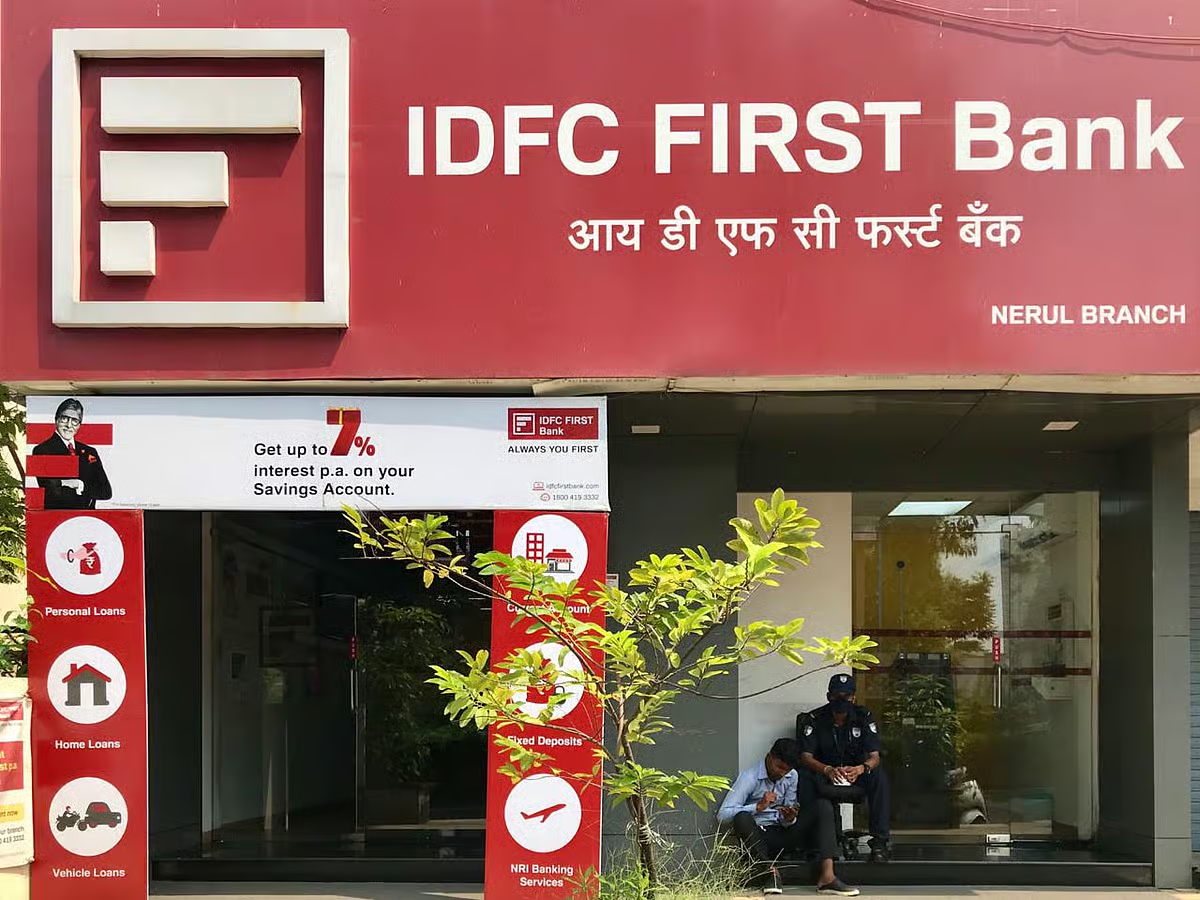
Nomura has initiated coverage on IDFC First Bank with a Buy rating and a target price of Rs 105, citing a clear operating leverage inflection and strong earnings momentum as the bank transitions into a phase of sustained profitability. The brokerage believes the multi-year investment and balance sheet transformation is largely complete, setting the stage for broad-based improvement in returns.
According to Nomura, IDFC First Bank has built a robust liabilities franchise, with CASA at around 50% as of the first half of fiscal 2026, while borrowings now account for just 13% of the funding mix, sharply lower than 32% in financial year 2022.
The bank has also structurally shifted its business model from being wholesale-led to retail-focused, with the retail-to-wholesale mix improving to 80:20 in first half of this fiscal from 37:63 in fiscal 2019. This transformation provides strong visibility on growth, with loans and deposits expected to deliver 20% and 22% CAGRs respectively over FY26–28. In addition, the bank’s fee income profile, at over 2% of average assets, compares favourably with peers.
Nomura expects a sharp earnings inflection over the next three years, driven by operating leverage and improving profitability. Core pre-provision operating profit is forecast to grow at a strong pace over fiscal 2026–28, supported by a moderation of around 50 basis points in cost-to-assets and an improvement of about 14 basis points in net interest margins.
Combined with a roughly 35 basis point decline in credit costs, this should lift return on assets to 1.2% and return on equity to 11.8% by financial year 2028, from 0.6% and 5.4% respectively in fiscal 2026. The brokerage estimates a sector-leading EPS CAGR of 67% over FY26–28.
ALSO READ
Q3 Results: HDFC Bank, ICICI Bank, IDFC First Bank To Announce Quarterly Earnings On This Date
Operating leverage is emerging as a structural earnings tailwind. Operating expenses were elevated between FY19 and FY25 as the bank invested heavily in branches, technology, people and new businesses. While this has weighed on headline ratios, operating leverage is already visible at the segment level across retail liabilities, assets and credit cards.
As growth normalises and scale benefits accrue, Nomura expects cost-to-assets and cost-to-income ratios to decline to 5.1% and 64% respectively by fiscal 2028, from 5.6% and 71% in financial year 2026.
Margins are expected to stabilise with potential upside. Nomura believes that net interest margin pressure seen during the previous financial year and the first half of this fiscal, driven by repo-linked repricing and loan-mix changes, is largely behind the bank.
As term deposits reprice, NIMs are expected to bottom out in FY26, recover gradually in FY27 and stabilise thereafter. Savings account rate cuts remain an upside lever, with a 50–100 basis point reduction potentially adding meaningfully to margins and returns.
Asset quality stress, in Nomura’s view, has been largely addressed. Stress has been concentrated in the microfinance portfolio, where corrective measures have been implemented, while asset quality in credit cards and consumer loans has remained contained. The brokerage builds in lower credit costs of 1.9% and 1.8% for FY27 and FY28, compared with higher levels in FY25 and FY26.