Hedge Fund-Style Products To Reshape $900 Billion Indian Market

A new investment product that brings sophisticated strategies to affluent Indians is set to usher in a fresh era for the nation's asset managers.
Earlier this year, India's securities regulator introduced specialized investment funds — also called SIFs — which allow managers to short stocks, use derivatives and pursue absolute-return strategies once reserved for hedge funds.
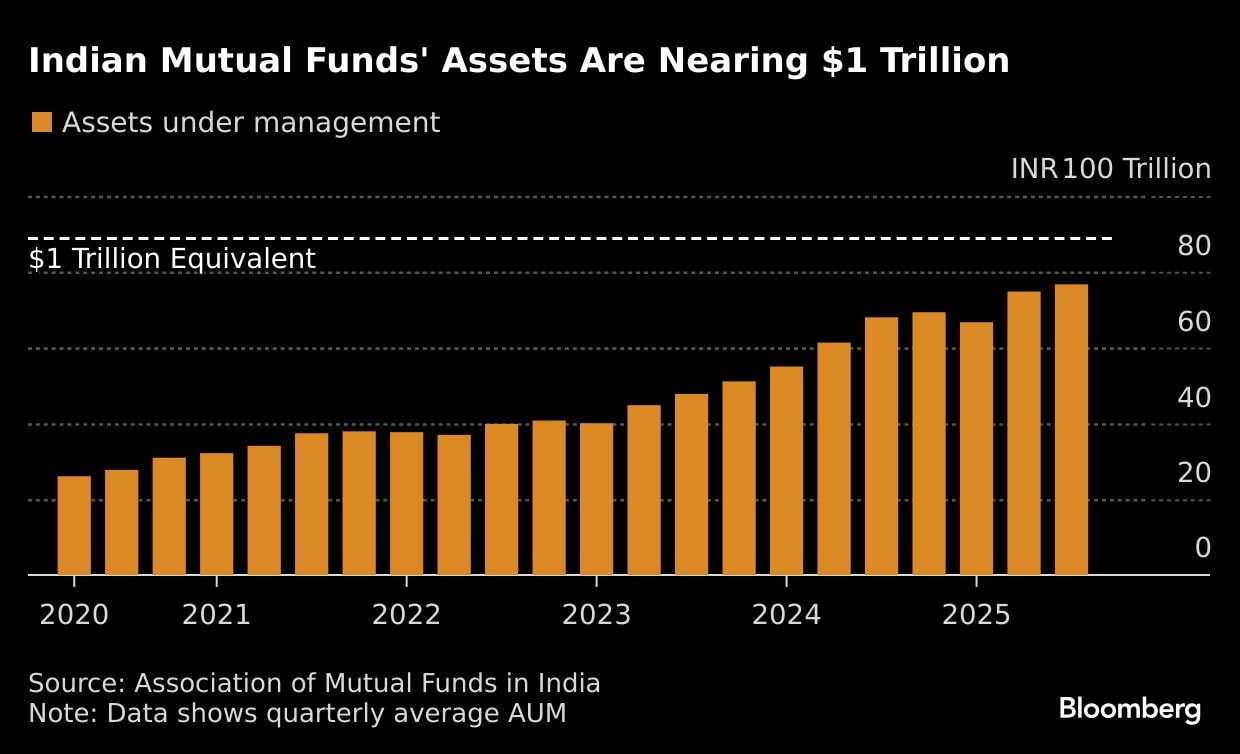
The program opens the door to hedge fund-style strategies for a broader range of investors in India's booming $900 billion mutual fund industry. Firms from Edelweiss Asset Management Ltd. to SBI Mutual Fund have rushed to start funds under this category, hopeful that they will take the rapidly growing market to the next level.
“The last decade was about financialization — getting India to invest,” said Radhika Gupta, chief executive officer of Edelweiss. “The next decade will be about sophistication — teaching investors that risk-adjusted returns matter.”
SIFs mark the transition from long-only investing toward market-neutral and tactical strategies designed to cushion losses. Globally, they mirror US liquid alternative funds and Europe's UCITS products — vehicles that blur the line between retail and institutional investing, even if they lack the leverage of many hedge funds.
“I think of them as ‘hedge fund-lite',” said Edelweiss's Gupta. “This will give consumers a taste of risk-adjusted, absolute-return thinking.”
Yet India's market structure may temper the early promise. Derivatives trading is restricted to a universe of about 200 stocks, limiting the ability to build diversified, hedge fund-style portfolios.
Quant's Tandon says the number is “a good starting point,” and the list will eventually swell to about 500. “It's not like we will grow in isolation; market depth and breadth will also grow,” he said.
Another constraint centers on people. A shortage of quantitative talent and limited experience in running complex long-short books mean most asset managers will face a learning curve before these funds can scale meaningfully.
Still, as more distributors come on board, the funds are set to expand in coming years, according to Mirae Asset Mutual Fund CEO Swarup Mohanty.
“SIFs are scalable,” Mohanty said. “In five years, they could form 20–30% of the mutual fund industry.” Mirae plans its first SIF within six months.
Several AIF and portfolio management firms — including Alpha Alternatives, Carnelian, and Estee Advisors — have applied for mutual fund licenses, seeing SIFs as more tax-efficient with a greater potential to expand. Nippon Life India has brought in veteran hedge fund manager Andrew Holland to lead its SIF business.
At SBI Mutual Fund, the country's largest asset manager, Gaurav Mehta is positioning his first SIF launch as a conservative, income-oriented hybrid. “There's a perception that SIFs are aggressive because they use derivatives,” he said. “But derivatives can mitigate risk as much as they can enhance it.”
For Sreepriya NS, CEO of Entrust Family Office, the onus is on the Securities and Exchange Board of India to make the new products a success.
“They open alternatives to investors who could never access them before,” she said. “That's healthy, as long as SEBI's guardrails remain.”

-
We May Need Another Tukaram Mundhe To Fight Air Pollution | The Reason Why

Developers may install basic measures such as sprinklers and green nets, resume work, and continue violating rules when this equipment stops working.
-
Extracting Value From Battery Scrap Could Be Challenging For India | The Reason Why
A discarded lithium-ion battery still contains valuable materials such as lithium, nickel and cobalt. These can be recovered and reused. When such batteries are crushed and shredded, they produce a dark powder called black mass.
-
One El Nino, India Can Handle. Two Could Break The Granary
India's grain stocks can absorb one bad year, but a second El Nino could drain the buffer in two to three years, economists say.
-
India's Troika Of Good Luck | Joining The Dots
As Jensen Huang's exit drags Nvidia down, a cooling AI trade and resilient earnings have revived investor interest in India. A likely RBI rate hike looms.
-
Talking Points This Week: Leadership Shock At Nvidia, Earnings Strength, And The Fog Over Hormuz
The Anthropic IPO pricing and first trading day, Nvidia's upcoming earnings, and any fresh signals from Iran will set the tone for the following week.
-
Signature Play: The Classic Cocktail Is Dead. Or Is It?
Classic cocktails are disappearing from India's cocktail menus. But they're still being ordered, taught to bartenders and borrowed from. So, who's really having the last drink?
-
A New Samvat Wishlist: Inclusive Prosperity And Human Development
India has strengthened its economic foundations through infrastructure, digital access and enterprise. Its next growth chapter must deepen productivity, create better livelihoods and widen participation in prosperity.
-
Love, Sex Aur Dhokha: The Audacious Plot To Spy On Jensen Huang
A Taipei dinner, a Singapore chip buyer and a suspected Chinese asset: inside the alleged spy operation that got close to NVIDIA's Jensen Huang.
-
Ten Things I Learnt This Samvat
Patience can be a trap. Cheap stocks can stay cheap. Leverage can wipe you out. What did Samvat 2082 teach us? Niraj Shah writes on 10 lessons from the year gone by.
-
Talking Points This Week: Tech Nerves, FII Buying, And A Faraway Banking Shock
The global markets are not shining this Diwali. The exception in the large markets is, India.