

Cupid Shares Hit Over One-Month Low After Block Deal; Falls Over 330% In The Last 12 Months
According to Bloomberg, 2.13 million shares change hand in block trade during the pre-market trading session.




The shares of Cupid Ltd. fell over 19% on Monday after block deal in the pre-market trading session.
According to Bloomberg, 2.13 million shares change hand in block trade during the pre-market trading session. The buyers and sellers of the shares were unknown.
This comes after the company in the last month approved plans to set up a fast-moving consumer goods facility in Saudi Arabia.
The proposed unit will be Cupid’s first manufacturing plant outside India, aimed at supporting its FMCG growth strategy and strengthening its presence in overseas markets, starting with the Gulf Cooperation Council (GCC) region.
Founded in 1993, Cupid is India’s leading manufacturer and brand of male and female contraceptives, water-based personal lubricants, IVD kits, deodorants, perfumes, almond hair oil, body oils, petroleum jelly, and other FMCG products. The company operates with a strong commitment to public health and ethical business practices aligned with international standards.
As part of its strategic growth plans, Cupid has recently expanded into FMCG categories such as fragrance products (Eau De Perfumes, Deodorants, Pocket Perfumes), personal care items (Toilet Sanitizers, Hair & Body Oils, Hair Removal Sprays, Face Wash), and other wellness solutions.
In March 2024, the company completed a strategic land acquisition in Palava, Maharashtra, enabling it to increase production capacity by 1.5 times its current output.
Cupid Shares In Focus
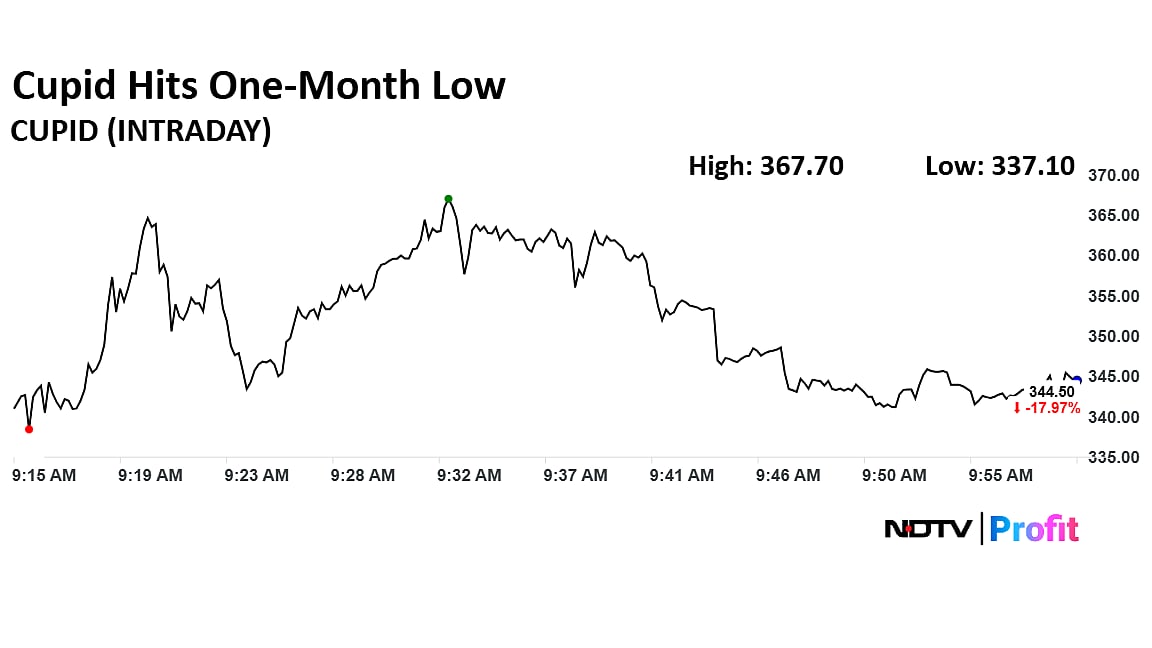
The shares of Cupid were in focus on Monday after bulk trade. The scrip fell as much as 19.73% to Rs 337.10 apiece on Monday, the lowest level since Dec. 1. It pared gains to trade 16.93% lower at Rs 348.85 apiece, as of 9:47 a.m. This compares to a 0.05% advance in the NSE Nifty 50 Index.
It has fallen 337.76% in the last 12 months. Total traded volume so far in the day stood at 18 times its 30-day average. The relative strength index was at 36.