

Social Security Cover: Govt Drafts Unified Rules For EPF, ESI, Gig Workers & Maternity Benefits — Details Here
Gig and platform workers must be engaged with a single aggregator for at least 90 days in a year to qualify for benefits such as health, life and personal accident insurance.



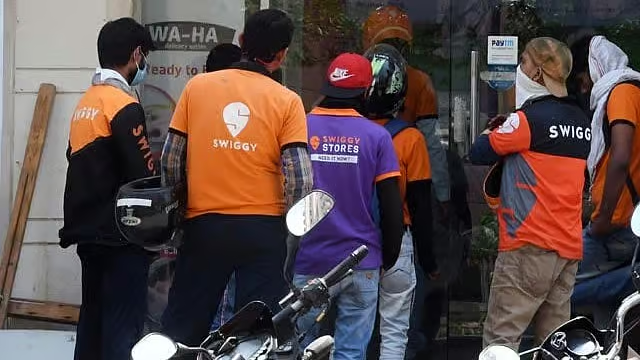
The Ministry of Labour and Employment has unveiled draft rules under the Code on Social Security, 2020, aiming to unify and streamline social security provisions for millions of workers across India.
The proposed Code on Social Security (Central) Rules, 2025 consolidates regulations governing the Employees’ Provident Fund (EPF), Employees’ State Insurance (ESI), maternity benefits, and welfare schemes for gig and platform workers.
Social Security For Gig Workers
For the first time, gig and platform workers will be brought under the social security net. Gig and platform workers will need to meet minimum workday criteria in a financial year to be eligible for social security benefits, according to new draft rules issued by the Centre as part of the Social Security Code.
Under the draft rules circulated for public comment, gig and platform workers must be engaged with a single aggregator for at least 90 days in a year to qualify for benefits such as health, life and personal accident insurance.
For workers associated with multiple platforms, including food delivery, ride-hailing, and e-commerce aggregators, the minimum requirement has been set at 120 days of engagement in a financial year.
A worker will be treated as engaged from the day they start earning income from an aggregator, regardless of the amount, and each calendar day on which income is earned will count toward eligibility.
For those working on several apps simultaneously, days will be counted cumulatively, meaning work done for three aggregators on the same day will be treated as three days for the purpose of meeting the threshold.
Expanded Coverage and Definitions
The rules define key terms such as average daily wages, benefit period, and dependent parents, whose income threshold is set at Rs 9,000 per month.
Gig and platform workers, previously outside the ambit of formal social security, will now be represented through the National Social Security Board, which includes members from unorganised sectors, employers, and experts.
Governance and Oversight
The draft prescribes detailed governance norms for bodies like the Central Board of Trustees (EPF) and the Employees’ State Insurance Corporation (ESIC). Investment of funds will follow government guidelines, with any variation requiring prior approval. ESIC’s annual expenditure on health and welfare is capped at Rs 1,000 crore.
Meetings of these boards will have strict quorum requirements and decisions will be taken by majority vote, with the chairperson holding a casting vote. Non-government members will receive travel allowances equivalent to Level 12 of the pay matrix.
Benefits Under ESIC
The draft rules detail a comprehensive benefits package under ESIC:
Sickness Benefit: 70% of wages for up to 91 days, subject to 78 days of contribution.
Extended Sickness: Up to 730 days at 80% wage.
Maternity Benefit: 26 weeks of leave, Rs 7,500 medical bonus, and six weeks for miscarriage.
Disablement and Dependants’ Benefit: Compensation up to 90% of wages for permanent disablement; structured support for widows and children.
Additionally, funeral expenses up to Rs 10,000 and free annual health check-ups for insured persons aged 40 and above are included.
The government has invited stakeholders to submit feedback within 45 days. Once finalised, these rules will mark a significant shift towards inclusive social security, covering formal employees, gig workers, and unorganised labour under a unified legal framework.