

Centre Proposes New Rules To Bring Gig Workers Under Social Security Cover: Details Here
Gig and platform workers must be engaged with a single aggregator for at least 90 days in a year to qualify for benefits such as health, life and personal accident insurance.



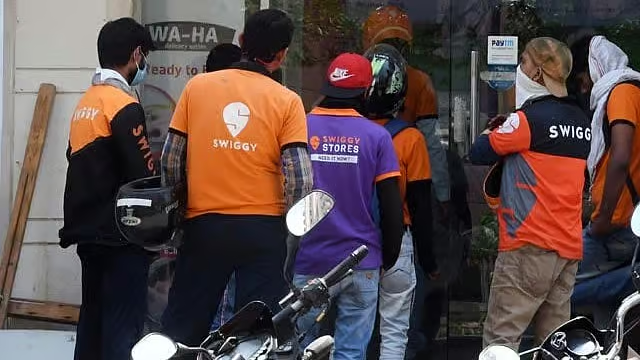
Gig and platform workers will need to meet minimum workday criteria in a financial year to be eligible for social security benefits, according to new draft rules issued by the Centre as part of the Social Security Code.
Under the draft rules circulated for public comment, gig and platform workers must be engaged with a single aggregator for at least 90 days in a year to qualify for benefits such as health, life and personal accident insurance.
For workers associated with multiple platforms, including food delivery, ride-hailing and e-commerce aggregators, the minimum requirement has been set at 120 days of engagement in a financial year.
A worker will be treated as engaged from the day they start earning income from an aggregator, regardless of the amount, and each calendar day on which income is earned will count toward eligibility.
For those working on several apps simultaneously, days will be counted cumulatively, meaning work done for three aggregators on the same day will be treated as three days for the purpose of meeting the threshold.
ALSO READ
Magicpin Management Delivers Food On New Year's Eve, Firm Says 'No Impact' Of Gig Workers' Strike
Social Security For Gig Workers
The rules mandate Aadhaar-linked registration for all gig and platform workers above 16 years of age, with aggregators required to share worker details on a central portal to generate a universal account number.
Every eligible registered worker will be issued a digital or physical identity card, and the database will be integrated with platforms such as the e-Shram portal and schemes like Ayushman Bharat to extend social security coverage, according to a notification by government.
The draft notification also sets out the framework for the proposed National Social Security Board, which will be tasked with assessing the gig workforce, identifying new categories of aggregators and recommending welfare policies.
The board will include representatives of unorganised workers and employers and will oversee implementation of schemes, with gig workers ceasing to be eligible if they turn 60 years or do not meet the 90/120-day condition in the previous fiscal.