US Post-Pandemic Economic Growth Revised Higher In Annual Update

(Bloomberg) --The US economy bounced back from the pandemic in stronger shape than previously estimated, spurred mainly by bigger consumer-fueled growth in 2022 and 2023, according to revised government data.
The comprehensive annual update from the Bureau of Economic Analysis showed a 5.5% average inflation-adjusted increase in gross domestic product from the second quarter of 2020 through 2023. The revised figure compared with a previously published 5.1% advance.
Overall, the revisions found that the economy grew $294.2 billion more in the five years ended in 2023 than previously reported. About two-thirds of that revision was due to stronger consumer spending.
Growth last year was revised up to 2.9% from 2.5%, though the source of the adjustment was concentrated in the first half. GDP, while still robust, was revised down in the third and fourth quarters.
Real GDP advanced 2.5% in 2022, 0.6 percentage point stronger than previously estimated. Moreover, the updated figures now show that only the first quarter of that year experienced declining GDP rather than back-to-back quarterly decreases as initially reported.
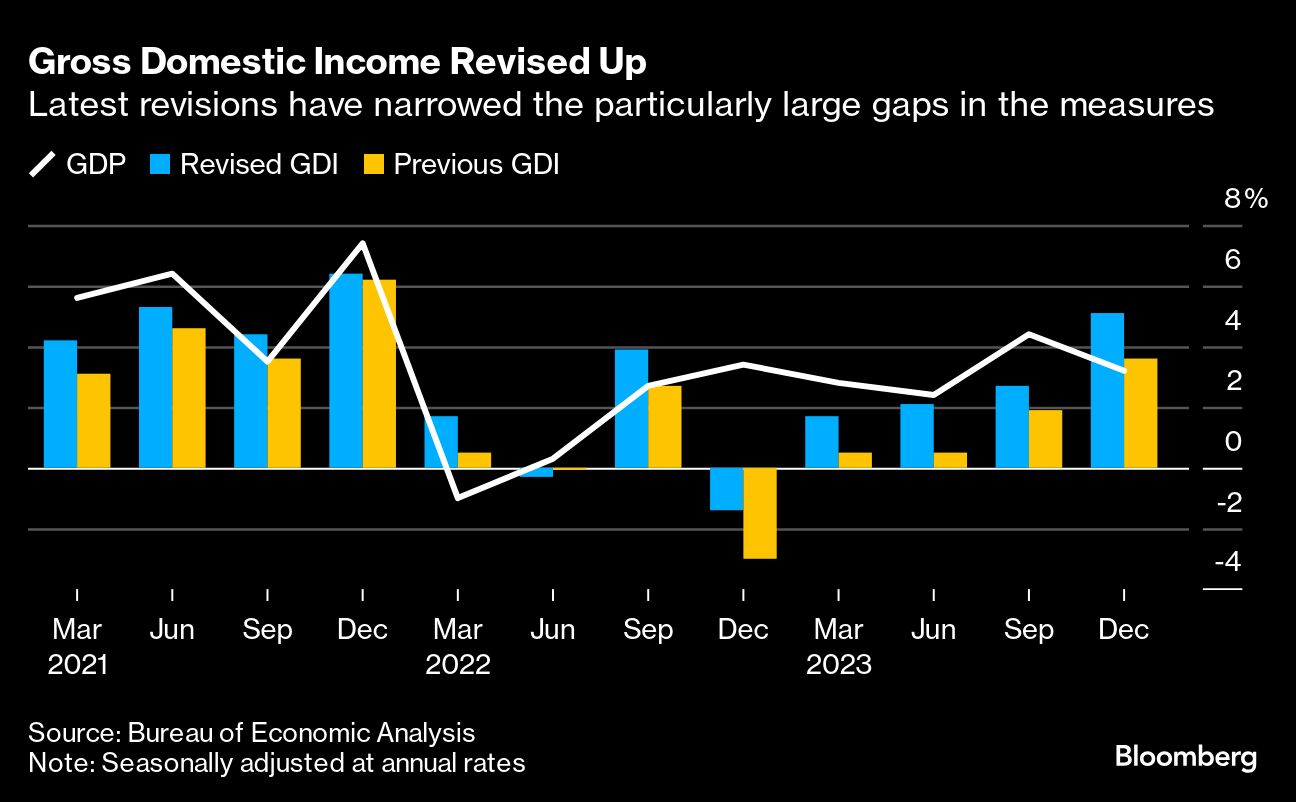
The government figures also showed an upward revision to 2023 gross domestic income, or the income generated and costs incurred from producing goods and services. Inflation-adjusted GDI growth last year was boosted to 1.7% from 0.4%.
Gross Domestic Product
Two things that stand out in the GDP portion of the update are the upward revision to second-quarter 2022 GDP and the modest softening of growth in the second half of last year. While still robust, growth was revised down 0.5 percentage point to 4.4% in the third quarter and 0.2 point to 3.2% in the fourth quarter of 2023 — indicating a little less momentum entering 2024.
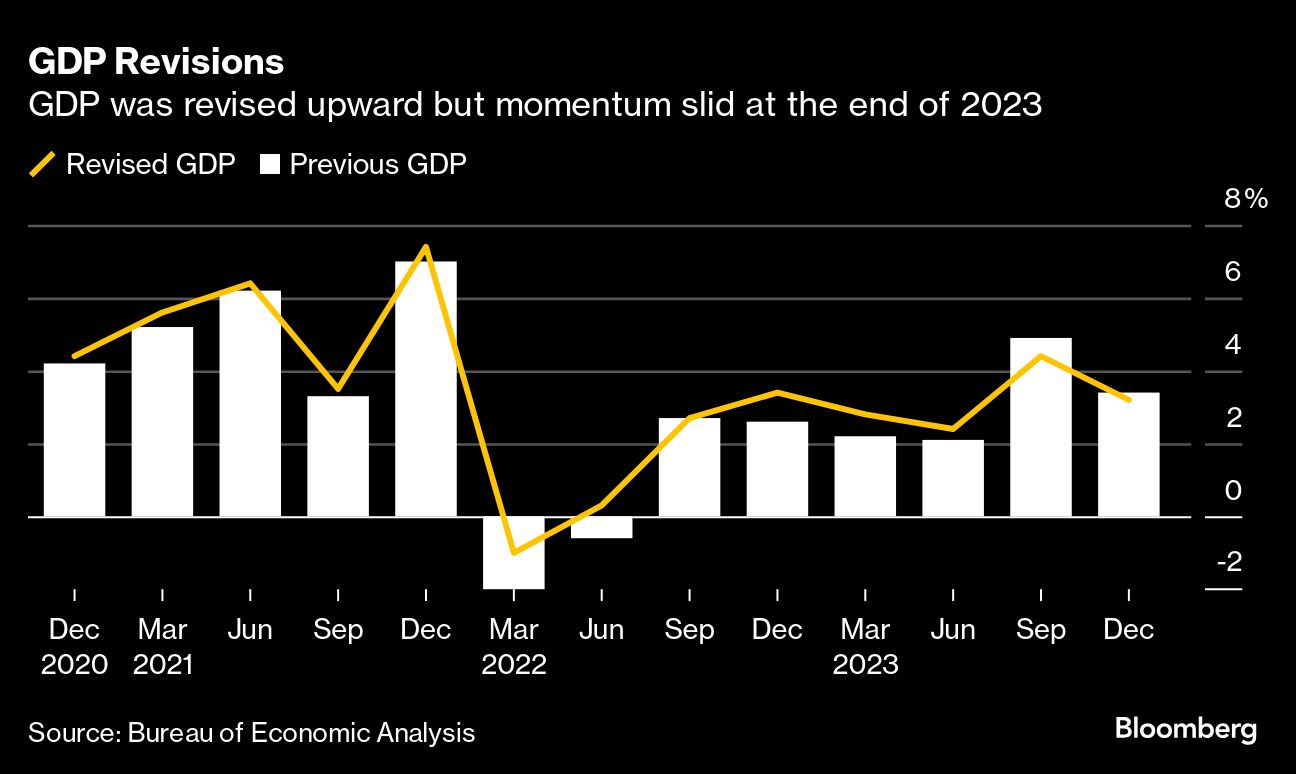
For 2022, the government revised up second-quarter GDP to a 0.3% increase from a decline of 0.6%. Previously, the data showed consecutive quarters of declining GDP that had fit the traditional definition of a recession, but in the US it's not official until economists at the National Bureau of Economic Research deem it so.
Gross Domestic Income
The annual revisions bring GDI — the total income earned by all sectors of an economy, including wages, profits, taxes, and rental income, while excluding subsidies — closer to GDP. The BEA update boosted 2022 national income by $240 billion and 2023 by almost $559 billion.
In theory, GDP and GDI should be equal, but in practice, the measures can occasionally offer differing pictures of the economy. The latest revisions helped narrow the differences. In 2023, GDI growth was revised up to 1.7% from 0.4%. Growth in 2022 GDI was revised to 2.8% from 2.1% and in 2021 it was revised up half a percentage point.
The revisions show that the ancillary income some Americans receive was more robust than previously measured too. These types of personal income including interest income, dividends and proprietors' income were marked higher in 2023. The strength may help explain why consumers were able to spend more freely than many thought possible.
The annual update also showed a sizable increase in corporate profits in the five years through 2023. Earnings were revised up $288.5 billion for 2023.
Inflation
The BEA update also showed the Federal Reserve's preferred inflation metric — the personal consumption expenditures price index — was revised only a touch higher last year. The price gauge rose 3.8% in 2023 – up from the 3.7% previously estimated. Excluding food and energy, the so-called core PCE price index was unrevised at 4.1%.
Business Cycles
After an abrupt downturn of the economy because of the pandemic, the subsequent rebound was quite strong. That snapback reflected trillions of dollars in fiscal spending and a swift reduction in interest rates. The expansion that started in the second quarter of 2020 is so far among the best since the aftermath of World War II.
The BEA's annual update is based on both newly available and revised data and includes revisions from the first quarter of 2019 through the fourth quarter of 2023.

-
Gold Is Rs 22,000 Cheaper Than A Month Ago. Should You Buy Amid The Wedding Season?

Gold's potential slide to $3,500 could save around Rs 4,700 per 10 grams, but a soft inflation print could just as easily push prices back up. One way to split the risk is to buy in parts, some now and the rest after the Fed's Dec. 9 decision.
-
AI Agents Are Gaining Power. Who Governs Them?
Artificial intelligence agents promise to transform productivity by moving machines from assisting decisions to executing them. But as organisations delegate greater authority to these AI-agents, they must first establish who controls that authority and who remains accountable when things go wrong.
-
Why Swapping Your Old Gold Can Trigger A Rs 5 Lakh Tax Bill, And How You Can Avoid It Legally
Swapping old gold for new is taxed as a sale and a fresh purchase. Getting your own gold remade can cut most of that bill, though it has its own costs.
-
The AI Trade is Done. The Real Opportunity for Investors Starts in 2027 | Unhedged Position
As pureplay AI stocks plunge and circular, capex-led financing unwinds, 2027 is set to be a year of reckoning for AI companies. Yet the bust clears the way for a better opportunity for investors in 2027 -- shifting the spotlight from AI builders to the companies using AI.
-
Leadership As Mission: Why The Age Of AI Demands More Human Leadership
Debjani Ghosh examines how AI is changing leadership, arguing that its success must be measured by its impact on people and the accountability of those guiding its use.
-
We May Need Another Tukaram Mundhe To Fight Air Pollution | The Reason Why
Developers may install basic measures such as sprinklers and green nets, resume work, and continue violating rules when this equipment stops working.
-
Extracting Value From Battery Scrap Could Be Challenging For India | The Reason Why
A discarded lithium-ion battery still contains valuable materials such as lithium, nickel and cobalt. These can be recovered and reused. When such batteries are crushed and shredded, they produce a dark powder called black mass.
-
One El Nino, India Can Handle. Two Could Break The Granary
India's grain stocks can absorb one bad year, but a second El Nino could drain the buffer in two to three years, economists say.
-
India's Troika Of Good Luck | Joining The Dots
As Jensen Huang's exit drags Nvidia down, a cooling AI trade and resilient earnings have revived investor interest in India. A likely RBI rate hike looms.
-
Talking Points This Week: Leadership Shock At Nvidia, Earnings Strength, And The Fog Over Hormuz
The Anthropic IPO pricing and first trading day, Nvidia's upcoming earnings, and any fresh signals from Iran will set the tone for the following week.









