Trump Eyes 100% Chips Tariff, But 0% for US Investors Like Apple
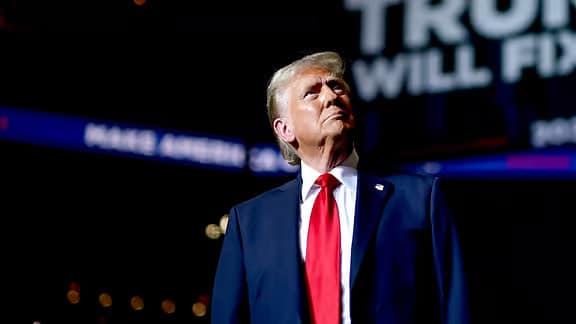
Donald Trump said he would impose a 100% tariff on imports that include semiconductors, though would exempt companies moving production back to the United States, as Apple Inc. CEO Tim Cook and the president announced a fresh $100 billion investment plan from the Oval Office.
“We're going to be putting a very large tariff on chips and semiconductors, but the good news for companies like Apple is, if you're building in the United States, or have committed to build, without question, committed to build in the United States, there will be no charge,” Trump told reporters.
“So in other words, we'll be putting a tariff of approximately 100% on chips and semiconductors. But if you're building in the United States of America, there's no charge,” Trump said. “Even though you're building and you're not producing yet, in terms of the big numbers of jobs and all of things building, if you're building, there will be no charge.”
The announcement amounts to a major victory for Apple and Cook, who have faced escalating threats from Trump's tariffs that threatened to ratchet up the cost of producing their signature phones and computers.
Apple's $100 billion US investment will include a new manufacturing program designed to bring more of Apple's production to the US. The company's American Manufacturing Program partners include glassmaker Corning Inc., Applied Materials Inc., Texas Instruments Inc. and others, the company said.
Corning will dedicate an entire factory in Kentucky to Apple glass production, increasing that company's workforce in the state by 50%, the iPhone maker said. Corning was already a supplier to Apple, making glass for the very first iPhone at the same factory.
Apple had previously pledged to spend $500 billion in the US over the next four years, a slight acceleration over its prior investments and previously announced plans, adding about $39 billion in spending and an additional 1,000 jobs annually. The announcement will bring Apple's cumulative commitment to $600 billion.
The previously-planned $500 billion is said to include work on a new server manufacturing facility in Houston, a supplier academy in Michigan and additional spending with its existing suppliers in the country.
The increased pledge comes as Trump escalates a tariff push that's set to raise costs for Apple throughout its international supply chains.
Trump plans to whack India — a key production market for Apple — with 50% tariffs, the first half of which takes effect just after midnight alongside a raft of other country-specific levies designed to reduce trade imbalances. The other half, to penalize India for buying Russian energy, will take effect later this month.
The president has said he could unveil separate levies on all products containing semiconductor chips as soon as next week.
Cook, who attended the president's inauguration and donated to his inaugural committee, has pushed for tariff exemptions for his company's iPhones. Most iPhones sold in the US come from India, while the bulk of other products, including Apple Watches, iPads and MacBooks, are manufactured in Vietnam, which was hit with a 20% tariff.
While details of those tariffs — and how firms would qualify for exemptions — have yet to be released, Trump singled out Cook's Apple as an example of how to avoid the increased levies.
Cook's investment echoes dozens of pledges from companies since Trump won the 2024 presidential election, with CEOs flying to his Mar-a-Lago resort in Florida, and then to the White House once he was sworn in, to court the new administration and announce hundreds of billions of dollars worth of new deals.
Many of these investments were already in the works prior to the November election, or were on par with previous investment trends, Bloomberg previously reported. Economists have also questioned whether all of the pledged spending, and associated job opportunities, will come to fruition.
Apple's promised investments, while substantial, fall short of the full shift to US-based production that Trump and top White House officials have envisioned and encouraged. Earlier this year, the president threatened to impose a tariff of at least 25% on Apple if it didn't move manufacturing of the iPhone to the US, a day after he met with Cook at the White House.
Cook told the president that final iPhone assembly “will be elsewhere for a while,” though highlighted that several components are being made in the US.
Trump, seemingly satisfied, praised the Apple leader's plans.
“Look, he's not making this kind of an investment anywhere in the world, not even close,” Trump said of Cook. “He's coming back. I mean, Apple's coming back to America.”

-
One Battle After Another: India's Corporate Dynasties Battle For Control

2026 could go down as Corporate India's year of succession wars, governance battles and family fault lines.
-
Rs 50-Lakh Gold In Bank Locker, Rs 3 Lakh Of Protection: The Gap Most Families Don't Know About
The RBI ties a bank's liability to the annual locker rent and families who want to insure their jewellery face a separate question about how to prove what was inside.
-
The More Food Turns Into Fuel, The Harder It Is To Read Agricultural Markets | The Reason Why
A policy designed to reduce dependence on imported fuel can create new pressures elsewhere in the food economy.
-
Your iPhone Costs 12 Grams Of Gold, A Car About 100. What Does Your Life Weigh?
Measured in rupees, almost everything looks more expensive than it did a generation ago. Measured in grams of gold, a lot of it has become cheaper.
-
Gold Is Rs 22,000 Cheaper Than A Month Ago. Should You Buy Amid The Wedding Season?
Gold's potential slide to $3,500 could save around Rs 4,700 per 10 grams, but a soft inflation print could just as easily push prices back up. One way to split the risk is to buy in parts, some now and the rest after the Fed's Dec. 9 decision.
-
AI Agents Are Gaining Power. Who Governs Them?
Artificial intelligence agents promise to transform productivity by moving machines from assisting decisions to executing them. But as organisations delegate greater authority to these AI-agents, they must first establish who controls that authority and who remains accountable when things go wrong.
-
Why Swapping Your Old Gold Can Trigger A Rs 5 Lakh Tax Bill, And How You Can Avoid It Legally
Swapping old gold for new is taxed as a sale and a fresh purchase. Getting your own gold remade can cut most of that bill, though it has its own costs.
-
The AI Trade is Done. The Real Opportunity for Investors Starts in 2027 | Unhedged Position
As pureplay AI stocks plunge and circular, capex-led financing unwinds, 2027 is set to be a year of reckoning for AI companies. Yet the bust clears the way for a better opportunity for investors in 2027 -- shifting the spotlight from AI builders to the companies using AI.
-
Leadership As Mission: Why The Age Of AI Demands More Human Leadership
Debjani Ghosh examines how AI is changing leadership, arguing that its success must be measured by its impact on people and the accountability of those guiding its use.
-
We May Need Another Tukaram Mundhe To Fight Air Pollution | The Reason Why
Developers may install basic measures such as sprinklers and green nets, resume work, and continue violating rules when this equipment stops working.









