SoftBank’s Shares Dive After Nvidia Sale Spooks AI-Wary Market

SoftBank Group Corp.'s stock slid as much as 10% after the tech investor's exit from AI sector leader Nvidia Corp. spooked investors already nervous about climbing tech sector valuations.
The Japanese company's shares touched a one-month low during early morning trading in Tokyo. That's after SoftBank on Tuesday disclosed it had sold its entire stake in Nvidia Corp. for $5.83 billion to help bankroll AI investments. The fall came despite better-than-projected quarterly results from SoftBank, which also disclosed a 4-for-1 stock split.
SoftBank's Nvidia exit coincides with a growing debate about whether spending by big tech firms like Meta Platforms Inc. and Alphabet Inc. — expected to surpass $1 trillion in coming years — will produce commensurate returns. Investors have begun to question the amount of capital pouring into a technology with uncertain returns, and outsized gains in most of the companies considered frontrunners in that race to build and develop AI. Nvidia's shares slid as much as 3.9% in US trading, after climbing 48% this year through Monday's close.
SoftBank founder Masayoshi Son has been unwinding positions to pay for a plethora of AI projects, including Stargate data centers with OpenAI and Oracle Corp.
“The value of the company fluctuates on the market's assessment of the value of its investments, so we think the shares are likely to prove to be highly volatile up ahead,” Citigroup analyst Keiichi Yoneshima wrote in a note. “But with NAV on an expansionary trajectory, we think investors will warm to the shares.”
His company is keen to become a leading player in that growing ecosystem, with plans to leverage stakes in sector linchpins from OpenAI to US chip designer Ampere Computing LLC. On Tuesday, SoftBank executives sidestepped questions about whether the industry is fomenting an AI investment bubble, and said the sale had nothing to do with Nvidia itself but was a necessary financing measure.
“I can't say if we're in an AI bubble or not,” Chief Financial Officer Yoshimitsu Goto said during an earnings conference. SoftBank sold Nvidia “so that the capital can be utilized for our financing,” he added, without elaborating.
SoftBank has sold out of Nvidia once before, in 2019. The company resumed buying small stakes in Nvidia in 2020 — two years before the advent of ChatGPT ignited a historic rally. It disclosed that it increased its stake in the US chipmaker to around $3 billion at the end of March. It's done well just on that measure: Nvidia has gained more than $2 trillion of market value since.
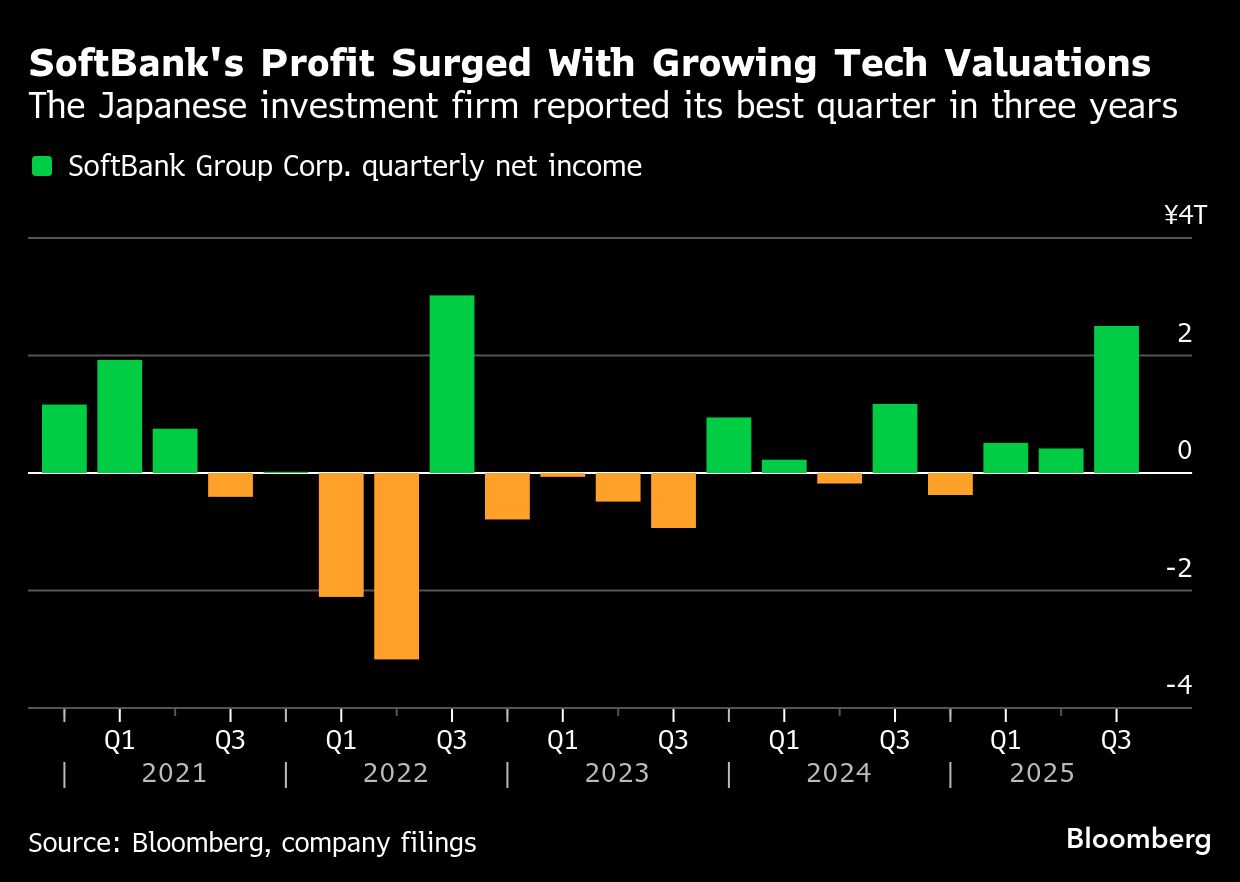
That rally, along with its investment in OpenAI, helped prop up SoftBank's bottom line. The Japanese company reported a surprise net income of ¥2.5 trillion ($16.2 billion) in its fiscal second quarter, far outrunning the average of analyst estimates of ¥418.2 billion. OpenAI's value has risen $14.6 billion since SoftBank invested, Goto said.

-
High US Salaries, No Green Card Certainty: The Financial Calculation Facing Indian H-1B Families

The suspension of PERM processing at eight technology employers does not cancel existing H-1B visas. What it does is force a question many Indian families have been avoiding: is the US salary worth tying your career and family plans to one employer?
-
Swiggy vs Eternal: Food Delivery's Two Rivals Are No Longer In The Same Race
Eternal is building a private AI assistant, dark.ai. Swiggy is still working out how to make Instamart pay, with an operating loss of Rs 895 crore in the July-September quarter while Blinkit stayed profitable.
-
Where You Live Shapes How You Get To Work | The Reason Why
Two-wheelers are the most popular way to get to work in India, accounting for nearly 43% of workplace commutes.
-
Unhedged Position: Can India See An Indonesia-Style Time Correction?
The Nifty is trading below levels it first clocked in 2024. Is there, then, as I have suggested in the headline, potential that the current time correction drags on painfully for the next three-five, even ten years?
-
Navigating Friction And Energy Realities: An Analysis Of Marco Rubio's October Visit To India
Occurring at a critical juncture marked by stalled trade negotiations and escalating geopolitical pressures over global energy supplies, the visit offers a profound window into modern US-India relations.
-
India Exports Capital. Why Not Export Trusteeship?
The big question, then, is whether India can build an institution that global borrowers, investors, banks, and lawyers can trust, even without an Indian connection.
-
France's Economy & Politics Are In Crisis | The Reason Why
Let's look at how the French economy and politics evolved under Nicolas Sarkozy, Franois Hollande and Emmanuel Macron.
-
You May Inherit The Business. You Must Earn Its Credibility.
Succession tests the founder's ability to share authority as much as it tests the next generation's readiness to assume it.
-
Signing Deals Is One Thing; Making Them Work Is Another | The Week In Whys
Sometimes, things don't turn out as planned. Indian companies have lost some bids to rivals, some projects won't produce until 2030.
-
FOMC Wall, PERM Suspension, Hospital Stocks | Talking Points This Week
A PERM suspension would directly affect green-card sponsorship rather than H-1B visas, so the near-term earnings impact could remain relatively limited. The key question is whether this marks a new phase in US scrutiny of Indian IT.









