Bowman Says Fed Should Use Smallest Possible Balance Sheet
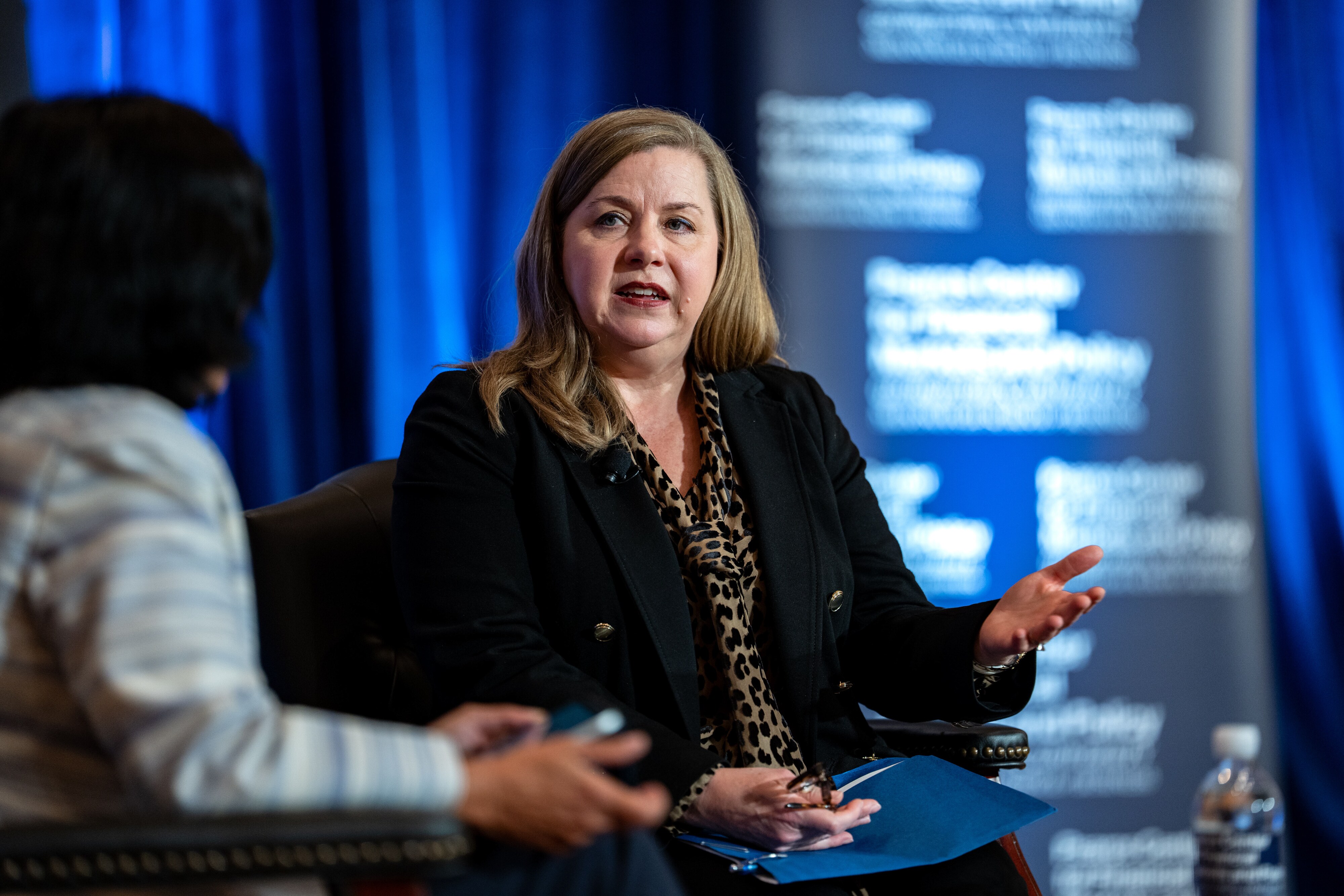
Federal Reserve Vice Chair for Supervision Michelle Bowman said the US central bank should seek to achieve the smallest balance sheet possible and overhaul its regime for implementing monetary policy.
“Over the longer run, my preference is to maintain the smallest balance sheet possible with reserve balances at a level closer to scarce than ample,” Bowman said Friday in prepared remarks for a speech at the Forecasters Club of New York.
Bowman argued that returning to a regime where the Fed is actively managing the balance sheet would give it better indications of market stress and functioning issues.
“Allowing a modest amount of volatility in money markets can enhance our understanding of market clearing points,” Bowman said.
The Fed moved to a rate-control framework called the ample reserves regime following the financial crisis, when historic stimulus measures and new regulations lifting the amount of capital banks were required to hold flooded markets with dollars. Before that, the Fed conducted large daily operations in markets, buying and selling Treasuries to ensure that its benchmark interest rate traded close to its target.
Bowman, who has been mentioned as a candidate to replace Jerome Powell when his term as chair expires next year, also said she supported holding only Treasuries on the Fed's balance sheet, with maturities tilted slightly to shorter-dated securities instead of perfectly mirroring those of the broader market. This would give the Fed more flexibility, she said.

The Fed should consider actively selling its mortgage-backed securities holdings, Bowman added.
“Simply relying on MBS runoff will not allow returning to a Treasury-only portfolio within a credible time frame,” she said.
The Fed's balance sheet ballooned to nearly $9 trillion following the pandemic, when the Fed bought large amounts of Treasuries and MBS in a bid to support markets and the economy. It has dropped to $6.6 trillion since then, but the Fed has in recent months slowed the pace at which it's shrinking the balance sheet, fearful of draining too many reserves from the financial system and causing stress in markets.
Emergency Lending
Bowman said she also favors restricting the use of the Fed's emergency lending powers and tools to use strictly during a crisis.
“Institutionalizing an activity that was created to temporarily respond to emergency conditions essentially normalizes an extreme emergency response to market illiquidity,” Bowman said.
While she supported the decision in 2021 to create the Standing Repo Facility, she said she did so with “significant reservations.” Bowman said she supports making changes to the tool to reinforce that it should only be used as a backstop during times of market dysfunction.
On monetary policy, Bowman reiterated her view that it's time for the Fed's rate-setting committee to act “decisively and proactively to address decreasing labor market dynamism and emerging signs of fragility.”
Still, she signaled that, for now, she may not be in favor cutting by more than a quarter-point at any one meeting.
“I do see risks to the labor market, but I would prefer that we take things with a gradual approach, and that we signal that we're watching carefully, that we're closely looking at signs of deterioration that would allow us to continue” to be proactive.
Bowman favored a rate cut in July when her colleagues held rates steady and supported the decision last week to lower rates by a quarter percentage point.

-
High US Salaries, No Green Card Certainty: The Financial Calculation Facing Indian H-1B Families

The suspension of PERM processing at eight technology employers does not cancel existing H-1B visas. What it does is force a question many Indian families have been avoiding: is the US salary worth tying your career and family plans to one employer?
-
Swiggy vs Eternal: Food Delivery's Two Rivals Are No Longer In The Same Race
Eternal is building a private AI assistant, dark.ai. Swiggy is still working out how to make Instamart pay, with an operating loss of Rs 895 crore in the July-September quarter while Blinkit stayed profitable.
-
Where You Live Shapes How You Get To Work | The Reason Why
Two-wheelers are the most popular way to get to work in India, accounting for nearly 43% of workplace commutes.
-
Unhedged Position: Can India See An Indonesia-Style Time Correction?
The Nifty is trading below levels it first clocked in 2024. Is there, then, as I have suggested in the headline, potential that the current time correction drags on painfully for the next three-five, even ten years?
-
Navigating Friction And Energy Realities: An Analysis Of Marco Rubio's October Visit To India
Occurring at a critical juncture marked by stalled trade negotiations and escalating geopolitical pressures over global energy supplies, the visit offers a profound window into modern US-India relations.
-
India Exports Capital. Why Not Export Trusteeship?
The big question, then, is whether India can build an institution that global borrowers, investors, banks, and lawyers can trust, even without an Indian connection.
-
France's Economy & Politics Are In Crisis | The Reason Why
Let's look at how the French economy and politics evolved under Nicolas Sarkozy, Franois Hollande and Emmanuel Macron.
-
You May Inherit The Business. You Must Earn Its Credibility.
Succession tests the founder's ability to share authority as much as it tests the next generation's readiness to assume it.
-
Signing Deals Is One Thing; Making Them Work Is Another | The Week In Whys
Sometimes, things don't turn out as planned. Indian companies have lost some bids to rivals, some projects won't produce until 2030.
-
FOMC Wall, PERM Suspension, Hospital Stocks | Talking Points This Week
A PERM suspension would directly affect green-card sponsorship rather than H-1B visas, so the near-term earnings impact could remain relatively limited. The key question is whether this marks a new phase in US scrutiny of Indian IT.









