India Hits Out At IMF for Saying Currency Intervention Excessive
(Bloomberg) -- India pushed back against the International Monetary Fund for saying the central bank's intervention in the foreign-exchange market was excessive, implying that the country was trying to influence the level of the rupee.
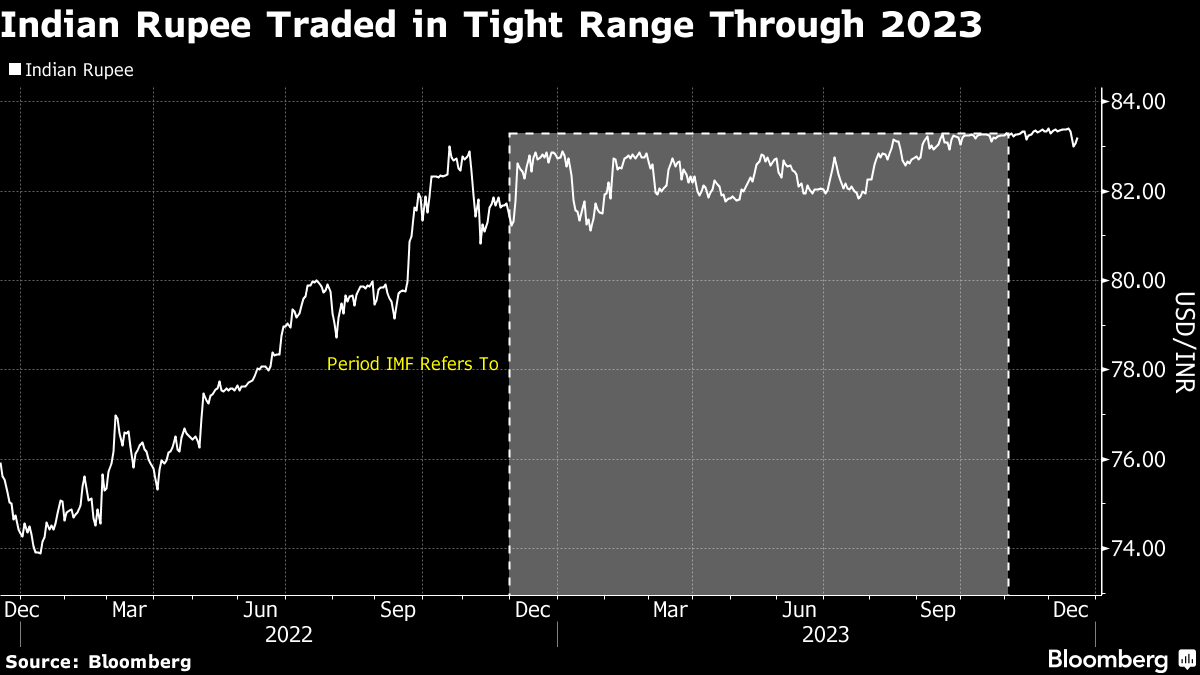
The Washington-based lender said the currency moved within a very narrow range from December 2022 to October 2023, suggesting the central bank's intervention “likely exceeded levels necessary to address disorderly market conditions.”
As a result, the IMF reclassified India's foreign-exchange regime to a “stabilized arrangement” from a “floating” system, it said in its annual Article IV country report released on Monday.
India “strongly disagreed” with the assessment, calling it “unjustified,” the IMF said. The Reserve Bank of India stated that the period was restricted to a short-term, and that the IMF's assessment would fail over a two- to five-year horizon, the fund said.
“The RBI strongly believes that such a view is incorrect as, in their view, it uses data selectively,” the IMF said in its report. A RBI spokesperson didn't immediately respond to text messages seeking further information.
The rupee weakened about 2% against the dollar between December 2022 and October 2023, after falling about 8% in the prior 12 months. The RBI is estimated to have intervened to the tune of $78 billion dollars in those nine months, according to Bloomberg Economics. The country's FX reserves of $604 billion is approaching the record high $642.5 billion reached in 2021.
Top officials from the RBI have repeatedly said the central bank doesn't target a level for the rupee, but intervenes in the currency market to smoothen volatility. Indian officials remain sensitive to the issue, though, since the US Treasury has placed India on its monitoring list of potential currency manipulators on and off since 2018. India hasn't been on the bi-annual watchlist since November 2022.
During the IMF's annual meetings in October, RBI Governor Shaktikanta Das criticized the Treasury's practice of putting countries on the watchlist. He said emerging markets like India need to build up their reserve buffers to offset global risks.
Michael Wan, a senior currency analyst at MUFG Bank Ltd., said it's unlikely India would be labeled a currency manipulator by the US as the central bank's intervention hasn't exceeded 2% of gross domestic product over a 12-month period.
“Looking ahead into 2024, RBI should ease some control over the rupee,” he said. “The dollar is expected to weaken in 2024, and so RBI should allow the rupee to strengthen in line with peers.”
In its Article IV report, the IMF gave a fairly optimistic outlook for India's economy, saying it has the potential to grow faster than the fund's forecast of 6.3% in the current and next fiscal years if the government undertakes key structural reforms.
India needs “ambitious” fiscal consolidation over the medium term in order to curb its public debt, the IMF said in an accompanying statement to its report. The central bank's current neutral monetary policy stance was “appropriate,” and should help bring inflation back to the 4% target, it said.
--With assistance from Karl Lester M. Yap.
(Updates with details of currency intervention, analyst comment.)
More stories like this are available on bloomberg.com
©2023 Bloomberg L.P.

-
Why Swapping Your Old Gold Can Trigger A Rs 5 Lakh Tax Bill, And How You Can Avoid It Legally

Swapping old gold for new is taxed as a sale and a fresh purchase. Getting your own gold remade can cut most of that bill, though it has its own costs.
-
The AI Trade is Done. The Real Opportunity for Investors Starts in 2027 | Unhedged Position
As pureplay AI stocks plunge and circular, capex-led financing unwinds, 2027 is set to be a year of reckoning for AI companies. Yet the bust clears the way for a better opportunity for investors in 2027 -- shifting the spotlight from AI builders to the companies using AI.
-
Leadership As Mission: Why The Age Of AI Demands More Human Leadership
Debjani Ghosh examines how AI is changing leadership, arguing that its success must be measured by its impact on people and the accountability of those guiding its use.
-
We May Need Another Tukaram Mundhe To Fight Air Pollution | The Reason Why
Developers may install basic measures such as sprinklers and green nets, resume work, and continue violating rules when this equipment stops working.
-
Extracting Value From Battery Scrap Could Be Challenging For India | The Reason Why
A discarded lithium-ion battery still contains valuable materials such as lithium, nickel and cobalt. These can be recovered and reused. When such batteries are crushed and shredded, they produce a dark powder called black mass.
-
One El Nino, India Can Handle. Two Could Break The Granary
India's grain stocks can absorb one bad year, but a second El Nino could drain the buffer in two to three years, economists say.
-
India's Troika Of Good Luck | Joining The Dots
As Jensen Huang's exit drags Nvidia down, a cooling AI trade and resilient earnings have revived investor interest in India. A likely RBI rate hike looms.
-
Talking Points This Week: Leadership Shock At Nvidia, Earnings Strength, And The Fog Over Hormuz
The Anthropic IPO pricing and first trading day, Nvidia's upcoming earnings, and any fresh signals from Iran will set the tone for the following week.
-
Signature Play: The Classic Cocktail Is Dead. Or Is It?
Classic cocktails are disappearing from India's cocktail menus. But they're still being ordered, taught to bartenders and borrowed from. So, who's really having the last drink?
-
A New Samvat Wishlist: Inclusive Prosperity And Human Development
India has strengthened its economic foundations through infrastructure, digital access and enterprise. Its next growth chapter must deepen productivity, create better livelihoods and widen participation in prosperity.









