Who Pays To Keep India's Offshore Wind Ambitions Afloat?
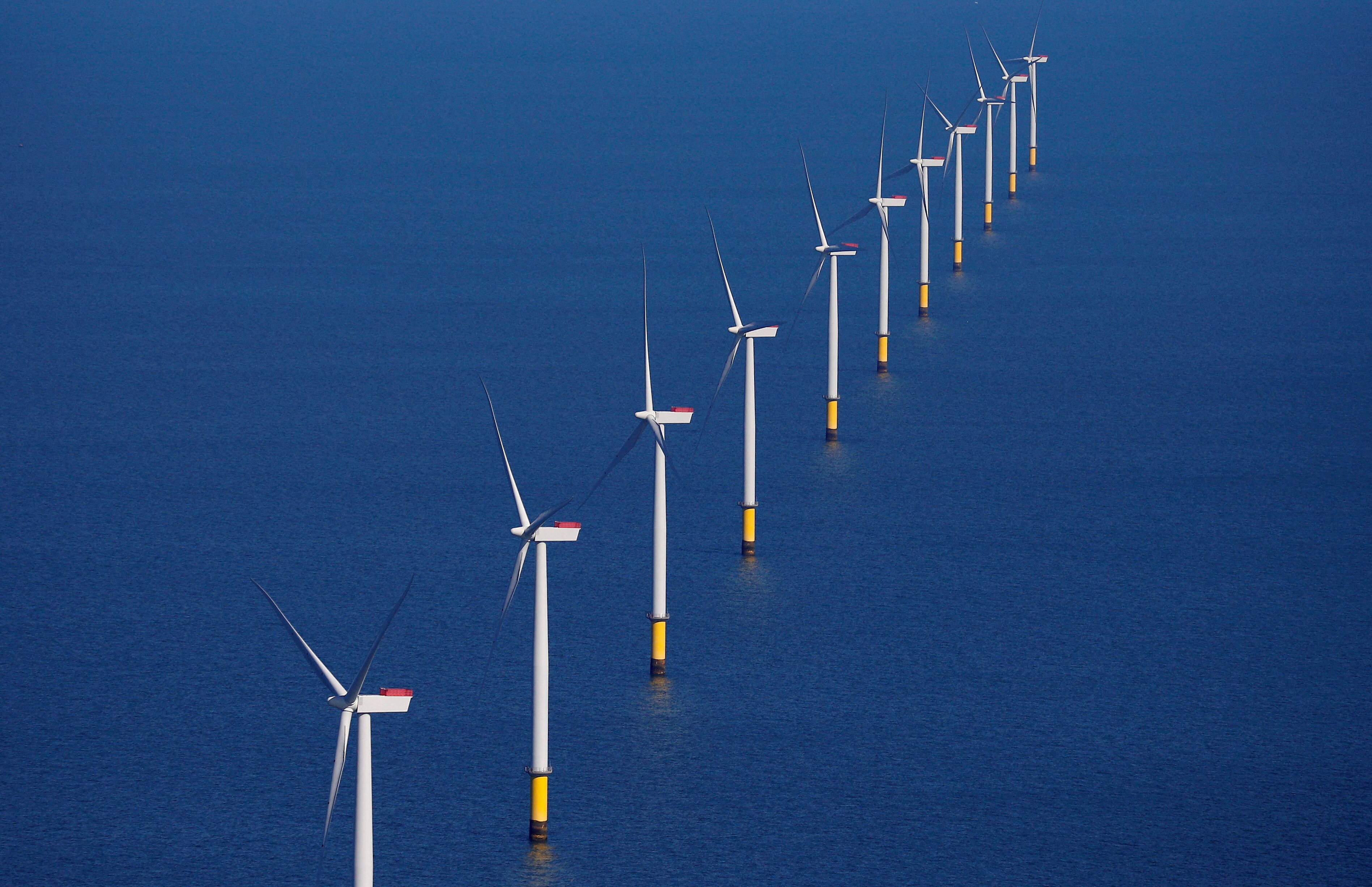
Seven years. Two targets. And still, no project in sight.
That's the story of India's offshore wind ambitions. It has been over half a decade since the country announced a policy for setting up large electricity-producing wind turbines in the open sea. Not even one has taken off.
The country planned 5 gigawatts of offshore capacity by 2022, and 30 GW by 2030. The first planned project of 1 GW capacity off the coast of Gujarat had attracted interest from 35 developers in 2018. But the tender has not been floated, yet.
"Matters on offshore have been very slow," said Tulsi Tanti, chairman of the Indian Wind Turbine Manufacturers Association, and the Suzlon Group.
"Such projects are not viable unless backed by a viability gap funding," he said, referring to support offered to make up for losses. "Several players were interested but due to uncertainty of tariff things have been pending."
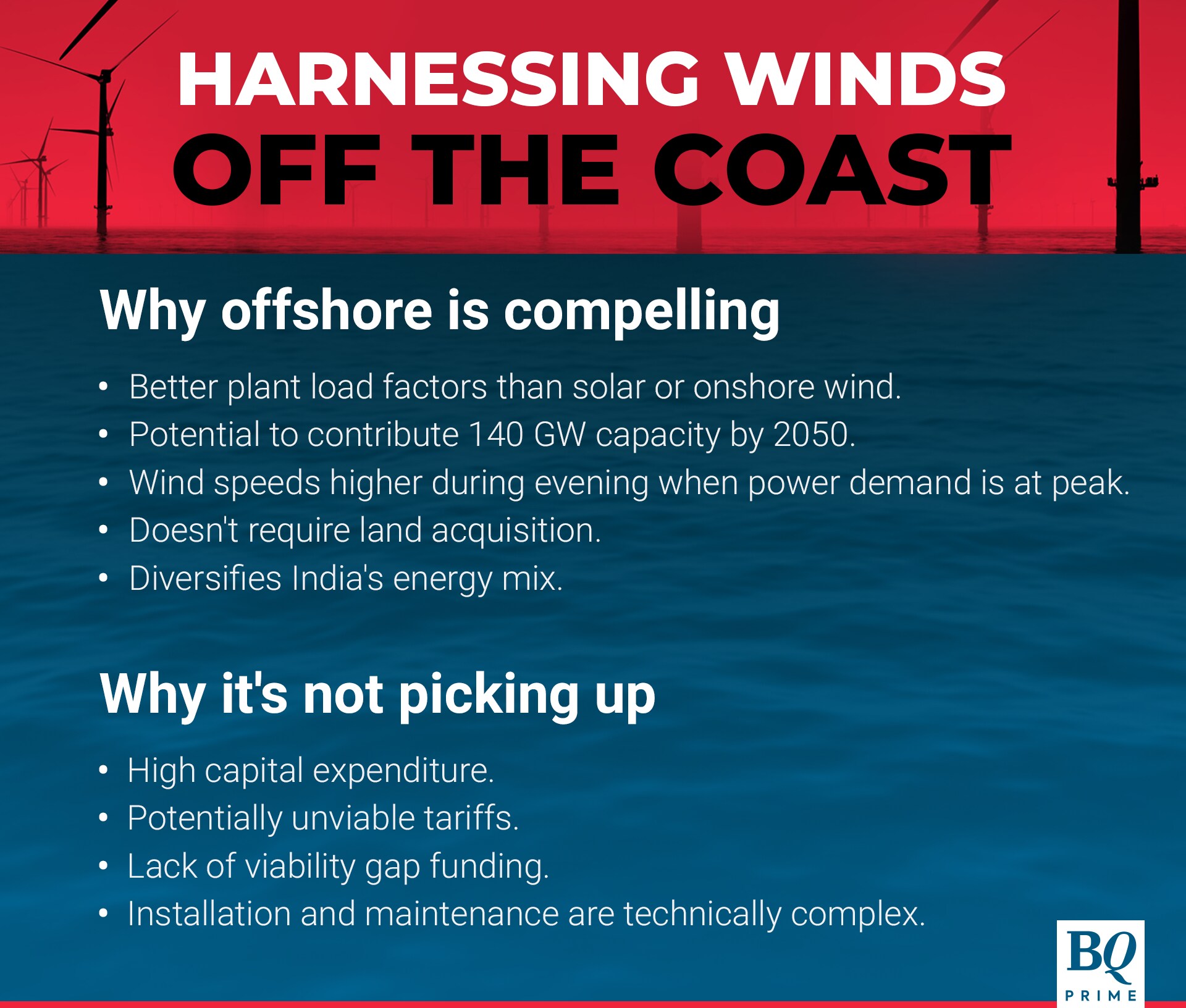
The snail's pace of progress belies the country's massive potential for harnessing offshore wind power. According to the central government's own estimates, the 7,600-kilometre-long coastline can generate 140 GW of power by 2050. That's more than half of the country's 201 GW peak power demand.
There are obvious advantages an offshore wind system over conventional power sources. It has significantly better plant load factors of 50-55% compared to 30-35% for onshore wind and solar. No requirement of land acquisition, usually a long-drawn process, makes setting up plants smoother.
Offshore wind is also a compelling addition to the energy mix, especially given the ambition to phase out coal. It can take care of energy requirements in the evening, when wind speeds are higher, power demand is at its peak and solar energy is intermittent. Replacing 1 GW of coal requires at least 3 GW of solar power. The ratios are much better with offshore wind, meaning fewer installation can draw more power.
Tata Power Renewables recently signed a memorandum of understanding with Germany's RWE Renewables to explore offshore wind power. India's Minister of Power RK Singh also promised the government will invite bids for up to 2GW of projects soon and has been inviting European nations to invest.
Still, the problem of high capital costs persists. Offshore wind turbines can cost up to three times more than the onshore equipment, according to a March 2021 report by the Lok Sabha's 17th Standing Committee on Energy. Technical complexity of installation and maintenance push costs higher.
Developers are left asking just one question: who pays for that?
"The challenge is that higher capex requirement results into a higher tariff," said Ashish Khanna, president of Tata Power Renewables told BQ Prime. "When you're looking at a tariff of about Rs 2-3 per unit for solar and onshore wind, and you look at the tariffs in offshore, which can be multiples of that, then why will you invest the money?"
You need a trigger. Guys like us need to smell it, that there's a business opportunity there.Ashish Khanna, President, Tata Power Renewables
JMK Research estimates that power tariffs from offshore wind in India will be between Rs 7-9 a unit, nearly the thrice of what conventional renewable sources offer.
To bring costs down, India will need to scale up operations massively, said Shirish Garud, director of renewable energy technologies at The Energy and Resources Institute. "But to get to that level of scale without any prior experience is very hard."
Tata Power said it is the exact reason why they are collaborating with RWE. "We have never worked in this field. No one has in this country," Khanna said. "There are countries who've adopted offshore way before us. Let's learn from them."
He alludes to European nations like Germany, the U.K. and Denmark, which have made large strides in offshore wind power, partly thanks to the great wind speeds in the North Sea.
Kashish Shah, energy analyst at the Institute for Energy Economics and Financial Analysis, explains that globally there has been a massive deflation in offshore wind power prices. On average, he said, the price was around $207 per megawatt hour in 2010. Now it has fallen by three-fourths to around $42 per MwH.
"In the Indian context that is roughly Rs 3.5 per unit," Shah said. "But that has come down in Europe over the years because they've built capacity and expertise. In India, that is completely absent."
We will have to begin with a price premium. Either the consumer pays more, or the government subsidises it.Kashish Shah, Energy Analyst, IEEFA
And there lies the missing piece of the puzzle—viability gap funding.
"Viability funding on capex and perhaps also on tariff to begin with is extremely important," Tanti said. "My first and foremost expectation from the central government is to enable VGF on capex, resulting in project internal return rate of 14% with a determined tariff."
India provides financial support to public-private infrastructure projects through the viability gap funding scheme. It has not been sanctioned yet for the first planned offshore wind project in Gujarat.
At a wind energy conference in April, Minister of New and Renewable Energy official Prabir Kumar Das said the VGF sanction of up to Rs 15,000 crore is pending with the Ministry of Finance. If it comes this year, then the bidding for the Gujarat tender can go ahead.
BQ Prime awaits responses to queries on the status of VGF emailed to the renewable ministry's Joint Secretary Dinesh Dayanand Jagdale, who handles all administrative and financial matters for onshore and offshore wind energy.
There are other ways of saving on costs, according to Ajay Devaraj, secretary of the India Wind Power Association. "One way is to develop floating energy islands with other complementary things like solar or desalination units on it. That help can bring overall costs down."
That's something the Tamil Nadu government is planning to set up with the help of the Denmark government in the Gulf of Mannar.
Another is to start manufacturing the larger, 60-tonne-plus offshore wind turbines locally, Devaraj said.
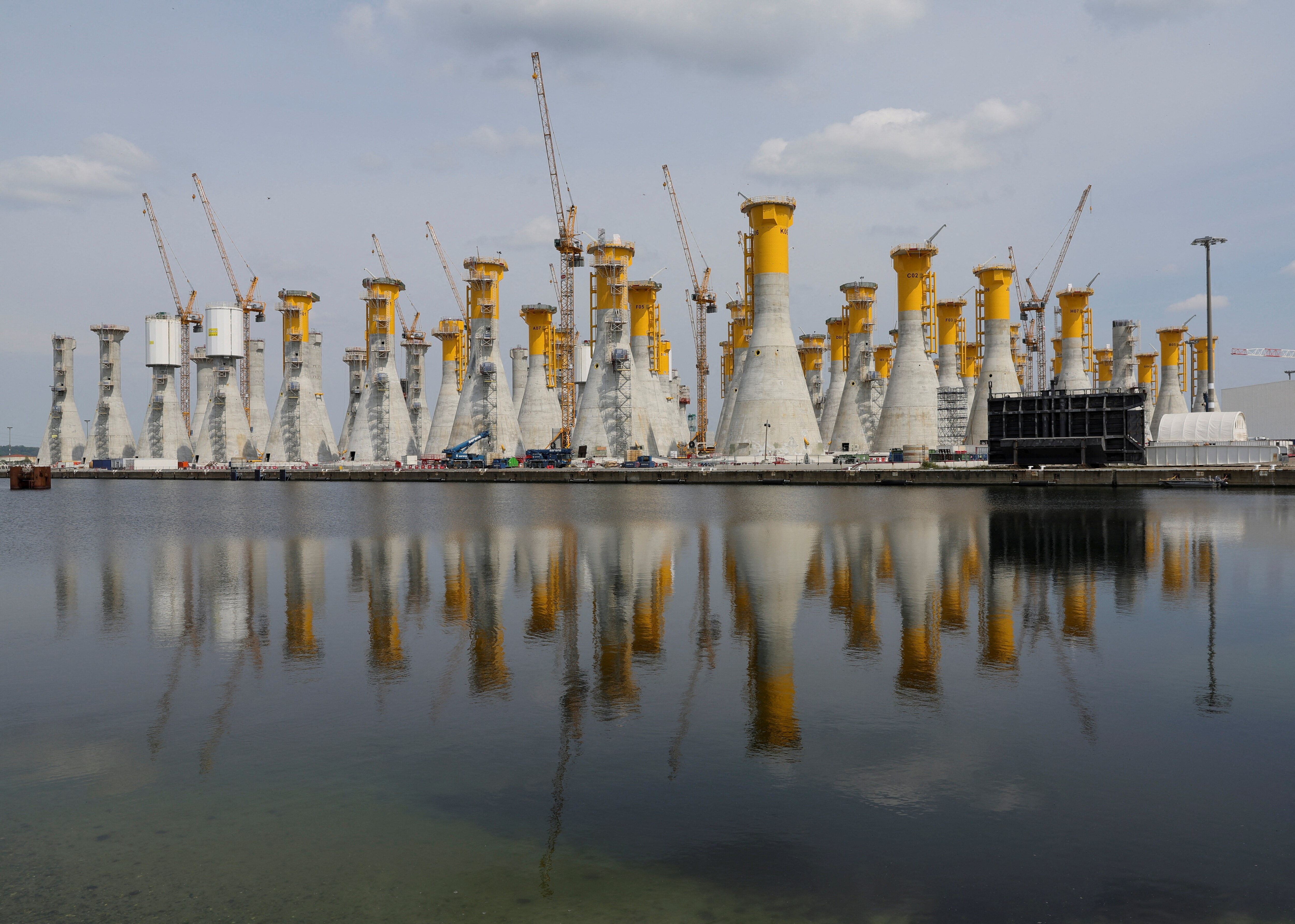
A general view shows the construction site for the foundations of wind turbines for the Fecamp offshore park, in Le Havre, Normandy, France. [REUTERS/Pascal Rossignol]
That's not easy. "Unless the manufacturers see a long-term offtake for offshore wind, and they see a viable business there, they may not like to invest in manufacturing," Khanna said. "Although if tenders start flowing, I am very confident that we will have Made-In-India turbines."
Shah agreed. "We need assemblies and capacities near the port. It is a long-term strategy to create an entire value chain. I don't see that happening at least in the medium term."
India has set a target of installing 30 GW of offshore wind by 2030. It missed its earlier target of 5GW by 2022.
Shah said while the targets are not realistic, they should not be seen as set in stone. But instead as way to give visibility, intention and scope to the industry.
"I've always said about India's targets," Shah said. "They aim for the moon, so that they at least end up on the treetop."

-
One Battle After Another: India's Corporate Dynasties Battle For Control

2026 could go down as Corporate India's year of succession wars, governance battles and family fault lines.
-
Rs 50-Lakh Gold In Bank Locker, Rs 3 Lakh Of Protection: The Gap Most Families Don't Know About
The RBI ties a bank's liability to the annual locker rent and families who want to insure their jewellery face a separate question about how to prove what was inside.
-
The More Food Turns Into Fuel, The Harder It Is To Read Agricultural Markets | The Reason Why
A policy designed to reduce dependence on imported fuel can create new pressures elsewhere in the food economy.
-
Your iPhone Costs 12 Grams Of Gold, A Car About 100. What Does Your Life Weigh?
Measured in rupees, almost everything looks more expensive than it did a generation ago. Measured in grams of gold, a lot of it has become cheaper.
-
Gold Is Rs 22,000 Cheaper Than A Month Ago. Should You Buy Amid The Wedding Season?
Gold's potential slide to $3,500 could save around Rs 4,700 per 10 grams, but a soft inflation print could just as easily push prices back up. One way to split the risk is to buy in parts, some now and the rest after the Fed's Dec. 9 decision.
-
AI Agents Are Gaining Power. Who Governs Them?
Artificial intelligence agents promise to transform productivity by moving machines from assisting decisions to executing them. But as organisations delegate greater authority to these AI-agents, they must first establish who controls that authority and who remains accountable when things go wrong.
-
Why Swapping Your Old Gold Can Trigger A Rs 5 Lakh Tax Bill, And How You Can Avoid It Legally
Swapping old gold for new is taxed as a sale and a fresh purchase. Getting your own gold remade can cut most of that bill, though it has its own costs.
-
The AI Trade is Done. The Real Opportunity for Investors Starts in 2027 | Unhedged Position
As pureplay AI stocks plunge and circular, capex-led financing unwinds, 2027 is set to be a year of reckoning for AI companies. Yet the bust clears the way for a better opportunity for investors in 2027 -- shifting the spotlight from AI builders to the companies using AI.
-
Leadership As Mission: Why The Age Of AI Demands More Human Leadership
Debjani Ghosh examines how AI is changing leadership, arguing that its success must be measured by its impact on people and the accountability of those guiding its use.
-
We May Need Another Tukaram Mundhe To Fight Air Pollution | The Reason Why
Developers may install basic measures such as sprinklers and green nets, resume work, and continue violating rules when this equipment stops working.









