What Market Watchers Say About China Unrest And The Global Impact
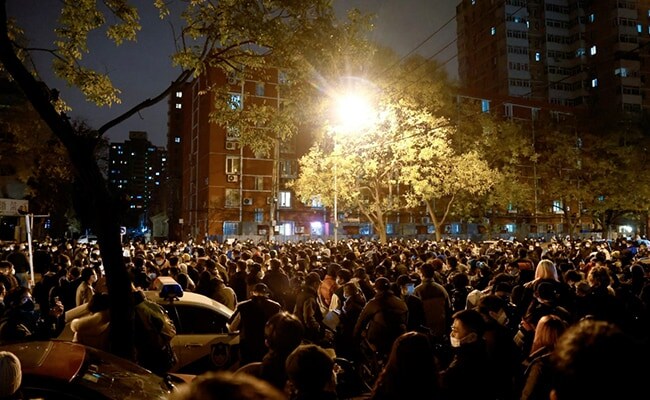
As anger over China's strict zero COVID-19 policy intensifies, residents in some major cities took to the streets at the weekend, clashing with police over restrictions that have taken a heavy toll on the economy and people's freedoms.
In rare scenes of open dissent, some have called for Chinese President Xi Jinping to step down.
Chinese stocks slumped on Monday as recent monetary easing measures failed to offset investor worries about the protests in the world's second-largest economy, while the yuan weakened versus the dollar.
Here's what market watchers are saying about the unrest:
Robert Subbaraman, Chief Economist for Asia Ex-Japan At Nomura In Singapore:
"There is a tail risk that the road to living with COVID is too slow, surging COVID cases fuels more protests and social unrest further weakens the economy are market concerns.
"Things are very fluid. Protests could also be the catalyst that leads to a positive outcome in leading the government to set a clearer game plan on how the country is going to learn to live with COVID, setting a more transparent timetable, and accelerating China's move to living with COVID."
Alvin Tan, Asia FX Strategist At RBC Capital Markets In Singapore:
"The scale of the protests will necessarily elicit a response from Beijing. The developments have caused pressure on the renminbi and China-related assets such as the Aussie dollar this morning as the market prices in political risk.
"Apart from the risk of further political unrest, near-term COVID risks continue to mount as winter approaches. Much tighter restrictions with associated economic disruptions are more likely in coming weeks than an abrupt loosening."
Hui Shan, Economist At Goldman Sachs In Hong Kong:
"The central government may soon need to choose between more lockdowns and more COVID outbreaks. The current situation imposes further downside risk to our below-consensus Q4 GDP forecast. Our 30% subjective probability of reopening before Q2 next year includes some chance of a forced and disorderly exit."
Ken Cheung, Chief FX Strategist At Mizuho In Hong Kong:
"The China economy is heading to the direction of reopening but the road to the reopening could be a bumpy one.
"Overall, the China Q4 growth outlook should remain grim given the COVID resurgence and the related mobility tightening. What's more, the outbreak of the social unrest reflected the prevailing feeling of anti-pandemic fatigue after a long period of lockdowns and all of these will likely suppress consumption."
Joe Capurso, Head Of International Economics At Commonwealth Bank Of Australia (CBA) In Sydney:
"Even if China is on a path to eventually move away from its zero-COVID approach, the low level of vaccination among the elderly means the exit is likely to be slow and possibly disorderly. The economic impacts are unlikely to be small."
Gary NG, Economist At Natixis In Hong Kong:
"The market does not like uncertainties that are difficult to price and the China protests clearly fall into this category. It means investors will become more risk-averse.
"The China-linked markets across Asia, such as Australia, Hong Kong, Taiwan and Korea, are more likely to see a larger impact."
Martin Petch, Vice President At Moody's Investors Service:
"We expect the protests...to dissipate relatively quickly and without resulting in serious political violence.
"However, they have the potential to be credit negative if they are sustained and produce a more forceful response by the authorities."
(Except for the headline, this story has not been edited by NDTV staff and is published from a syndicated feed.)

-
Joining The Dots | Dark Skies, Steady Diya: Why Hope Holds This Diwali

With war, a weak rupee and foreign outflows weighing on sentiment, policymakers at the NDTV World Summit and market veterans at NDTV Profit Ignite: Diwali Edition offered the same advice: stay invested and filter out the noise.
-
The Curious Case of Equitas Small Finance Bank And A CEO Who Quit For Stock
PN Vasudevan believes persistent investor concerns over a perceived conflict of interest had become a governance overhang on Equitas Small Finance Bank's stock, even as the lender improved profitability and asset quality.
-
Talking Points This Week: AI Cash Burn, A Tiger Comeback And An India That Still Finds Its Own Path
India is not immune to higher oil or tighter global liquidity, yet its earnings base is broader, its domestic policy levers are still available.
-
Foreign Investors Own Half Of HDFC Bank and ICICI Bank. An LTCG Cut Could Matter Most Here
Foreign portfolio investors have US$115 billion parked in HDFC Bank, ICICI Bank. If the government cuts long-term capital gains tax, Jefferies says returning foreign money could land here first.
-
'Never Seen This Level Of Negativity': Sandeep Tandon Says The Next Rally May Be Closer Than You Think
Veteran investor Sandeep Tandon says foreign selling is easing, large-caps are due a comeback and mid-caps are crowded, while he turns positive on gold, power and pharma this Diwali.
-
Indians Stay With Family, Not In Hotels | The Reason Why
India still lacks enough clean, reliable and affordable hotels for budget-conscious travellers.
-
The Economic Imperative: Analysing The Material Driving Force Behind India-Canada Strategic Reset
This economic complementarity is further reinforced by deep institutional investment ties and talent mobility, which form the bedrock of the bilateral framework.
-
Medicine Pricing: Where Must Profit Stop?
India must confront excessive margins, hidden incentives and regulatory gaps that threaten the integrity of medicine.
-
Why Amazon And Flipkart Are Struggling To Beat Meesho In India's Smaller Cities
With 274 million users and lowest-cost logistics, Meesho is defending its value commerce crown against giants like Amazon and Flipkart.
-
High US Salaries, No Green Card Certainty: The Financial Calculation Facing Indian H-1B Families
The suspension of PERM processing at eight technology employers does not cancel existing H-1B visas. What it does is force a question many Indian families have been avoiding: is the US salary worth tying your career and family plans to one employer?










