What Infosys And HDFC Bank Results Don't Tell You
MP: Who would you want to meet for lunch?
WB: It would be Isaac Newton.
This conversation once took place between Warren Buffett and his protege Mohnish Pabrai.
In June 2007, Pabrai had made headlines by bidding with Guy Spier for a charity lunch with Buffett. So, he wondered who Buffett would love to have lunch with. And Buffett's reply stumped him.
The desire to meet the 17th century mathematician and physicist was not out of Buffett's desire for quantitative insights on stocks from the genius. Rather Buffett wondered how even someone like Newton could go wrong.
Brilliant scientists have been known to do foolish things. But Isaac Newton's financially disastrous moves during the South Sea Bubble of 1720 are a particularly remarkable blunder. Despite Newton's expertise in finance, groupthink led him to plunge into the South Sea Bubble and lose much of his fortune.
It seems Newton had invested early and liquidated his stake in the company early. But as the stock kept rising, Newton gave in to his greed and bought the stock again. Only to lose much of his fortune.
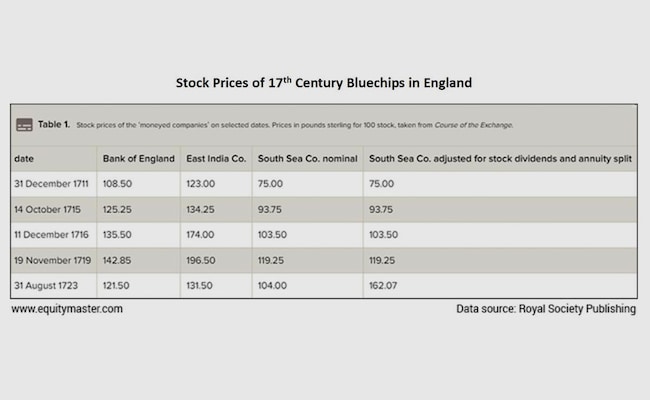
But the fact is that both the rise and the crash in the stock were temporary. Data suggests that had Newton avoided selling or buying the stock for few more years, he would have bagged a decent profit.
Stock Prices of 17th Century Bluechips in England
Now, why dwell on 300-year-old market crashes? Especially when we have sufficient cases of steep price corrections in stocks close at hand?
Well, Buffett's curiosity and Newton's folly is the repetitive nature of fear and greed cycles.
So, let's consider the recent market apathy towards Infosys.
Through 2022, most Indian tech companies began warning of slowing growth and loss of clients. But Infosys continued to impress analysts on earnings calls by talking up its revenue pipelines. To analysts' delight, the company kept raising its growth forecasts for the year.In January 2023, the company reported signing a US$ 3.3 bn contract value. So, it raised its full-year revenue growth guidance for the third time. Naturally, the stock price kept soaring in anticipation of lofty near-term earnings growth.When the company prepared to disclose its full-year results in April, market expectations were high. Unfortunately, the inevitable occurred.
Infosys failed to meet its own guidance, despite a reasonable earnings growth at 15.4% for the year. Analysts tracking quarterly numbers were disappointed. And the stock was taken to the cleaners.
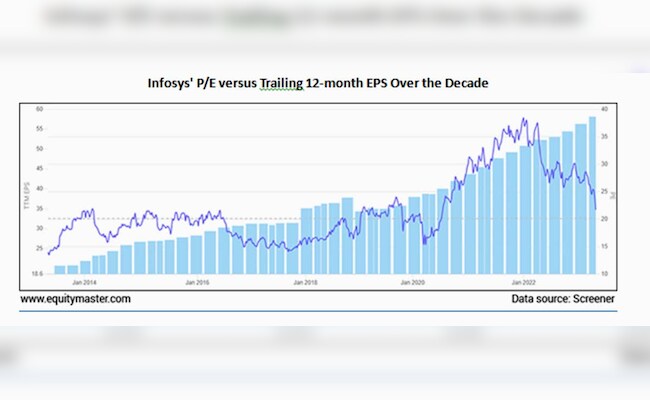
What the results did not say was that such earnings volatility has been a part of Infosys' track record for decades.
And the sharp correction in the PE multiples have been a great opportunity to accumulate the stock. But only if investors have a long-term perspective.
Infosys' P/E versus Trailing 12-month EPS Over the Decade
Similar is the case with HDFC Bank.
Lofty expectations about the merger with HDFC allowed the stock premium valuations for months. But a delay in the merger proceedings disappointed markets.
Moreover, stiff competition from fintech peers has also got markets nervous about HDFC Bank's future.
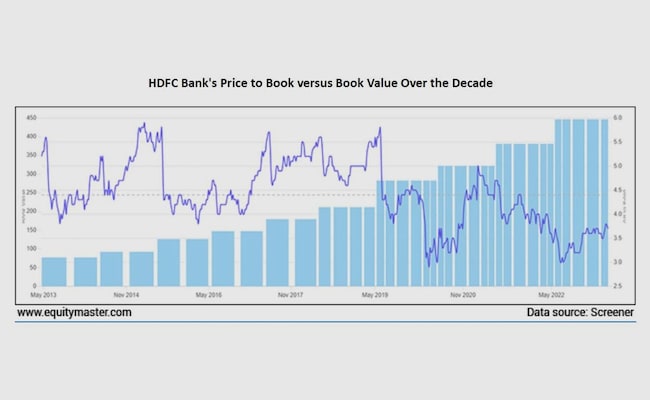
What the bank's results do not tell you is how its consistency in keeping NPAs in check works wonders for the stock.
HDFC Bank's Price to Book versus Book Value Over the Decade
Now, if I were to hazard a guess on what Newton would tell Buffett at the lunch table, it would be this...
It's not mathematical genius but disciplined buying and selling that works wonders.
Warm regards.
Disclaimer: This article is for information purposes only. It is not a stock recommendation and should not be treated as such.
This article is syndicated from Equitymaster.com
(Except for the headline, this story has not been edited by NDTV staff and is published from a syndicated feed.)

-
The Economic Imperative: Analysing The Material Driving Force Behind India-Canada Strategic Reset

This economic complementarity is further reinforced by deep institutional investment ties and talent mobility, which form the bedrock of the bilateral framework.
-
Medicine Pricing: Where Must Profit Stop?
India must confront excessive margins, hidden incentives and regulatory gaps that threaten the integrity of medicine.
-
Why Amazon And Flipkart Are Struggling To Beat Meesho In India's Smaller Cities
With 274 million users and lowest-cost logistics, Meesho is defending its value commerce crown against giants like Amazon and Flipkart.
-
High US Salaries, No Green Card Certainty: The Financial Calculation Facing Indian H-1B Families
The suspension of PERM processing at eight technology employers does not cancel existing H-1B visas. What it does is force a question many Indian families have been avoiding: is the US salary worth tying your career and family plans to one employer?
-
Swiggy vs Eternal: Food Delivery's Two Rivals Are No Longer In The Same Race
Eternal is building a private AI assistant, dark.ai. Swiggy is still working out how to make Instamart pay, with an operating loss of Rs 895 crore in the July-September quarter while Blinkit stayed profitable.
-
Where You Live Shapes How You Get To Work | The Reason Why
Two-wheelers are the most popular way to get to work in India, accounting for nearly 43% of workplace commutes.
-
Unhedged Position: Can India See An Indonesia-Style Time Correction?
The Nifty is trading below levels it first clocked in 2024. Is there, then, as I have suggested in the headline, potential that the current time correction drags on painfully for the next three-five, even ten years?
-
Navigating Friction And Energy Realities: An Analysis Of Marco Rubio's October Visit To India
Occurring at a critical juncture marked by stalled trade negotiations and escalating geopolitical pressures over global energy supplies, the visit offers a profound window into modern US-India relations.
-
India Exports Capital. Why Not Export Trusteeship?
The big question, then, is whether India can build an institution that global borrowers, investors, banks, and lawyers can trust, even without an Indian connection.
-
France's Economy & Politics Are In Crisis | The Reason Why
Let's look at how the French economy and politics evolved under Nicolas Sarkozy, Franois Hollande and Emmanuel Macron.










