The Global Wellness Industry Is Now Worth $6.3 Trillion

(Bloomberg) --The global wellness industry was worth $6.32 trillion in 2023, according to a new report from the Global Wellness Institute, a leading industry group. That's 25% larger than it was in 2019, making it bigger than the sports and pharmaceutical industries.
“Growth was even stronger than we predicted,” says Katherine Johnson, one of the authors of the Global Wellness Economy Monitor. She added that the wellness industry was boosted by the focus on health and well-being as a result of the pandemic. Research from the nonprofit argues that trends such as an aging population, chronic disease and an increased focus on mental health are helping drive growth.
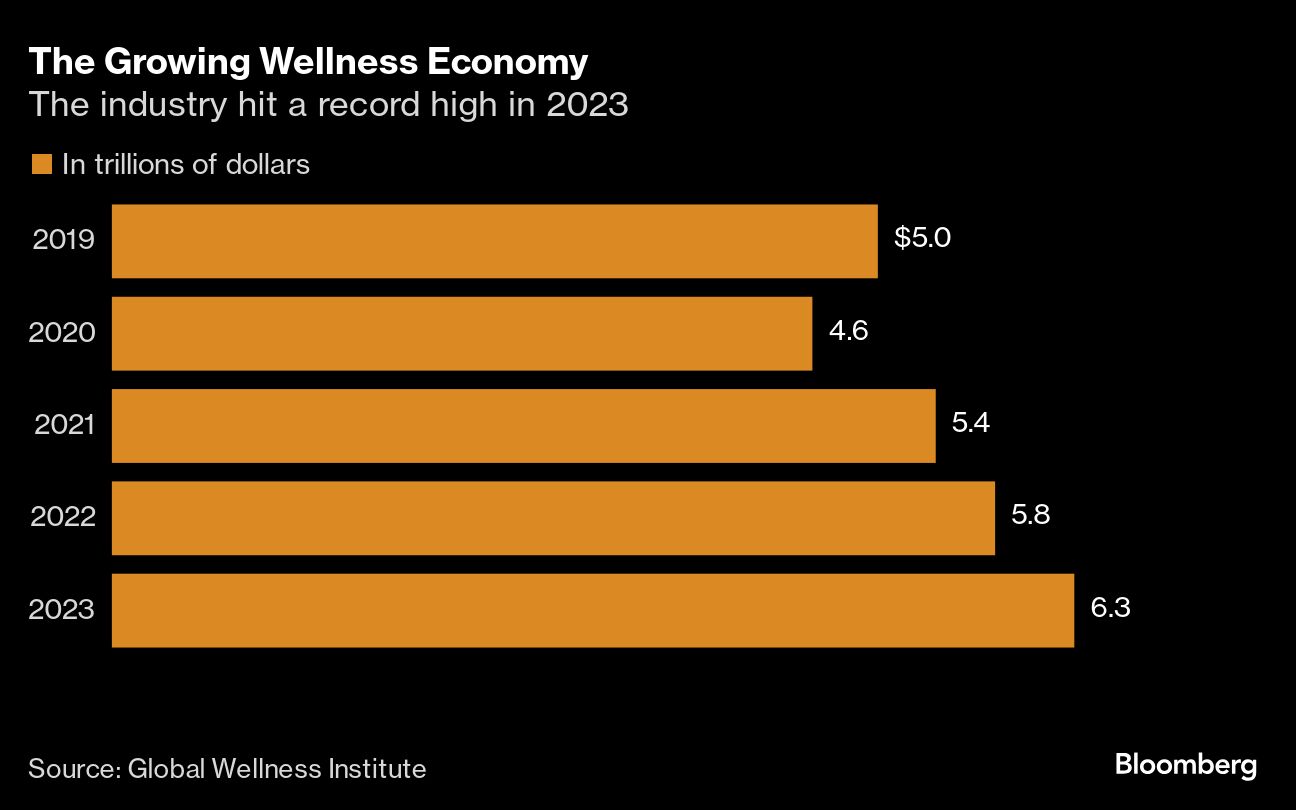
This staggering figure is partly due to the GWI's broad definition of wellness. For its purposes, wellness is “the active pursuit of activities, choices and lifestyles that lead to a state of holistic health.” The report tracks spending across 11 sectors, including tourism, real estate and public health endeavors.
By comparison, McKinsey & Co., which relies on consumer spending figures across six categories (better sleep and better nutrition, for example), estimated the size of the global wellness economy at a more modest $1.8 trillion in January 2024.
The largest of the 11 sectors is personal care and beauty, which the report values at $1.21 trillion alone. By the report's metrics, this category includes businesses such as hair and nail salons and consumer purchases of bath soaps.
The authors say that people may argue about whether those count as wellness but that the products in the personal care and beauty segment have been advertised as “self-care.”
“We're measuring dollars being spent on services and products,” says Ophelia Yeung, another one of the report's authors, speaking to Bloomberg ahead of the report's release. “Many people view those products that they use and those activities that they're doing as self-care as wellness. And increasingly, many companies are marketing those products as such.” She adds that the authors look at wellness strictly as an economic transaction in the research.
The next two largest categories are healthy eating, nutrition and weight loss, which totals $1.09 trillion, and physical activity, which is $1.06 trillion.
The report says the region with the biggest per capita spend was North America, at $5,768 spent per year, versus $1,794 in the second-biggest region, Europe.

Tourists bathe at the Blue Lagoon geothermal spa near Grindavik, Iceland. Wellness tourism and spas are two categories in the report. Photographer: John Moore/Getty Images
The fastest-growing category was wellness real estate—both residential and commercial buildings supporting the health of the people inside them— totaling $438.2 billion with an average growth rate of 18.1%. It can include anything from offices with smart air-filtration systems to extensive gyms with amenities such as saunas or smart temperature-control systems.
“Businesses and investors and consumers and people who build offices and across the board are starting to recognize that if we want to shape people's wellness, we have to shape the environments that they're in,” says Yeung. “There is very solid evidence that the physical environments and social environments that we live in are fundamental to our health.”
Companies like the Well are increasingly focusing on the wellness real estate market. The brand, which started off as a members club in New York City, is set to open its first residences in Miami next year, with home prices starting at $1.3 million. More residences in South Florida are being developed.
There are also new ventures such as the Estate, led by Sam Nazarian and Tony Robbins, which is planning 15 hotels and residences and 10 longevity centers by 2030; the first is set to open in Los Angeles next year. The company is capitalizing on the growing consumer desires for longevity and medical wellness.
“I think a lot of people are rolling their eyes at wellness at times,” Rebecca Parekh, chief executive officer and co-founder of the Well, told Bloomberg earlier this year. “But it's a very real need.”
Hospitality companies are getting increasingly competitive with offerings as the wellness tourism trend—valued at $830 billion according to the report— grows in popularity with consumers prove more willing to shell out for these experiences.
Siro, a new hotel brand owned by luxury company Kerzner, opened its first wellness-focused hotel in Dubai earlier this year. Everything from the workout equipment and snacks in the suites to the 1,000-square-foot fitness floor are dedicated to health and well-being. Another Siro is set to open in Montenegro next year.
When the Emory hotel opened in London earlier this year, it dedicated four floors and 21,500 square feet of space to the wellness club Surrenne, with membership at more than £10,000 ($13,000) a year.
Additional GWI categories in the report include public health, prevention and personalized medicine, a $781 billion category, along with traditional and complementary medicine, a $553 billion segment. There's also the $233 billion mental wellness market. The smallest categories are spas as $137 billion, thermal and mineral springs like Japan's onsens at $63 billion and workplace wellness (think programs aimed at boosting employees' health and well-being, such as fitness and educational classes) at $51.8 billion. The report notes that the figures don't total up as there is overlap between categories. but doesn't specify the exact difference.
“Once wellness starts to permeate your personal or consumer values, it starts shaping your purchasing decisions and just becomes a bigger and bigger share of your out-of-pocket spending,” says the GWI's Johnson. The report predicts that as the sectors continue to recover from the pandemic, the wellness economy could reach nearly $6.8 trillion by the end of 2024.

-
Gold Is Rs 22,000 Cheaper Than A Month Ago. Should You Buy Amid The Wedding Season?

Gold's potential slide to $3,500 could save around Rs 4,700 per 10 grams, but a soft inflation print could just as easily push prices back up. One way to split the risk is to buy in parts, some now and the rest after the Fed's Dec. 9 decision.
-
AI Agents Are Gaining Power. Who Governs Them?
Artificial intelligence agents promise to transform productivity by moving machines from assisting decisions to executing them. But as organisations delegate greater authority to these AI-agents, they must first establish who controls that authority and who remains accountable when things go wrong.
-
Why Swapping Your Old Gold Can Trigger A Rs 5 Lakh Tax Bill, And How You Can Avoid It Legally
Swapping old gold for new is taxed as a sale and a fresh purchase. Getting your own gold remade can cut most of that bill, though it has its own costs.
-
The AI Trade is Done. The Real Opportunity for Investors Starts in 2027 | Unhedged Position
As pureplay AI stocks plunge and circular, capex-led financing unwinds, 2027 is set to be a year of reckoning for AI companies. Yet the bust clears the way for a better opportunity for investors in 2027 -- shifting the spotlight from AI builders to the companies using AI.
-
Leadership As Mission: Why The Age Of AI Demands More Human Leadership
Debjani Ghosh examines how AI is changing leadership, arguing that its success must be measured by its impact on people and the accountability of those guiding its use.
-
We May Need Another Tukaram Mundhe To Fight Air Pollution | The Reason Why
Developers may install basic measures such as sprinklers and green nets, resume work, and continue violating rules when this equipment stops working.
-
Extracting Value From Battery Scrap Could Be Challenging For India | The Reason Why
A discarded lithium-ion battery still contains valuable materials such as lithium, nickel and cobalt. These can be recovered and reused. When such batteries are crushed and shredded, they produce a dark powder called black mass.
-
One El Nino, India Can Handle. Two Could Break The Granary
India's grain stocks can absorb one bad year, but a second El Nino could drain the buffer in two to three years, economists say.
-
India's Troika Of Good Luck | Joining The Dots
As Jensen Huang's exit drags Nvidia down, a cooling AI trade and resilient earnings have revived investor interest in India. A likely RBI rate hike looms.
-
Talking Points This Week: Leadership Shock At Nvidia, Earnings Strength, And The Fog Over Hormuz
The Anthropic IPO pricing and first trading day, Nvidia's upcoming earnings, and any fresh signals from Iran will set the tone for the following week.









