

The Foundery: What Founders Should Know Before Applying To Kamath And Biyani's Venture
For applicants, participation involves weighing the programme’s stated benefits against the contractual terms governing selection, equity, control and rights.



When The Foundery — a co-founder identification and immersion programme by Nikhil Kamath and Kishore Biyani — opened applications, it positioned itself as a rare opportunity. It gave a funding-hungry startup country structured access to capital, mentorship, and the chance to become a co-founder in companies promoted by the programme’s affiliates.
The promise, as outlined in the programme documents, is significant. 30 participants are selected to become co-founders in affiliate-promoted ventures, with investment 'upto Rs 4 crore' and 'entitlement for up to 25% equity'.
But a close reading of The Foundery’s long-winding 10,000-words worth of Terms and Conditions shows that the structure outline gives the organisers wide discretion while limiting their liability. While none of the clauses are unlawful, these are points applicants should understand before paying the application fee or submitting an idea.
Application Fee And Selection Process
The Foundery requires applicants to pay a 'non-refundable registration fee of Rs 5,000/- plus applicable GST' at the application stage. Applicants submitting multiple ideas must use different mobile numbers and pay the fee for each submission.
Across multiple clauses, the programme reserves absolute authority over selection and elimination. Selection, at any stage, does not create enforceable expectations.
The terms state that, "The decision of the relevant Participating Affiliate in respect of any Applicant, Selectee or Cohort shall be final and binding and non-appealable."
Applicants also explicitly waive the right to question outcomes. Even successful applicants are not insulated from removal.
Hardeep Sachdeva, Senior Partner at AZB & Partners, said discretion itself is not uncommon, but the extent matters. "Early stage founder programmes often reserve broad discretion for the organisers, but the degree of control matters," he says, "Terms that skew heavily toward unilateral rights, without balancing founder protections, can appear unusually one sided."
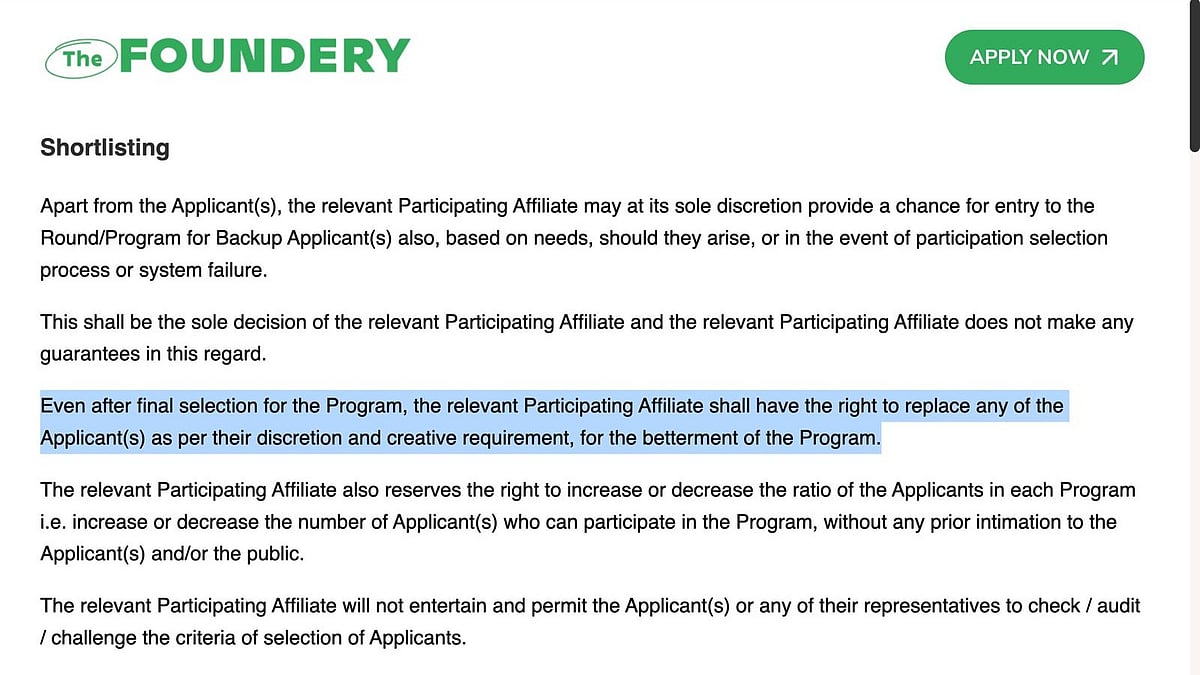
As highlighted in the image, the document adds that even after being selected, the affiliate can replace any applicant at its discretion for creative reasons or to improve the program.
Ashima Obhan, Senior Partner at Obhan & Associates, said such clauses are usually framed as risk-management tools, and "when discretion extends into sweeping control over participation or unilateral termination rights, it can raise questions around governance balance."
(Image: The Foundery)
The Equity Promise, Not Guaranteed
One of The Foundery’s most eye-catching claims is the potential equity remaining with you. The terms state that successful selectees may be invited to become co-founders, subject to definitive agreements, which will stipulate two things —
“(i) the exact amount of Investment (upto INR equivalent of $500,000)…
(ii) entitlement for up to 25% equity in such company (subject to appropriate and customary lock-ins and reverse vesting).”
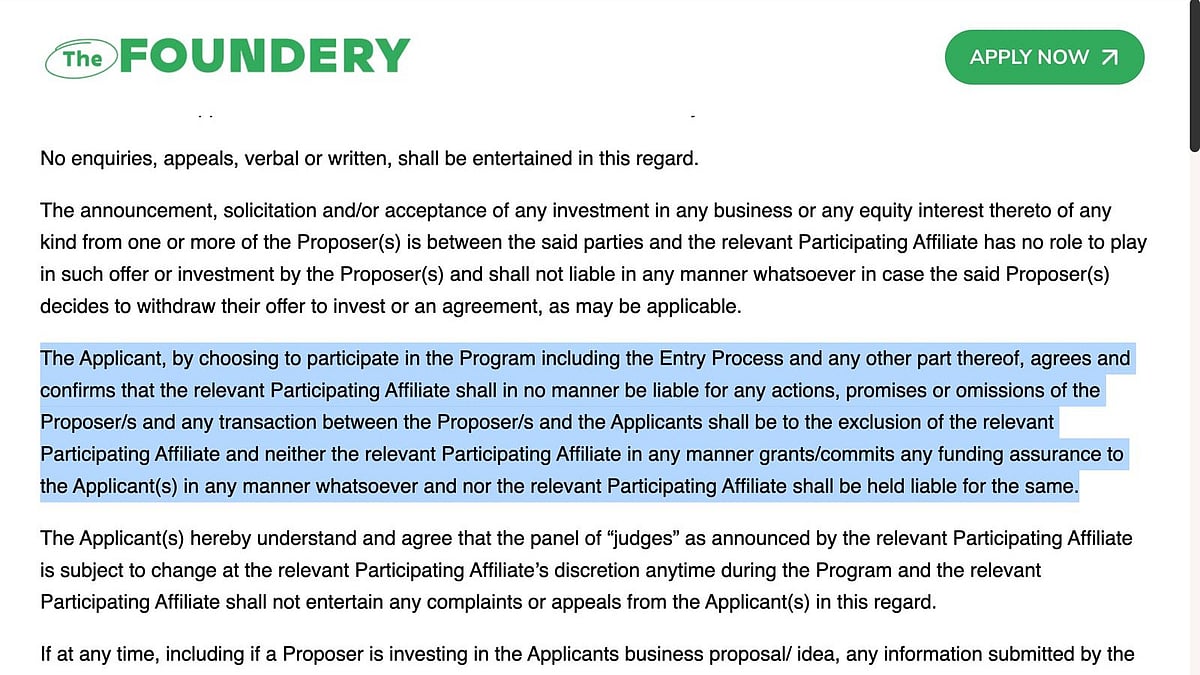
However, the document also limits what this means in practice, as highlighted in the image. This means the affiliate (the company or entity involved) is not promising or guaranteeing any financial support or funding to the applicant(s).
On the commercial implications of this structure, Ankita Singh, Founder of Saarvank Associates, says, "A cap table where the operating founder holds a minority stake, such as 25%, at the pre-seed stage can be challenging for future fundraising. Series A or B investors generally prefer founders to hold a significant controlling stake to ensure long-term motivation."
Further, the document adds that "The relevant Participating Affiliate shall not be liable in any manner whatsoever in case the said Proposer(s) decides to withdraw their offer to invest." This means if the proposer (the person who initially offered to invest) changes their mind and backs out, the affiliate cannot be held responsible or blamed for that decision.
(Image: The Foundery)
Let's Talk About IPs
The Foundery distinguishes between ownership of ideas and rights over their expression — but the practical implications are substantial.
Applicants are informed that public disclosure "may adversely affect their interests in the business… including… the protection of the business idea through the acquisition of Intellectual Property Rights." This is a disclosure on The Foundery's end that if applicants reveal details about their business idea publicly during the program, it could harm their business interests, and might make it harder to protect their idea legally.
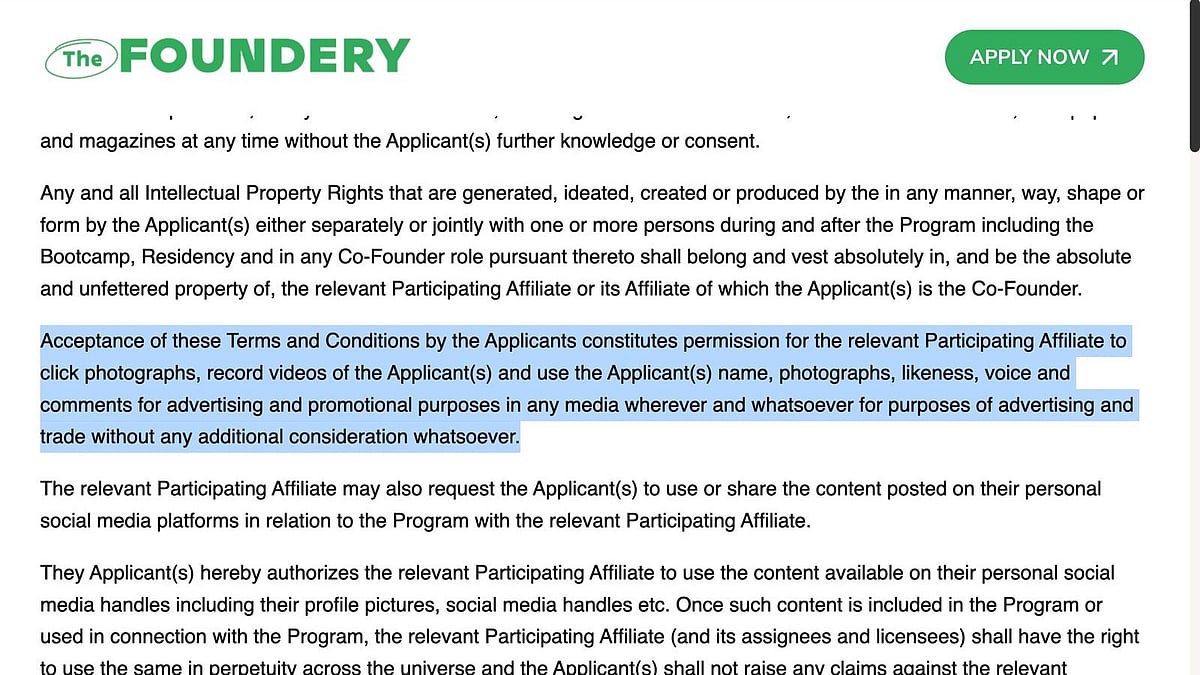
The programme also claims perpetual rights over recordings and materials, stating "Any photographs, videos, voice notes… shall on submission / creation become the property of the relevant Participating Affiliate… in perpetuity… across the universe."
On this structure, Rahul Hingmire, Managing Partner at Vis Legis Law Practice, says that if a platform owns your presentations and demo content, "it controls how your story is presented to customers and investors." Singh, meanwhile, noted that while separation between ideas and media rights exists in some programmes, scope matters.
Obhan added that such clauses can also affect future positioning, "Waiving rights indefinitely can create reputational and strategic risks if a founder’s likeness or association is later used in contexts that conflict with future ventures or investor expectations."
Applicants further have to agree that, "All the Intellectual Property Rights of the Applicant(s)… including but not limited to the copyright, rights of publicity, moral rights… shall stand waived."
This essentially means that the applicant(s) are waiving all their legal rights related to intellectual property for the work or content they have created or submitted. These rights include copyright (ownership of the creative work), rights of publicity (control over the use of their name, image, or likeness), and moral rights (such as the right to be credited or to object to changes in the work).
(Image: The Foundery)
Gag Clauses And Media Restrictions
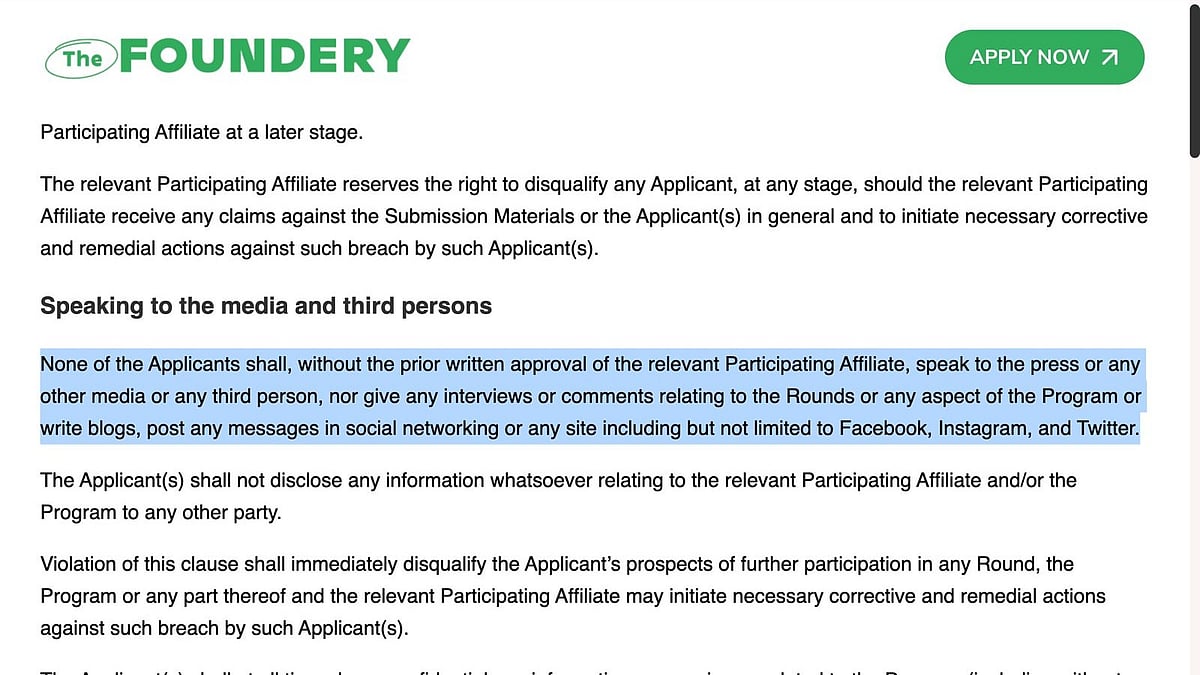
Participants are barred from publicly discussing the programme without approval, with this clause: "None of the Applicants shall, without the prior written approval… speak to the press or any other media… or write blogs, post any messages in social networking sites."
They also prohibit criticism or parody, and violations can lead to disqualification and legal action, effectively limiting participants’ ability to publicly describe their experience.
Now, Obhan noted that said confidentiality and non-disparagement clauses are standard, but outright prohibitions are less typical. Hingmire, however, pointed that requiring approval for public communication would affect how founders engage with investors, talent and the broader ecosystem.
(Image: The Foundery)
What Founders Should Weigh Before Applying
Lawyers interviewed said founders should review clauses relating to discretion, equity, relocation, intellectual property and communication before applying.
As Singh also noted, “The impact of these clauses may not be immediate, but they can compound over time, particularly as a founder’s profile or business grows."
For applicants, participation involves weighing the programme’s stated benefits against the contractual terms governing selection, equity, control and rights.